Saskatchewan is Canada’s most misunderstood province — a jurisdiction where the word “flat” is used dismissively by those who have never stood on the endless Prairie horizon at sunset and felt the particular sensation of space and sky that no other landscape on Earth produces, where the Big Sky country light (painters have been coming to the Qu’Appelle Valley and the coulees since the 19th century for a quality of light that the Impressionists would have recognized) is the province’s most undervalued natural gift, and where the Prince Albert National Park wilderness, the Cypress Hills Interprovincial Park’s forest island in the Prairie, and the Athabasca Sand Dunes (the northernmost active sand dunes in North America, reachable only by floatplane) deliver wilderness experiences of genuine rarity. The province’s two anchor cities — Saskatoon on the South Saskatchewan River and Regina on Wascana Lake — are Prairie capitals of unexpected sophistication, where the arts scene, food culture, and community organizations exceed what visitors from the larger provinces tend to expect.
Saskatoon: The River City
Saskatoon (roughly 316,000), Saskatchewan‘s largest city, is built on seven bridges across the South Saskatchewan River — a Prairie city of unusual physical beauty, where the Meewasin Valley trail system along both banks of the river, the Broadway Bridge’s Art Deco architecture, and the Waskesiu Drive’s riverside parks form an urban outdoor recreation landscape that belies the city’s plains setting. The Broadway Avenue commercial strip (Saskatoon’s best-loved neighbourhood strip, independent restaurants and cafés on the hill above the river), the Farmers’ Market at River Landing (Saturday morning, the city’s community gathering point), and the Remai Modern art gallery (the boldest new museum on the Prairies since the Canadian Museum for Human Rights) define a city that operates with a creative ambition rare for its size. The Berry Barn (a working berry farm turned into Saskatoon’s favourite weekend excursion) and Wanuskewin Heritage Park (an Indigenous archaeological site of national importance) round out the visitor picture.
Saskatoon Must-Experiences
- Wanuskewin Heritage Park: The Northern Plains Indigenous cultural landscape 5km north of the city; tipi camps, buffalo jumps, and interpretive trails through the coulees above the South Saskatchewan River; a UNESCO World Heritage nomination site of deep archaeological importance, with a final dossier due to Parks Canada in 2026
- Remai Modern: The 2017 art gallery on the river bank; the collection’s emphasis on Picasso ceramics (the most comprehensive collection of Picasso’s ceramics in any public gallery) and contemporary Saskatchewan art is extraordinary for a Prairie city
- Meewasin Valley Trail: 80km of trail along both banks of the South Saskatchewan River through the city and into the natural valley; the backbone of Saskatoon’s outdoor recreation network
- Broadway Avenue: Saskatoon’s best-loved neighbourhood commercial strip; the independent restaurants, the Alhambra Indian Restaurant (a Saskatoon institution), the Broadway Theatre, and the Saturday Farmers’ Market at River Landing

Regina: The Capital City
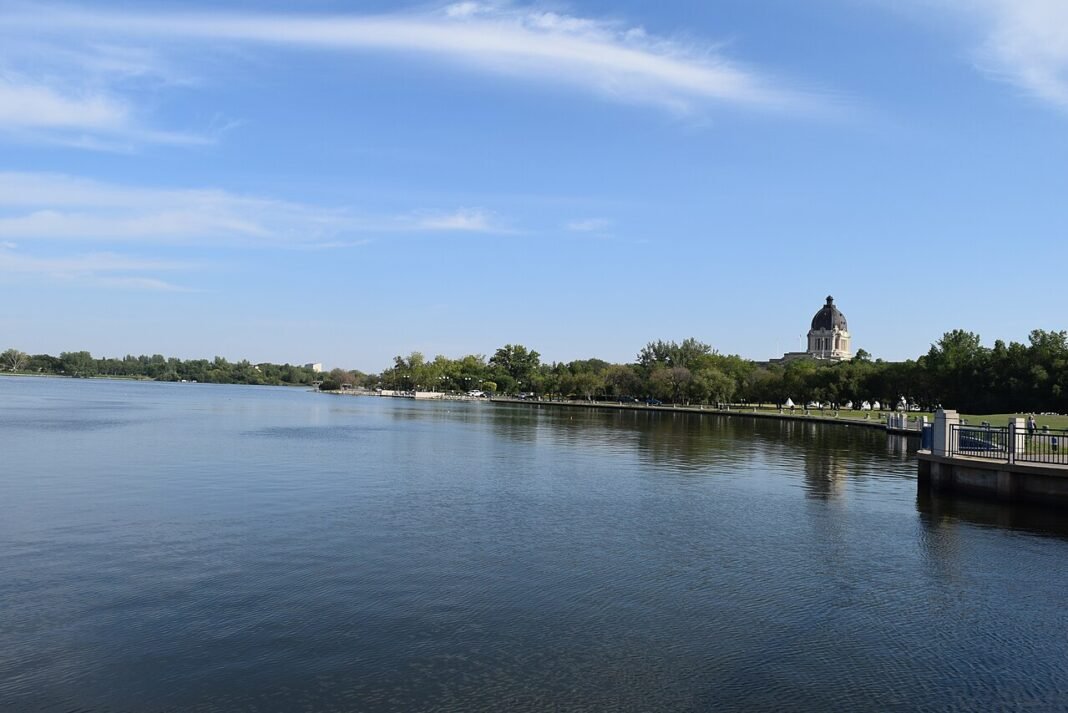
Regina (roughly 265,000), Saskatchewan’s provincial capital, is built around Wascana Lake — an artificial lake created from Wascana Creek in the 1880s that has grown into one of Canada’s finest urban park systems (Wascana Centre, 930 hectares of park, lake, and cultural institutions around the legislature). The Saskatchewan Legislative Building (a Beaux-Arts landmark of extraordinary ornamental detail, opened 1912), the Royal Saskatchewan Museum (the province’s natural history and First Nations museum), the MacKenzie Art Gallery, and the University of Regina campus all front on Wascana Lake in an institutional grouping that lends Regina a civic gravitas few visitors anticipate of an administrative service city. The Cathedral Village neighbourhood’s Albert Street restaurant and arts strip and the Warehouse District’s craft brewery scene round out the contemporary Regina picture.
Prince Albert National Park and the Northern Shield
Prince Albert National Park, 3,874 square kilometres of boreal forest wilderness north of Prince Albert city, is Saskatchewan’s most rounded outdoor destination — a transition zone between the Prairie and the Shield where the forest lakes, rivers, and wetlands support moose, black bear, woodland caribou, and the province’s only protected free-roaming plains bison herd (on the park’s grassland margin). The Grey Owl heritage (Archie Belaney’s cabin on Ajawaan Lake, accessible by a 20km canoe route from Kingsmere Lake) and the Waskesiu townsite’s 1930s resort architecture anchor the visitor experience. The canoe route network (500+ km of connected lakes and portages) and the Amisquibi backcountry circuit provide the wilderness depth.
Grasslands National Park: Prairie Wilderness
Grasslands National Park in the southwest corner of Saskatchewan, 240km from Regina, protects the largest remaining block of unbroken mixed-grass prairie in Canada — a landscape of eroded valley coulees, prairie dog towns, pronghorn antelope, and the reintroduced plains bison herd that adds up to the truest Great Plains wildlife experience in Canada. The Frenchman River Valley’s badland formations, the T.rex Discovery Centre in Eastend (the town that produced the most complete T. rex skeleton found in Canada, “Scotty”), and the Two Trees area’s genuinely dark night skies shape the park’s distinct visitor experiences. Grasslands is the quietest of Canada’s prairie national parks — which means visitors encounter a wilderness solitude that the busier northern parks cannot match.
Planning Your Saskatchewan Visit
Saskatchewan’s travel geography divides between the southern plains and cities (Saskatoon, Regina, the Qu’Appelle Valley, the Cypress Hills, and the Grasslands) and the northern Shield lakes and boreal forest (Prince Albert National Park and the Churchill River canoe system). A comprehensive Saskatchewan itinerary requires at least 7–10 days: 2 days in Saskatoon, 2 days in Regina and the Wascana Centre, 1 day in the Qu’Appelle Valley, and separate trips north to Prince Albert or west to the Cypress Hills. Summer opens up the fullest access; winter belongs to Waskesiu and the northern skiing. The Trans-Canada Highway’s Moose Jaw to Regina stretch rewards patience with the scale and sky of a prairie horizon that no photograph fully captures.
Getting the Most Out of Your Visit
A few practical points that will improve any trip to Saskatchewan. Book accommodation and major attractions — particularly national parks, popular hiking trails, and well-known restaurants — as far in advance as possible; the best options can fill weeks or months ahead, especially in peak season. A car gives you the most flexibility for exploring beyond the main centres, and many of Saskatchewan’s richest experiences sit in places that public transport does not reach easily. The sharpest local knowledge tends to surface in regional visitor centres, independent bookshops, and conversations with residents — the discoveries that stay with you are rarely the ones printed in the guidebooks. Allocate more time than you think you need: Saskatchewan consistently rewards travellers who slow down and explore in depth rather than trying to cover maximum ground in minimum time.
Frequently Asked Questions
What defines Saskatoon as a Prairie city worth understanding?
Saskatoon — Saskatchewan’s largest city (about 316,000 in the city, roughly 352,000 across the metropolitan area as of 2025), on the South Saskatchewan River in the central prairies — has emerged as one of Canada’s most dynamic mid-sized cities, driven by the potash mining industry (Saskatchewan holds about 40% of the world’s known potash reserves, essential for global food production), agricultural technology, and a university research cluster that has grown beyond its size. The South Saskatchewan River (bisecting the city, spanned by seven bridges) defines Saskatoon’s character: the Meewasin Valley Authority trail system (80km of paved and natural surface trail along both riverbanks) is the city’s signature feature, a continuous greenway that sets Saskatoon’s urban experience apart from comparable Prairie cities. Broadway Avenue (the commercial and cultural heart of Saskatoon’s Nutana neighbourhood, immediately south of the Broadway Bridge) holds the city’s densest walkable retail and restaurant corridor — independent shops, the Broadway Theatre, and the farmers’ market. The University of Saskatchewan’s main campus (designed by the Beaux-Arts campus plan of 1909, with a sequence of limestone collegiate buildings along the river) ranks among the most coherent historic university campuses on the Prairies.
What does Regina offer as Saskatchewan’s capital city?
Regina — Saskatchewan’s provincial capital (about 265,000 in the city, roughly 282,000 across the metropolitan area as of 2025), 250km south of Saskatoon on the flat plains adjacent to Wascana Lake — is one of the few planned provincial capitals in Canada, laid out on the treeless plains in a grid around Wascana Centre (a 930-hectare urban park surrounding Wascana Lake, the largest urban park on the Prairies and one of the most complete multi-institutional cultural and educational precincts in any Canadian city). The Saskatchewan Legislative Building (1912, Beaux-Arts, on the north shore of Wascana Lake) and the Royal Saskatchewan Museum (natural history and Indigenous peoples galleries) anchor the Wascana Centre precinct. Regina’s RCMP Heritage Centre (at the RCMP Depot, the training academy for Canada’s federal police force and still an active facility) is the country’s foremost RCMP historical site, with federal funding committed toward national museum status; visitors can watch the Sergeant Major’s Parade, the daily ceremonial training parade at the Depot. The city’s harder edges — the legacy of resource-economy cycles, a sizeable Indigenous urban population, and the North Central neighbourhood’s persistent challenges — coexist with cultural institutions of national standing.
What makes Saskatchewan’s landscape significant for visitors?
Saskatchewan’s landscape — 651,000 square kilometres of prairie, parkland, and boreal forest, flat enough in the southern third that the curvature of the Earth is reportedly visible on clear days — turns on the relationship between the immense horizontal sky and the minimal land, producing a light quality and spatial experience unlike any other landscape in the world. The Cypress Hills Interprovincial Park (shared with Alberta, the highest point of land in Canada between the Rocky Mountains and Labrador at 1,466m, an isolated highland of lodgepole pine rising from the surrounding plains) is the single most striking landscape in Saskatchewan and the site of the 1873 Cypress Hills Massacre, an event that led directly to the formation of the North West Mounted Police (predecessor to the RCMP). The Qu’Appelle Valley (the glacially carved valley running east-west through southern Saskatchewan, with a chain of lakes that anchor summer cottage culture for Regina residents) is the defining landscape feature of the southern prairies. Grasslands National Park (in the extreme south, on the Montana border) preserves the last mixed-grass prairie ecosystem in Canada, with black-tailed prairie dog colonies (the only such colonies in the country), pronghorn antelope (the fastest land animal in North America), and some of the richest short-grass prairie birdlife on the continent.
What is Saskatchewan’s economic character and what drives its cycles?
Saskatchewan’s economy is the most agricultural of any Canadian province, with the prairie agricultural sector (wheat, canola, lentils, and pulses — Saskatchewan is the largest lentil producer in the world) providing the foundation on which the province’s prosperity rests, amplified by the potash industry (Nutrien, headquartered in Saskatoon, is the world’s largest producer of potash, used globally as crop fertilizer) and uranium mining (the Athabasca Basin in northern Saskatchewan contains the world’s highest-grade uranium deposits; Cameco is the world’s largest publicly traded uranium company, headquartered in Saskatoon). The province’s population has grown from 1.0 million in 2000 to approximately 1.2 million in 2026, driven by immigration (principally from the Philippines, India, and Ukraine) and the economic conditions created by the commodity boom. Saskatchewan’s NDP-Cooperative Commonwealth Federation heritage (the CCF government of Tommy Douglas introduced universal Medicare in 1962, the first such program in any Canadian province and the model later adopted nationwide) gives the province a social democratic tradition that coexists with the conservative sentiment of its rural communities.
What are housing costs like in Saskatchewan compared to other provinces?
Saskatchewan consistently offers the most affordable housing of any Canadian province with a provincial capital and a major university city, making Saskatoon and Regina two of the most underrated large cities in Canada. Saskatoon’s median detached house price in 2026 is approximately CAD $380,000–$460,000, with sought-after inner-city neighbourhoods (Nutana, Varsity View adjacent to the University of Saskatchewan, and Caswell Hill) at CAD $400,000–$600,000. Regina’s median detached price runs slightly lower at CAD $330,000–$420,000, reflecting the capital’s slower growth relative to Saskatoon’s resource-driven economy. The combination of affordable housing, no provincial health premiums, and below-national-average income tax rates (though not as low as Alberta) makes Saskatchewan competitive for households seeking Prairie affordability with better public services than Alberta’s boom-and-bust cycle provides. The province’s immigration programs (the Saskatchewan Immigrant Nominee Program) have actively attracted skilled workers and entrepreneurs, contributing to population growth and a more diverse urban culture than the province’s demographics would have predicted 20 years earlier.