Newfoundland and Labrador Travel Guide 2026: St. John’s, Gros Morne, and the Edge of the World
Newfoundland and Labrador — “The Rock” and its vast mainland territory — is Canada’s most dramatically positioned province: the island of Newfoundland jutting into the North Atlantic at the point where the Labrador Current meets the Gulf Stream, where icebergs drift past fishing villages that have been continuously inhabited since the 1500s, where humpback whales breach within sight of St. John’s harbour, and where Gros Morne National Park’s exposed mantle rock makes the geological processes that formed the earth’s continents legible to anyone willing to walk the Tablelands trail. The province is the youngest in Confederation (joined in 1949, having previously been a self-governing dominion under British sovereignty), which gives Newfoundlanders a distinctive relationship to Canada — proudly separate in culture, accent, and outlook in ways that the province’s geographic isolation from the mainland has preserved and amplified. The result is one of the most authentically distinct regional cultures in North America: the Newfoundland English dialect, the traditional music culture of the George Street pub scene in St. John’s, the outport communities connected by ferry to the mainland, and the cuisine of salt cod and toutons (fried bread dough) and bakeapples (cloudberries) that defines a provincial food identity with roots in the 16th-century Basque and Portuguese fishing traditions.
St. John’s: North America’s Oldest City
St. John’s — one of the oldest European-founded cities in North America, established as a fishing station in the early 1500s — is Newfoundland’s capital (220,000 metropolitan) and the easternmost city in North America. The city’s geography is defined by Signal Hill (the site of Marconi’s first transatlantic wireless signal, 1901), the Narrows (the harbour entrance defended by Fort Amherst’s cannon), and the colourful row houses of the downtown (the “Jellybean Row” terraces photographed on every Newfoundland tourism campaign). George Street — the highest density of bars per square block in North America — is the centre of St. John’s traditional music scene; the Ship Inn, the Martini Bar, and the historic Trapper John’s preserve a pub culture where traditional Newfoundland music (accordion, fiddle, and the bodhran) is played nightly by musicians who learned from the generation before them. The Johnson Geo Centre (geological sciences museum built into Signal Hill), the The Rooms (Newfoundland’s provincial museum, art gallery, and archives combined in a dramatic clifftop building), and the Cape St. Mary’s Ecological Reserve (the most accessible northern gannet colony in North America, 90 minutes from St. John’s) anchor the city’s visitor experience.
Gros Morne National Park
Gros Morne National Park (1,805km² on Newfoundland’s western coast) is Canada’s most geologically significant national park — a UNESCO World Heritage Site where the exposed mantle rock of the Tablelands, the fjord-carved Western Brook Pond, and the Long Range Mountains’ glacier-carved plateau provide a landscape of extraordinary scientific and aesthetic significance:
- The Tablelands: The park’s most distinctive feature — a vast, rust-coloured peridotite plateau that was once the earth’s mantle, thrust to the surface by tectonic collision 480 million years ago; the toxic chemistry of the ultrabasic rock creates a near-barren landscape surrounded by boreal forest; the 4km Tablelands Trail provides the most visually dramatic and scientifically significant hiking in Atlantic Canada
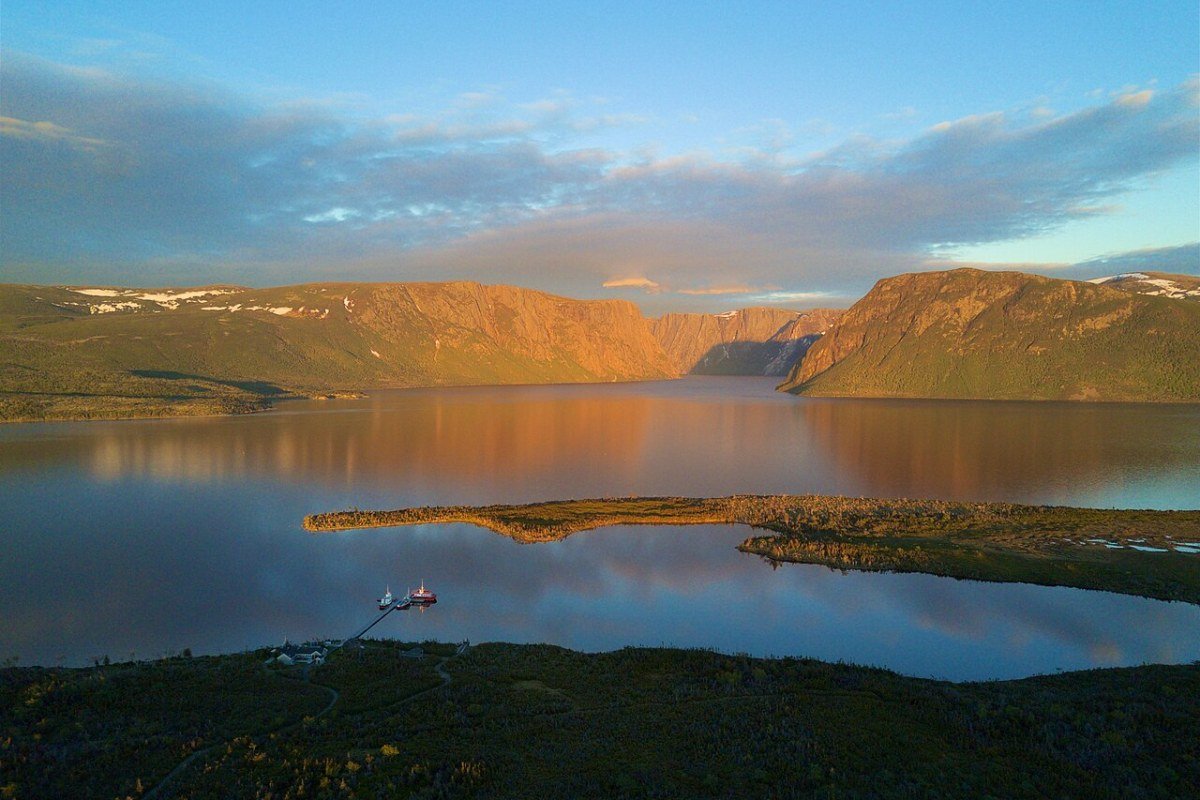
- Western Brook Pond: The landlocked fjord (technically a freshwater lake carved by glaciers in the Long Range Mountains) provides Gros Morne’s most iconic experience — a 3km walk across coastal bog to the boat dock, then a 2-hour boat tour on the 165-metre-deep gorge with 600-metre vertical cliffs; the combination of boat tour and surrounding hiking trails makes this Newfoundland’s most complete single day activity
- Gros Morne Mountain: The park’s highest peak (806m); the summit trail via Ferry Gulch (16km return, strenuous) provides panoramic views of the Gulf of St. Lawrence, the Long Range plateau, and the coastal communities of Bonne Bay; the most demanding and rewarding day hike in the Maritime provinces
- Norris Point and Woody Point: The communities on the shores of Bonne Bay (the fjord that divides the park) provide accommodation, dining, and sea kayaking on the sheltered tidal inlet; the Gros Morne Theatre Festival (July–August) in Norris Point’s corner brook community adds performing arts to the park experience

The Avalon Peninsula and Cape St. Mary’s
The Avalon Peninsula surrounding St. John’s provides Newfoundland’s most concentrated visitor experience outside of Gros Morne — a landscape of barrens, sea stacks, puffin colonies, and the ghost towns of the outport tradition within 2 hours of the provincial capital:
- Cape St. Mary’s Ecological Reserve: The most accessible seabird nesting colony in North America — a 1km walk from the interpretive centre leads to Bird Rock, where 60,000 northern gannets nest on a sea stack separated from the mainland by a 5-metre channel; the gannets’ plunge-diving and the constant noise, smell, and visual drama of the colony create one of the most visceral wildlife encounters on the continent; minke whales and humpbacks are routinely visible from the cape
- Witless Bay Ecological Reserve: The puffin colonies on the islands of the Witless Bay Reserve (35 minutes south of St. John’s) support the largest Atlantic puffin nesting colony in North America; boat tours from Bay Bulls navigate between the islands at the height of the June–July nesting season; humpback whales are a near-guaranteed sighting in June and July
- Signal Hill National Historic Site: The hill above St. John’s Narrows where Guglielmo Marconi received the first transatlantic wireless signal (letter “S” in Morse code, 1901); the Cabot Tower at the summit provides panoramic views of the North Atlantic, St. John’s harbour, and the Avalon Peninsula; the daily tattoo ceremony (July–August) recreates the 19th-century British garrison life
- Iceberg Alley: The spring (May–June) drift of icebergs calved from Greenland’s glaciers past the Newfoundland coast creates one of the world’s most unusual seasonal tourism phenomena; icebergs visible from shore in Twillingate, Bonavista, and the St. John’s harbour approaches; boat tours provide close-range access to 10,000-year-old ice
The Viking Trail and Labrador
Beyond Gros Morne, the Northern Peninsula and Labrador provide Newfoundland’s most remote and historically significant experiences:
- L’Anse aux Meadows National Historic Site: The only confirmed Norse settlement in North America (c. 1000 CE, predating Columbus by 500 years) at the tip of the Northern Peninsula; the reconstructed turf buildings, the Norseman interpretive centre, and the annual Viking Festival (July) provide the most significant pre-Columbian European contact site in the Western Hemisphere; the remote location at the land’s end adds to the experience’s psychological weight
- Red Bay National Historic Site (Labrador): The 16th-century Basque whaling station on the Labrador coast — the largest whaling operation in the world during the 1570s–1580s; the underwater archaeological remains of the San Juan (a Basque galleon sunk in 1565) and the interpretive centre’s artefacts provide the most complete picture of early trans-Atlantic commercial enterprise in North America
- Torngat Mountains National Park: The most remote national park in eastern Canada — the Inuit homeland at the northern tip of Labrador, accessible only by charter floatplane or boat; polar bears, caribou, and the most dramatic fjord landscape in eastern North America; the base camp at Saglek Fjord provides guided wilderness experiences in a truly frontier setting