Newfoundland and Labrador holds a cost-of-living profile unlike anywhere else in Canada — St. John’s housing sits among the cheapest of any provincial capital (average house prices CAD $310,000–$430,000), yet the remote outport communities and Labrador mining camps carry some of the highest grocery and consumer-goods prices in the country, the unavoidable cost of moving freight to an island. A family settled in St. John’s or along the Avalon Peninsula runs a household budget that is far easier to manage than equivalent urban life in Ontario or British Columbia. The province’s resource sector — offshore oil (Hibernia, Hebron, Terra Nova, White Rose), the Voisey’s Bay nickel mine in Labrador, the iron-ore operations around Labrador City, and the Churchill Falls hydroelectric complex — supplies high-wage technical employment and produces a sharply split income picture: resource crews earning well above the national average alongside a service sector paid at Atlantic Canadian rates. With roughly 548,000 residents and an island geography, the cost structures here reflect both the efficiency of a compact urban labour market (the St. John’s metropolitan area, about 240,000 people) and the logistics of supplying isolated communities.
Newfoundland Cost at a Glance 2026
- St. John’s average house price: CAD $310,000–$430,000 (metropolitan area)
- Mount Pearl and CBS (metro west): CAD $280,000–$390,000
- Corner Brook (western NL): CAD $200,000–$310,000
- Gander and Grand Falls-Windsor: CAD $170,000–$270,000
- Smaller outport communities: CAD $80,000–$200,000 (variable based on remoteness)
- Labrador City/Wabush (iron-ore mining towns): CAD $200,000–$320,000, with a resource-economy wage premium
- Newfoundland Power electricity: Average residential CAD $1,400–$2,100/year; rates run higher than New Brunswick because of island grid costs
- HST: 15% (5% federal GST + 10% provincial component)
St. John’s: The Capital’s Housing Market
The St. John’s housing market reflects a stable resource-economy employment base and a compact urban footprint:
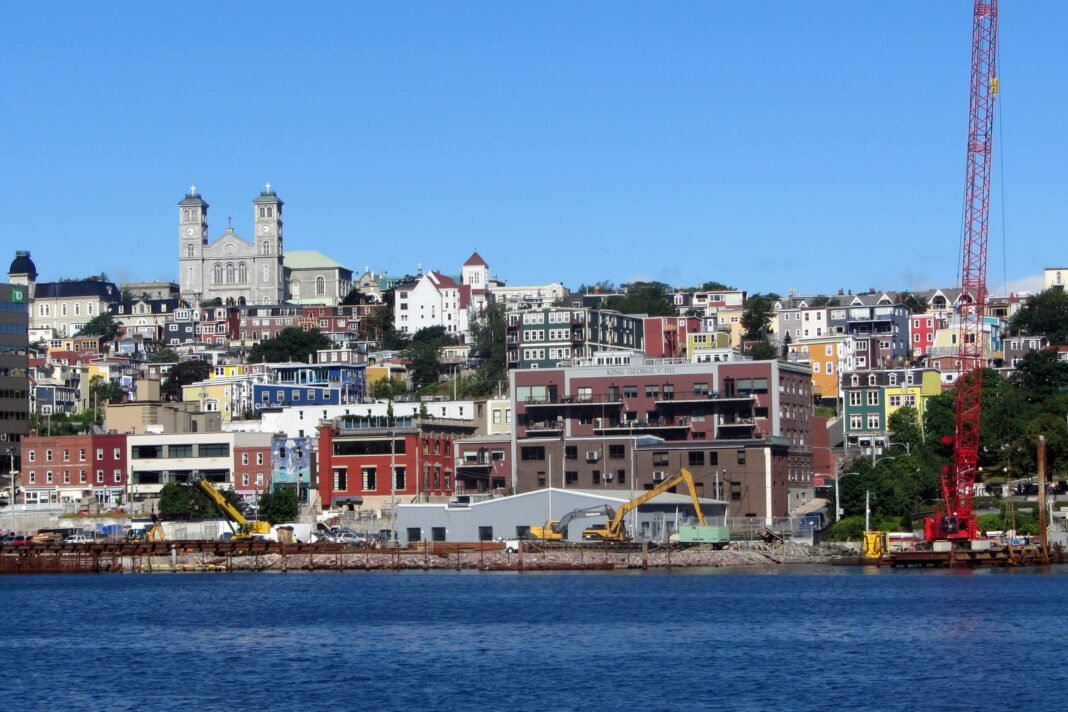
- Downtown and Georgestown (heritage core): The colourful row houses of the Jellybean Row terraces and the Victorian heritage homes of Georgestown; renovated character housing at CAD $380,000–$550,000; the most photographed residential architecture in Atlantic Canada, within walking distance of George Street, Duckworth Street’s restaurants, and the harbour
- Battery (historic fishing village within the city): The dramatic cliff-face community below Signal Hill; heritage properties in a genuinely historic setting from CAD $290,000; some homes reachable only by narrow footpaths, which keeps prices below equivalent character housing in the central neighbourhoods
- East End and Quidi Vidi: The established family districts east of the downtown core; Quidi Vidi Lake’s rowing regatta park anchors the outdoor amenity; detached housing at CAD $340,000–$480,000
- Mount Pearl and Paradise: The suburban communities west of St. John’s; new detached housing at CAD $320,000–$440,000; the most family-oriented suburban infrastructure in the region, with new schools and commercial development
.jpg?width=1200)
The Resource Economy and Wages
Newfoundland’s resource industries put together compensation packages that dwarf what the provincial service economy pays:
- Offshore oil (Hibernia, Hebron, Terra Nova, White Rose, West White Rose): The Grand Banks platforms employ offshore installation managers, drillers, production operators, and marine engineers on rotation schedules (3 weeks on/3 weeks off is typical); packages of CAD $100,000–$200,000+ for senior technical roles; Hebron is now the largest producing field, and the West White Rose extension is set to add roughly 80,000 barrels a day of capacity as it comes online in 2026
- Voisey’s Bay Nickel Mine (Labrador): Vale’s fly-in/fly-out nickel, copper, and cobalt operation south of Nain employs trades, operators, and engineers at rates the local service economy cannot match; the underground expansion has lifted workforce requirements through the 2020s
- Iron ore (Labrador City/Wabush): The Iron Ore Company of Canada (IOC), majority-owned by Rio Tinto, anchors the Labrador West economy with open-pit mining, concentrating, and rail operations to the shipping terminal at Sept-Îles; trades, heavy-equipment operators, and rail crews earn the region’s characteristic mining premium
- Churchill Falls hydroelectric: The Labrador generating station — operated by Churchill Falls (Labrador) Corporation under Newfoundland and Labrador Hydro — runs on operations and maintenance crews; the 2024 memorandum of understanding with Hydro-Québec, which sharply raises the price Quebec pays for Churchill Falls power and opens co-development of new river projects, points to a long employment horizon for Labrador workers
- Public sector (provincial government, Memorial University, NL Health Services): The mainstay employment for St. John’s professionals; Memorial University (the province’s only university, about 17,000 students) and the provincial health authority are the city’s largest non-resource employers; professional salaries CAD $60,000–$110,000
Cost Challenges and the Island Premium
- Grocery costs in remote communities: Distance and a dependence on ferry or road access push food prices up sharply in isolated areas; grocery costs running 20–40% above mainland equivalents are common in small coastal communities, a true reflection of freight expense
- Heating fuel: Many outport and rural homes burn furnace oil rather than natural gas, which is unavailable outside St. John’s and a few larger centres; volatile oil prices and an older, draughtier housing stock can make heating the single largest line in a household budget through a hard winter
- Ferry costs (Marine Atlantic): Reaching the mainland means either flying (YYT to Halifax, Toronto, or Montreal) or the Marine Atlantic ferry from North Sydney, Nova Scotia to Port aux Basques or Argentia; the crossing (vehicle plus passengers, CAD $100–$250 depending on season and route) is a real transportation expense for anyone travelling off-island regularly
- Sales tax on essentials: Newfoundland follows the federal pattern, applying HST relief to basic groceries, children’s clothing, and other necessities; the provincial structure offers no unique tax edge over its Atlantic neighbours and uses the standard 15% Maritime HST
For households moving to Newfoundland and Labrador from the rest of Canada, the picture is a place where buying a home costs among the least in the country, but where the price of remoteness — heating fuel, ferry access, and thin retail competition in smaller towns — adds expenses that vanish in headline statistics yet bite in a real monthly budget.
Budgeting Practically for Newfoundland and Labrador
Understanding the cost of living in Newfoundland and Labrador is the starting point — the next step is sorting which costs are fixed and which you can optimize for your own situation. Housing is the biggest variable in almost any budget, and the neighbourhood you choose within the province can swing your monthly outlay dramatically while still keeping you close to the places and amenities you care about. Utilities, transport, and food compound over time, so even small monthly differences add up across a year. The savings here relative to high-cost cities like New York, San Francisco, or Sydney are real and measurable — plenty of people who relocate report a stronger financial position alongside a better quality of life. Treat these figures as a working framework, and check current rental and property prices for your specific target area, since local markets can move faster than annual cost-of-living studies.
Frequently Asked Questions
Is St. John’s affordable compared to other Canadian provincial capitals?
Yes — St. John’s averages roughly CAD $310,000–$430,000 for a detached house, among the lowest of any provincial capital in Canada. Mount Pearl and Conception Bay South run CAD $280,000–$390,000, while Corner Brook in the west sits at CAD $200,000–$310,000. Prices climbed through 2025, with the benchmark home value up about 10% year over year, but they remain well below Ontario, British Columbia, and Alberta equivalents. The city’s stable resource-economy employment base supports steady demand without the speculative spikes seen in larger markets.
Does island geography add costs for Newfoundland residents?
Yes — most goods reach the island by the Marine Atlantic ferry or by air, and that freight cost shows up at the till. Groceries and consumer goods can run 20–40% above mainland prices in remote outport communities, though St. John’s itself is far closer to national norms. The ferry crossing from North Sydney, Nova Scotia costs roughly CAD $100–$250 for a vehicle and passengers, depending on the season and whether you take the Port aux Basques or Argentia route — a budget item for anyone who travels off-island regularly.
What are electricity and heating costs in Newfoundland?
Newfoundland Power residential electricity averages about CAD $1,400–$2,100 a year, with island grid costs keeping rates above those in New Brunswick. Many rural and outport homes heat with furnace oil rather than natural gas, which is unavailable outside St. John’s and a few larger centres; heating-oil bills swing with global fuel markets and can become the largest single household cost in a severe winter. Newer homes fitted with heat-pump technology can cut annual heating costs well below those figures.
What is Newfoundland’s employment base beyond the resource sector?
Outside offshore oil, mining, and hydroelectric work, the steadiest professional employment comes from the provincial government, Memorial University (about 17,000 students), and the provincial health authority — the largest employers in St. John’s. Professional and management salaries run CAD $60,000–$110,000. The resource sector itself sits at the top end: offshore oil packages reach CAD $100,000–$200,000+ for senior technical roles, and mining at Voisey’s Bay and Labrador City pays a clear premium over the provincial average.
How do oil and the Churchill Falls deal shape the provincial economy?
Offshore oil is the province’s single largest economic driver, and Hebron is now its biggest producing field, with the West White Rose extension adding capacity as it comes online in 2026. In Labrador, the 2024 memorandum of understanding between Newfoundland and Labrador Hydro and Hydro-Québec sharply raises the price Quebec pays for Churchill Falls power and opens co-development of new river projects — a deal expected to deliver about CAD $1 billion a year to the province and to underpin long-term employment in Labrador. The HST rate is 15% (5% federal GST plus a 10% provincial component), the standard Atlantic Canadian structure.