Newfoundland and Labrador’s residential geography is defined by a fundamental geographical division: the island of Newfoundland and the vast territory of Labrador, connected by ferry, plane, and — in the south — the Trans-Labrador Highway. On the island, the choice is primarily between St. John’s and the Avalon Peninsula’s urban concentration (75% of the provincial population) and the smaller regional cities of Corner Brook, Gander, and Grand Falls-Windsor, which serve the island’s interior and west coast. In Labrador, the iron ore mining communities of Labrador City and Wabush offer a resource economy with wages that justify the cost of isolation. The province’s most distinctive feature — found nowhere else in Canada — is the outport tradition: the hundreds of small coastal communities, some accessible only by sea, where Newfoundland’s fishing heritage survives in settlements of 50–500 people living in coves carved from the North Atlantic rock. For remote workers and those after a genuinely different way of life, the outports offer an experience with no Canadian equivalent.
1. Downtown St. John’s and Georgestown
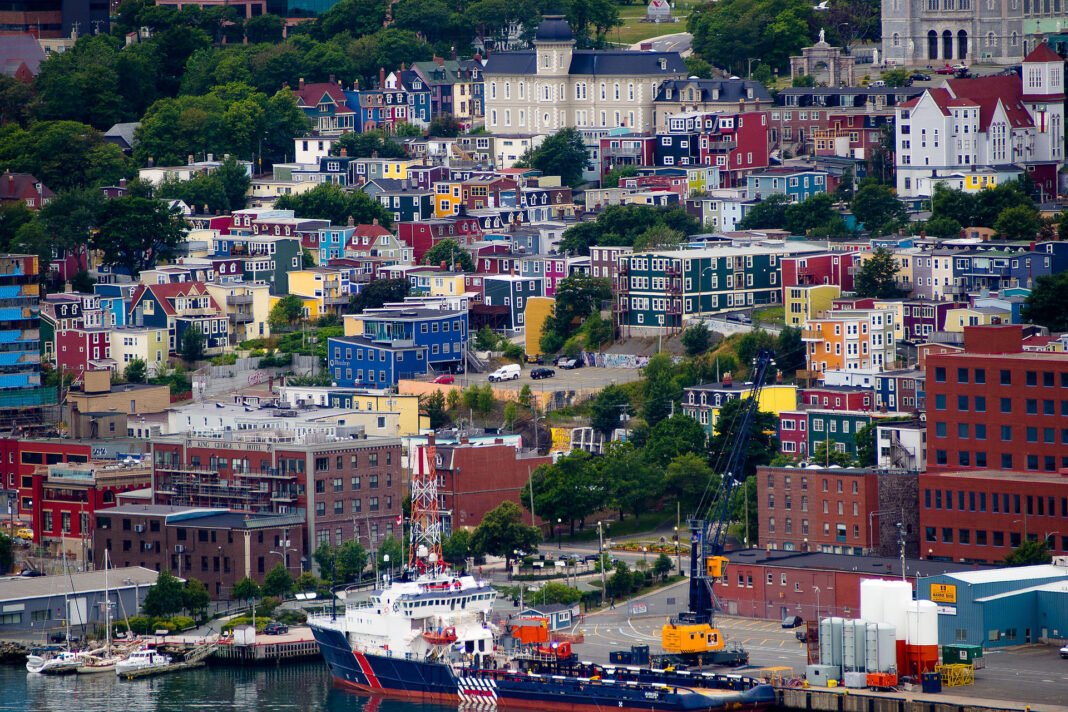
Downtown St. John’s — the heritage commercial and residential district around Water Street, Duckworth Street, and the Jellybean Row terraces of Gower Street and Prescott Street — is Canada’s most characterful small-city downtown. The Signal Hill backdrop, the harbour view from the Narrows, the George Street entertainment strip, and a restaurant scene centred on Duckworth Street (Terre, Chinched, Adelaide Oyster House) give the core a flavour few Canadian cities can match. The Victorian row houses of Georgestown are the most sought-after addresses in the province — period homes at CAD $380,000–$550,000 once renovated, in the city’s most walkable neighbourhood. Proximity to the Quidi Vidi Lake trails, the Signal Hill hiking routes, and the Battery fishing village puts outdoor recreation within easy reach.
2. Quidi Vidi and the East End
Quidi Vidi — the fishing village inside the city boundaries, a 10-minute walk from the downtown core — is St. John’s most photographed neighbourhood: the coloured fishing stages reflected in The Gut harbour, the Quidi Vidi Brewery taproom in a restored fishing premises, and the annual Royal St. John’s Regatta (the oldest annual sporting event in North America, first Wednesday in August) give it a heritage character all its own. The east end streets around the lake and the Quidi Vidi gut (the tidal inlet between the lake and the sea) hold established family housing at CAD $330,000–$470,000, with the lake trails and the brewery’s gathering space on the doorstep.

3. Mount Pearl: The Affordable Metro Option
Mount Pearl (22,500), immediately west of St. John’s and effectively part of the metropolitan area, is Newfoundland’s second-largest city and its most family-oriented suburb — a planned city with its own commercial core, recreational facilities (the Mount Pearl Glacier arena complex, the Glacier Bowl), and a housing market offering detached family homes at CAD $280,000–$390,000 with full access to St. John’s jobs and services. The planned street grid, the distance from downtown noise and tourist traffic, and the proximity to the airport and highway make Mount Pearl the pragmatic choice for families who value school access, new construction, and lower housing costs over downtown heritage character.
4. Corner Brook: The West Coast City
Corner Brook (19,500) on the west coast of Newfoundland — the island’s second-largest city, on the shores of the Bay of Islands — delivers a complete small-city lifestyle in the province’s most scenically dramatic urban setting. The city sits in an amphitheatre on the Humber River valley, ringed by the Long Range Mountains, with Marble Mountain ski resort (Atlantic Canada’s largest alpine ski area, 536m of vertical drop) 7km east. Grenfell Campus (Memorial University’s western campus) anchors the local educational and creative community; the city’s pulp and paper heritage (the Kruger newsprint mill, one of the last operating newsprint mills in Atlantic Canada) provides industrial employment; and a housing market at CAD $200,000–$310,000 makes Corner Brook the most affordable small city on the island with genuine urban services.
5. Labrador City: The Iron Ore Frontier
Labrador City (7,400) — the iron ore mining city on the Quebec–Labrador border, one of the most isolated resource communities in eastern Canada — is shaped entirely by the economics and logistics of the Iron Ore Company of Canada’s (IOC) massive open-pit mine. A fly-in/fly-out workforce and a permanent resident community create a bifurcated social structure; permanent residents earn the resource economy’s high wages (CAD $90,000–$140,000+ for mine operations roles) against the costs of remoteness and a climate far harsher than the island’s (–30°C to –40°C is routine in winter). Housing at CAD $200,000–$320,000 is reasonable relative to those wages; the community’s recreational facilities (the Carol Lake arena, the cross-country ski network in the Menihek Highlands) reflect the investment a resource company makes in keeping workers in an isolated place.
6. Twillingate: The Outport Experience
Twillingate (2,100) on Notre Dame Bay in north-central Newfoundland is the most visitor-accessible of the island’s outport communities — the “Iceberg Capital of the World” during spring iceberg season, with the Long Point Lighthouse perched on the headland above the Atlantic and prime whale watching (humpback, minke, and fin whales from June–September). It is a tourist destination that also works as a year-round home for those after the genuine outport experience. Heritage homes run from CAD $100,000–$200,000; the summer festival (Fish, Fun & Folk Festival, August) and the town’s role as the service centre for Notre Dame Bay’s island communities supply the social infrastructure for a choice few Canadians make but many find transformative.
Making Your Decision
Choosing where to live in Newfoundland and Labrador comes down to honestly matching your priorities with what each city and community genuinely delivers. Budget, career opportunities, access to outdoor recreation, climate preferences, and community character all weigh differently depending on your life stage and values — and no ranking can substitute for that personal assessment. The cities and towns profiled in this guide represent the strongest overall options, but Newfoundland and Labrador has smaller communities that offer compelling alternatives for those willing to trade urban convenience for affordability, quieter living, or closer access to natural landscapes. If possible, spend at least a long weekend in your shortlisted communities before committing — the practical factors matter enormously, but so does the less quantifiable sense of whether a place simply feels right for where you are in life.
Frequently Asked Questions
What makes St. John’s the best place to live in Newfoundland and Labrador?
St. John’s — the capital city, with 239,000 metropolitan population, providing 40%+ of Newfoundland’s total population in a single metropolitan area — is the only Newfoundland city with the full suite of urban services, employment diversity, and cultural infrastructure that makes major city living possible. Memorial University of Newfoundland (MUN, the province’s only university, with 17,000 students) is the city’s largest employer and the source of Newfoundland’s research and knowledge economy, with particular strength in ocean sciences, engineering, and medicine. The city’s neighbourhoods span from the Victorian architecture of the downtown and historic districts (Gower Street, Prescott Street, and the Battery — the historic fishing village at the foot of Signal Hill, where houses are built directly into the cliff face) to the suburban expansion of Mount Pearl (a separate municipality of 22,500 that forms the southern edge of the metropolitan area) and Paradise (the fastest-growing municipality in Atlantic Canada). The offshore oil industry (Hibernia, Terra Nova, and White Rose, whose operations employ roughly 5,000 people directly) has added a professional engineering and management class to St. John’s that was absent before Hibernia came online in 1997.
What is Corner Brook like and what does it offer?
Corner Brook — the largest city on Newfoundland’s west coast, with 19,500 population, 680km west of St. John’s on the Humber Arm of the Bay of Islands — is western Newfoundland’s service and commercial hub and the gateway to Gros Morne National Park (100km north). The Bowater Mersey paper mill (now Kruger Products) was Corner Brook’s dominant employer for most of the 20th century; its partial closure has pushed the city to diversify toward healthcare, education, and tourism. Grenfell Campus of Memorial University (1,200 students) provides the post-secondary anchor. Marble Mountain Ski Resort (7km east of downtown, 536m vertical drop, the largest ski resort in Atlantic Canada) delivers winter recreation of genuine regional significance — and the views from the summit over the Bay of Islands (a fjord-like inlet of the Gulf of St Lawrence with Long Range Mountains rising to 670m+ on both sides) rank among the most dramatic mountain-to-sea panoramas in Atlantic Canada. Corner Brook’s Captain James Cook Monument commemorates Cook’s 1763–1767 surveys of the Newfoundland coast, mapping the coastline with a precision that remained the navigational standard for a hundred years.
What are the housing costs across Newfoundland and Labrador’s communities?
Newfoundland and Labrador offers the most affordable housing of any Canadian province with a significant urban centre, with St. John’s median detached house prices in 2026 around CAD $340,000–$430,000 — comparable to New Brunswick’s Moncton but below every other Canadian provincial capital. Inner St. John’s heritage properties (Gower Street, Military Road, and downtown Victorian row houses with harbour views) range from CAD $380,000–$650,000 for fully restored examples, with unrenovated properties offering remarkable value. Corner Brook median prices sit around CAD $250,000–$320,000. The outport and inland towns (Grand Falls-Windsor, Gander, Clarenville, Carbonear) show medians of CAD $180,000–$260,000, with the most remote communities priced below conventional real estate valuation. Labrador City houses, despite the remoteness and the industrial landscape, run CAD $250,000–$380,000 — a reflection of demand from the iron ore operation’s workforce. The affordability is a real draw for families priced out of Ontario or BC, though the limits of the job market are equally real: Newfoundland’s unemployment rate has historically exceeded the national average, and the private sector outside oil and gas and healthcare is thin.
What do the smaller communities of Newfoundland offer for quality of life?
Newfoundland’s smaller communities offer a quality of life and community cohesion that urban Canada cannot replicate, at costs that keep family home ownership within reach for working-class households. Trinity (population 150, on Trinity Bay, the most intact 18th and 19th century outport community in Newfoundland) draws visitors and a small population of artists, writers, and remote workers attracted by the village’s remarkable preservation, its Rising Tide Theatre (outdoor performances in historic buildings throughout the village in summer), and its setting on one of the most beautiful bays in Atlantic Canada. Twillingate (population 2,100, on Notre Dame Bay, the self-described “Iceberg Capital of the World”) provides the province’s most accessible mix of iceberg viewing (April–June, when the Labrador current carries icebergs south past the island), humpback whale watching (July–August), and outport social life. Fogo Island (reached by ferry from Farewell, 45 minutes from the Trans-Canada) is home to the Fogo Island Inn (29 rooms, designed by Todd Saunders, consistently rated among the most extraordinary hotels in the world by Condé Nast Traveler and similar publications) and the Shorefast Foundation, a model community development organization that has rebuilt the island’s social fabric through cultural investment.
What employment opportunities exist in Newfoundland and Labrador?
Newfoundland and Labrador’s employment market rests on three major sectors: the offshore oil industry (Hibernia Management and Development Company, Suncor, and Equinor operate the Grand Banks fields that produce roughly 230,000 barrels per day at peak), the public sector (Memorial University, the provincial health authority, and Newfoundland and Labrador Hydro providing stable employment in St. John’s and Corner Brook), and the mining and resource sector in Labrador (Iron Ore Company of Canada in Labrador City, Voisey’s Bay nickel mine near Nain in northern Labrador). The fishing industry — the economic foundation of Newfoundland society for 500 years — was devastated by the 1992 Northern cod moratorium (the collapse of the northern cod stock, then among the most productive fishing grounds in the world, cost roughly 35,000 jobs in the single largest layoff in Canadian history) and has partially recovered through shrimp and crab harvesting. Seasonal work (tourism in summer, construction, and fish processing) provides income for rural communities. The FIFO (fly-in fly-out) model for offshore and Labrador employment lets workers live in St. John’s — or even mainland Canada — while working two-weeks-on/two-weeks-off rotations.