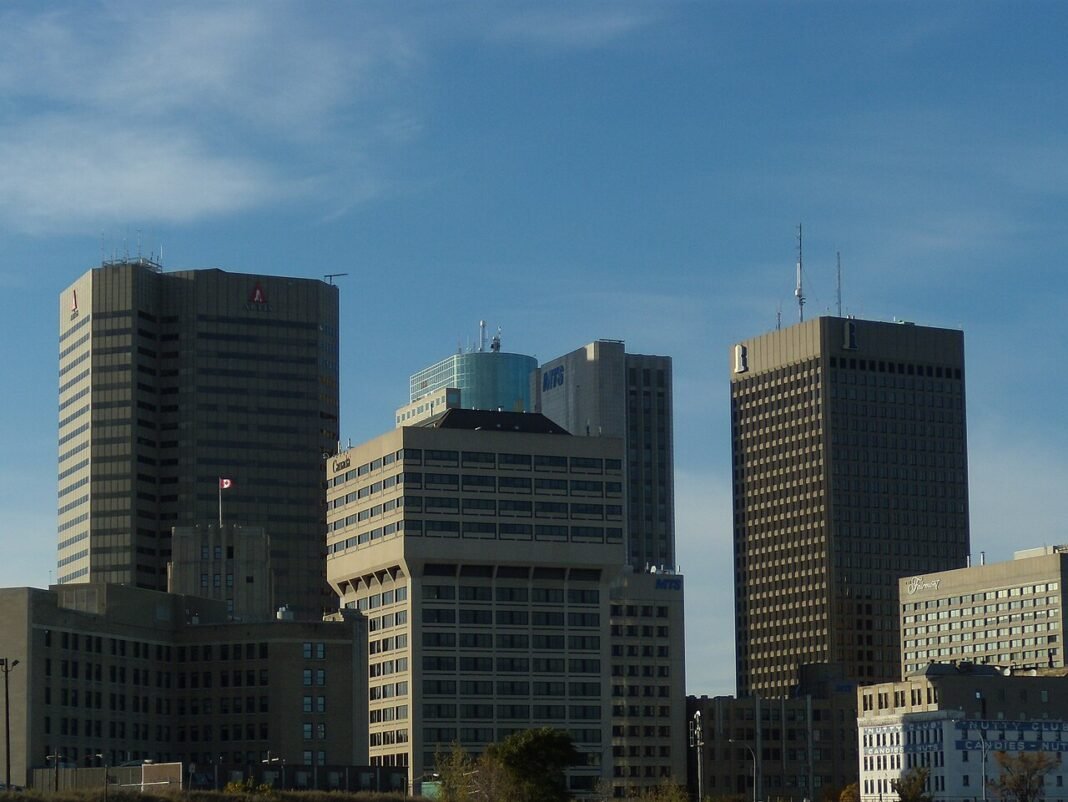
Manitoba‘s residential map is dominated by Winnipeg — roughly 60% of the province’s residents live in the capital and its suburbs — with the rest spread between the agricultural Prairie (Brandon, Portage la Prairie, Steinbach) and the remote north (Thompson, Flin Flon, The Pas). For a province this large (650,000 square kilometres), so much settled urban life packed into one city is striking. In practice, choosing where to live in Manitoba comes down to a single trade-off: Winnipeg’s inner neighbourhoods (character housing, walkability, and cultural density within 5km of downtown) versus the outer suburbs and satellite towns (newer builds, larger lots, and lower prices in exchange for a car-dependent commute). The province’s most unusual option sits in the southeast — the Mennonite-heritage corridor of Steinbach and Winkler, where compact family towns pair affordable housing with tight social bonds.
1. Wolseley: The Granola Belt
Wolseley sits immediately west of the Legislative Building on the south bank of the Assiniboine River, and it has anchored Winnipeg’s progressive politics, cooperative living, and environmental activism since the 1970s. The mixed Victorian housing stock — brick single-family homes, character duplexes, infill co-ops — sits alongside the Wolseley Gardens growing project and the Assiniboine River pathway, giving the area a social fabric the outer suburbs cannot match. Westminster Avenue and Westminster United Church serve as gathering points, and the short walk to the legislative precinct and downtown keeps Wolseley among the city’s most sought-after inner addresses for households that prize walkability and a sense of belonging. Detached homes typically run CAD $350,000 to $500,000.
2. Osborne Village and Fort Rouge: The Urban Heart
Osborne Village — centred on the Osborne Street strip between the Assiniboine River and Confusion Corner — is the densest urban pocket in the Prairie provinces. Independent restaurants, the Village Cinema, an Indigo bookstore, and the late-night bars and live-music rooms along Osborne and Corydon pack a level of commercial energy into a residential area that is genuinely rare west of Toronto. Just east, Fort Rouge offers the same river-pathway access and walkable amenities at a quieter pace. Expect CAD $380,000 to $600,000 for a detached home.
.jpg?width=1280)
3. River Heights and Crescentwood: The Corydon Corridor
River Heights and Crescentwood — Winnipeg’s wealthiest established districts, south of the Assiniboine — grew out of 1920s and 1930s development built on curving streets and substantial family homes. Corydon Avenue’s Little Italy (the city’s best-loved restaurant and gelato strip) and the Grant Avenue retail corridor supply the local shopping anchors; the schools (Gordon Bell High School, Kelvin High School) rank among Winnipeg’s most respected; and Assiniboine Park’s Leo Mol Sculpture Garden, the zoo, and the English Garden provide the green space. Detached homes here range from CAD $450,000 to $700,000.
4. St. Boniface: The French Quarter
St. Boniface — Winnipeg’s French quarter on the east bank of the Red River, linked to downtown by the Provencher Bridge — is the second-largest Francophone community in Canada outside Quebec. The Université de Saint-Boniface, the Centre culturel franco-manitobain, and the Festival du Voyageur (the winter celebration of fur-trade heritage) keep French-language life thriving inside bilingual Winnipeg. The Provencher Boulevard restaurant strip, the Cathedral of Saint-Boniface (where Louis Riel is buried), and the brick streets around the Précieux-Sang school give the quarter an unusual cultural depth. Detached homes typically sell for CAD $350,000 to $500,000.
5. Steinbach: The Southeast Value
Steinbach (about 17,800 residents), 65km southeast of Winnipeg, is one of Manitoba’s fastest-growing communities — a Mennonite-heritage city that has expanded as Winnipeg families discovered the commute works: 50 minutes to the Perimeter Highway buys suburban living at CAD $300,000 to $380,000 for a new detached home, with full municipal services, schools, and the retail base of a self-sufficient small city. The Mennonite Heritage Village museum and Steinbach’s family-centred civic life make for a tone that contrasts sharply with Winnipeg’s urban mix. For households that value family ties and can handle the drive, the value proposition is hard to argue with.
6. Gimli: Icelandic Heritage and Lake Winnipeg
Gimli (about 6,000 year-round residents, with a far larger summer population), 75km north of Winnipeg on the western shore of Lake Winnipeg, is the largest Icelandic settlement outside Iceland. The New Iceland heritage that took root here in the 1870s still shapes the town through the Icelandic Festival of Manitoba (held each August, one of Canada’s longest-running cultural festivals), the New Iceland Heritage Museum, and the working character of a lake town with its fishing fleet, marina, and the widest main beach on Lake Winnipeg. Winnipeg families have driven up demand for lake property within 45 minutes of the city; cabins and year-round homes run CAD $250,000 to $500,000, with prime lakefront above CAD $600,000. The Highway 9 drive north through the Interlake’s farm and wetland country is one of Manitoba’s prettiest paved routes.
7. Brandon: Manitoba’s Second City
Brandon (about 51,000 residents; roughly 54,000 across its wider area), Manitoba’s second-largest city, sits 200km west of Winnipeg and offers the province’s most complete regional-city experience outside the capital. Brandon University (founded as Brandon College in 1899), the Keystone Centre (western Manitoba’s largest arena and exhibition complex), the Agriculture and Agri-Food Canada research station, and home prices of CAD $250,000 to $380,000 make it one of the most affordable midsized cities in the country. The local economy leans on the Maple Leaf Foods pork plant (one of Canada’s biggest), agricultural research, and the distribution and retail role it plays for the southwestern farm belt. For remote workers who want Prairie space at low cost without giving up full city services, Brandon’s mix of affordability, regional completeness, and Trans-Canada access adds up to a real option.
Frequently Asked Questions
What defines Winnipeg’s character among Canadian cities?
Winnipeg — Manitoba’s capital and largest city, with a metropolitan population of roughly 850,000, sitting near the geographic centre of Canada where the Red and Assiniboine Rivers meet — is one of the country’s most underrated cities. It carries extraordinary cultural weight: the strongest Indigenous arts presence of any Canadian city, the Exchange District National Historic Site (the largest collection of turn-of-the-century commercial architecture in Canada), and a civic ambition out of proportion to its size. The Canadian Museum for Human Rights (opened 2014, the first national museum built outside the National Capital Region, designed by Antoine Predock) is the country’s most architecturally daring public building since Expo 67 and the world’s only museum devoted entirely to human rights. The Forks, at the river confluence that served as an Indigenous meeting place for 6,000 years, is the city’s busiest public space — a year-round market, an outdoor amphitheatre, and, in winter, the Red River Mutual Trail, a skating route maintained on the frozen river that has reached up to 10km in cold years and holds the Guinness record for the world’s longest naturally frozen skating trail. Winters that fall to -40°C (among the coldest of any major city outside Russia) and summers above 30°C frame the climate that shapes Manitoban life.
What makes the Wolseley and Osborne Village neighbourhoods distinctive?
Winnipeg’s inner districts hold the best-preserved pre-war housing of any Prairie city. Wolseley — west of the Assiniboine River along the Wolseley Avenue corridor — is the city’s most characterful inner-city area: tree-lined streets of late-Victorian houses (many with the sleeping porches built for hot summers), a strong Indigenous arts presence, the densest concentration of community gardens in Winnipeg, and an independent café and food scene centred on Sherbrook Street. The area has long drawn teachers, nurses, artists, and community workers, giving it a cooperative, socially engaged feel that sets it apart from more gentrified Canadian neighbourhoods. Osborne Village, south of the Assiniboine along Osborne Street, is Winnipeg’s tightest walkable mixed-use strip — cafés, restaurants, bookshops, independent clothing stores, and the Village Cinema — and stays genuinely affordable next to comparable districts in bigger Canadian cities. North of downtown, the Exchange District National Historic Site preserves the city’s finest architecture: five-storey terracotta and brick commercial buildings from 1900 to 1915, the Royal Albert Arms Hotel, and the Cinematheque art cinema.
What does the rest of Manitoba offer beyond Winnipeg?
Manitoba runs from the flat farmland of the Red River Valley (the country’s most productive wheat ground, draining north into Lake Winnipeg, the world’s tenth-largest freshwater lake by area) to the boreal forest and pre-Cambrian rock of the Canadian Shield in the north and east, and on to the Arctic tundra of the Hudson Bay Lowlands. Churchill — on Hudson Bay, population about 900, reachable only by air or the 36-hour Via Rail train from Winnipeg — draws visitors for two globally significant wildlife experiences: polar bears (late October to mid-November, when they gather on the tundra waiting for the bay to freeze, viewed from tundra buggies in what is the most accessible polar bear viewing on Earth) and beluga whales (July and August, when thousands crowd the Churchill River estuary). Closer in, Riding Mountain National Park — 3,000 square kilometres of upland boreal forest rising from the plains, 300km northwest of Winnipeg — is the province’s easiest wilderness to reach, with Clear Lake beach, cycling, and reliable black bear and elk sightings.
What are Manitoba’s housing costs compared to other Canadian provinces?
Manitoba is the most affordable province in Canada that still has a major metropolitan centre, which makes Winnipeg the best-value large city in the country for families who want urban amenities without coastal prices. Winnipeg’s median detached price in 2026 runs roughly CAD $380,000 to $460,000 — about a third of Vancouver and less than half of Toronto — in a city with a major university, an NHL team (the Winnipeg Jets), a deep professional arts scene, and an international airport. The desirable inner neighbourhoods (Wolseley, Osborne Village, River Heights, and the Crescents) sit closer to CAD $400,000 to $700,000 for a detached house. The catch is carrying cost: Manitoba’s combined education levy and municipal rates leave Winnipeg with property tax among the highest of any major Canadian city, which offsets part of the low purchase price. Brandon, the second city 200km west on the Trans-Canada (about 54,000 across its wider area), posts median prices of CAD $280,000 to $340,000, with Brandon University and the agricultural and healthcare sectors anchoring local employment.
What is Manitoba’s Indigenous cultural heritage and why is it significant?
Manitoba has one of the highest shares of Indigenous population of any Canadian province (around 18% of residents identify as First Nations, Métis, or Inuit), and Winnipeg is home to the largest urban Indigenous population in the country in absolute numbers. The Métis Nation — the people who emerged from the union of European fur traders and Indigenous women in the Red River Valley, who speak Michif (a blended Cree-French language) and historically followed the seasonal bison hunt — shaped the Red River Settlement and remain central to provincial identity. Louis Riel, the Métis leader who led the Red River provisional government that negotiated Manitoba’s entry into Confederation and was hanged for treason in 1885 after the North-West Resistance, is now recognized as a founder of Manitoba and the province’s first premier — the defining figure of Manitoba history. The Manitoba Museum’s Nonsuch Gallery (with its full-scale replica of the ketch that made the first Hudson’s Bay Company trading voyage in 1668) and the Métis Cultural Village hold the province’s richest heritage experiences. The Indigenous arts scene centred in Winnipeg’s North End is the most active and internationally recognized in Canada, led by the Urban Shaman Gallery and the Indigenous-run businesses along North Main Street.