Wyoming is the least populated state in the continental United States — 588,000 residents spread across 97,813 square miles, a density of 6.0 people per square mile that produces a landscape where you can drive for hours without leaving federal land, where bison outnumber the residents of some counties, and where the night sky over the high plains delivers Milky Way clarity that urban America has all but forgotten. The state holds two of the great national parks of the world: Yellowstone (the world’s first national park, established 1872, protecting the largest geothermal system on Earth) and Grand Teton (a 40-mile wall of granite peaks rising 7,000 feet straight off the Jackson Hole valley floor, the most dramatic mountain-plain interface in North America). Jackson, the tourist hub at the park’s southern gateway, has turned from a genuine cowboy town into one of the costliest small communities in the country — a 10,000-resident town that hosts the largest art market and auction week anywhere in the U.S. west of New York. Beyond the parks and Jackson, the state stays genuinely vast and untamed: the Wind River Range, the Bighorn Mountains, the Red Desert, and the high plains of the Wyoming Basin deliver outdoor recreation and solitude at a scale that is increasingly hard to find anywhere else in the contiguous 48.

Yellowstone National Park: The World’s Greatest Geothermal System
Yellowstone holds more geysers, hot springs, mud pots, and fumaroles than anywhere on Earth — over 10,000 hydrothermal features across the park’s 3,472 square miles, a landscape that sits above one of the planet’s most active volcanic hot spots — the Yellowstone Caldera, roughly 30 by 45 miles across. The park’s headline features run the full range, from the predictable (Old Faithful, erupting every 60–110 minutes to a height of 106–184 feet) to the surreal (the Grand Prismatic Spring, 370 feet across and 160 feet deep, its rainbow of thermophilic bacterial mats visible from the overlook trail) to the plainly dangerous (the boardwalk system exists because much of the thermal ground is thin crust over scalding water).
.jpg?width=1200)
Yellowstone Highlights
- Old Faithful and Upper Geyser Basin: The densest cluster of geysers on Earth, packed into a single square mile; Beehive Geyser (150–200 feet), Castle Geyser (historic cone), and Morning Glory Pool anchor the basin
- Grand Prismatic Spring: The largest hot spring in the United States and third largest in the world; the overlook trail (1-mile round trip from the Fairy Falls trailhead) gives you the aerial angle that photographers have made iconic
- Lamar Valley: “America’s Serengeti” — the surest wildlife viewing in North America; bison herds, wolf packs (Yellowstone hosts the most studied wolf population on the planet), grizzly bears, pronghorn, and elk in a valley of extraordinary scale
- Grand Canyon of the Yellowstone: The Yellowstone River drops 308 feet at the Lower Falls into a canyon of yellow and orange rhyolite that gave the park its name
Grand Teton National Park: Vertical Wyoming
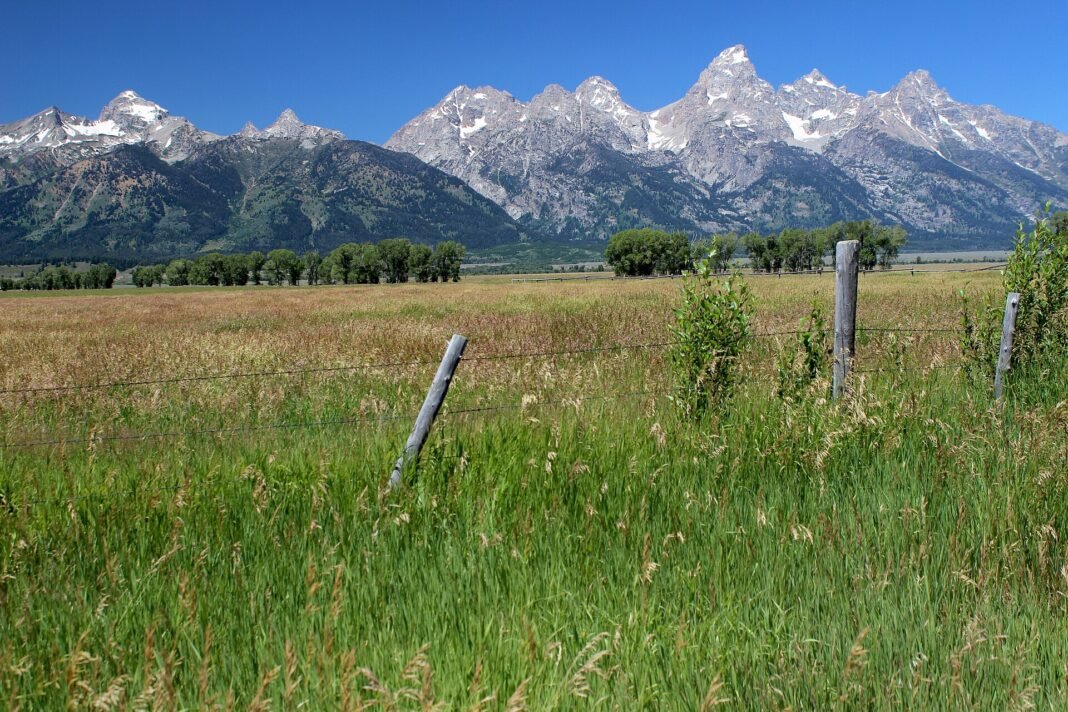
Grand Teton National Park, immediately south of Yellowstone, holds the most photographed mountain landscape in the country — the Teton Range climbing straight out of the flat Jackson Hole valley with no foothills to soften it, a 40-mile wall of 12,000–13,775-foot granite peaks (the Grand Teton itself at 13,775 feet, second-highest in Wyoming) mirrored in the oxbow ponds and the Snake River threading the valley floor. Its 310,000 acres carry hiking of every grade, from Class 1 valley trails (the Jenny Lake loop, the Taggart and Bradley Lakes routes) to serious technical mountaineering (the Grand Teton summit calls for rock-climbing skills and, for most people, a guided ascent). Jenny Lake draws the heaviest traffic — the String Lake picnic area, the shuttle boat to the Hidden Falls and Inspiration Point trailheads, and the 7.9-mile, entirely flat loop around the lake make up the easiest way into the park.
.jpg?width=1200)
Jackson: Wyoming’s Luxury Hub
Jackson, the town of 10,000 at the base of the Teton Range and the southern gateway to both Grand Teton and Yellowstone, ranks among the costliest communities in the country — pushed there by hedge fund managers and tech executives who treat Jackson Hole as their preferred second-home market, and by the ski infrastructure (Jackson Hole Mountain Resort, 4,139 feet of continuous inbounds vertical served by the aerial tram, regularly rated the best ski terrain in the U.S. by expert skiers) that makes the town a world-class winter draw. The Town Square, with its four arches built from shed elk antlers, anchors a commercial district of galleries, restaurants, and western-wear shops. Above the National Elk Refuge, the National Museum of Wildlife Art puts Yellowstone’s wildlife in context inside an ambitious building designed to disappear into the sagebrush bluff.
Wind River Range: Wyoming’s Wilderness Spine
The Wind River Range runs 100 miles through west-central Wyoming and holds the finest wilderness backpacking in the lower 48 — the Bridger-Teton and Shoshone National Forests guard a landscape of 40-plus peaks above 13,000 feet, 1,300 lakes, and 500-plus miles of maintained trail, with permit-free access and a depth of solitude that neither Yellowstone nor Teton can match. The Cirque of the Towers (a ring of granite spires above Lonesome Lake in the southern Winds) and the Titcomb Basin (a glaciated alpine valley in the northern Winds, reached from Pinedale) are the signature backpacking objectives. Fremont Peak (13,745 feet) was first climbed by John C. Frémont in 1842, and carries his name from that first western expedition.
Getting the Most Out of Your Visit
A few practical notes will improve any Wyoming trip. Book lodging and major attractions — national parks, popular trails, and well-known restaurants in particular — as far ahead as you can; the best options fill weeks or months out, especially in peak season. A car buys you the most freedom to explore past the main centers, and most of what makes the state worth the trip sits in places public transit never reaches. The sharpest local knowledge tends to come from regional visitor centers, independent bookshops, and conversations with residents — the trip’s best discoveries are rarely the ones printed in a guidebook. And give yourself more time than you think you need: Wyoming pays back travelers who slow down and go deep far better than those racing to cover ground.
Frequently Asked Questions
What makes Yellowstone National Park’s geothermal features the world’s most extraordinary?
Yellowstone National Park (3,472 square miles, established 1872 as the world’s first national park) holds more geysers, hot springs, mud pots, and fumaroles than anywhere on Earth — over 10,000 hydrothermal features sitting above the planet’s most active volcanic hot spot. Old Faithful — erupting every 60–110 minutes to heights of 106–184 feet — is the world’s most famous geyser, but the park’s wider thermal landscape is the real draw. The Grand Prismatic Spring (370 feet across, 160 feet deep, its rainbow of thermophilic bacterial mats running from deep blue at the center to orange and red at the cooler edges) is best seen from the Fairy Falls trail overlook rather than the crowded boardwalk below. The Grand Canyon of the Yellowstone (Upper Falls 109 feet, Lower Falls 308 feet) offers the finest canyon scenery in the interior West outside the Colorado River system. Lamar Valley (“America’s Serengeti”) gives you the park’s easiest wildlife viewing — bison herds, wolf packs (the Druid Peak pack was the world’s most studied wolf pack), grizzly bears, and pronghorn visible from the road across an unusually open valley floor.
What does Grand Teton National Park offer as a complement to Yellowstone?
Grand Teton National Park (310,000 acres, immediately south of Yellowstone) presents one of the great mountain frontscapes anywhere — a 40-mile wall of granite peaks rising 7,000 feet above the Jackson Hole valley floor with almost no foothills to break up the vertical relief. The Cathedral Group (Grand Teton at 13,775 feet, Mount Owen, and Teewinot Mountain) makes the most photogenic mountain wall in North America, best caught from the Snake River’s Oxbow Bend in morning light. The Teton Crest Trail (40 miles, 3–5 days, with a shuttle option via the tram at Jackson Hole Mountain Resort) is the finest long route in the Greater Yellowstone ecosystem. Jenny Lake concentrates the park’s easiest hiking: Hidden Falls and Inspiration Point (7 miles round trip), Cascade Canyon (continuing to the Forks for 9 miles round trip), and the Paintbrush-Cascade loop (19 miles, one of Wyoming’s great day hikes). Grand Teton climbing — above all the Grand itself, by the standard Owen-Spalding route or the Upper Exum Ridge — ranks among the major mountaineering objectives in the continental US.
What makes Jackson Hole one of America’s most expensive small communities?
Jackson (around 10,000 permanent residents, Teton County, Wyoming) has become one of the costliest communities in the country — a meeting point of extraordinary natural setting (the Teton Range, Grand Teton and Yellowstone National Parks, and the National Elk Refuge), the largest art market west of New York (Jackson Hole Art Auction week in September), and tech and finance remote workers driving home prices far past what the local service economy can bear. The median sale price in Teton County runs well into seven figures, leaving it one of the least affordable counties in the country relative to local wages. Jackson Hole Mountain Resort — 4,139 feet of continuous inbounds vertical served by the aerial tram, with Corbet’s Couloir (one of the most famous and demanding inbounds ski lines in North America) — is regularly ranked the finest ski resort in the U.S. by expert skiers. The National Elk Refuge (winter home to 7,000–8,000 elk) and its horse-drawn sleigh rides (run by the U.S. Fish and Wildlife Service) put one of North America’s most accessible large-mammal experiences within minutes of town.
What does Wyoming’s Wind River Range offer beyond the national parks?
The Wind River Range — 100 miles of granite peaks and alpine lakes in western Wyoming — holds the most extensive backcountry wilderness in the lower 48 outside the national parks. The range carries Gannett Peak (13,804 feet, Wyoming’s highest) along with most of the state’s 50 tallest summits, 1,300-plus lakes, and 63 named glaciers (the greatest concentration in the Rocky Mountains, surpassed in the contiguous US only by the Washington Cascades). The Popo Agie Wilderness, the Fitzpatrick Wilderness, and the Bridger Wilderness (the busiest wilderness in Wyoming, yet still far quieter than comparable Colorado areas) form the core backcountry terrain. The Highline Trail (75 miles from Green River Lakes to Big Sandy Lodge) is the Winds’ definitive long route, holding to altitude across the full length of the range. Trailheads cluster at Dubois (north end), Pinedale (south), and Big Sandy. The Wyoming Range and the Bighorn Mountains (the Bighorn Canyon National Recreation Area and Cloud Peak Wilderness in particular) add still more remote country in a state with 49 million acres of federal public land.
What wildlife viewing experiences make Wyoming exceptional beyond the national parks?
Wyoming’s wildlife reaches well past the Greater Yellowstone Ecosystem. The National Elk Refuge next to Jackson winters 7,000–8,000 elk (one of North America’s largest herds), and its horse-drawn sleigh rides put you among them. Pronghorn — the fastest land animal in the Western Hemisphere, able to hold 55 mph over open ground — are the state’s most abundant large mammal, with population estimates around 320,000, scattered across the plains and sagebrush flats. The Greater Yellowstone Ecosystem carries the most complete temperate large-mammal community in the lower 48: gray wolf (reintroduced 1995, roughly 100 in the park), grizzly bear (about 1,000 in the GYE), American bison (roughly 4,000–5,000 in Yellowstone, the largest free-roaming herd in the country), and wolverine (present but rarely seen). The Path of the Pronghorn — pronghorn covering more than 150 miles between summer range in Grand Teton and winter range in the Upper Green River Basin near Pinedale — is the longest pronghorn migration in North America and one of the longest land-mammal migrations left in the lower 48.