Idaho is the most underrated travel destination in the American West — a state of rare natural range that most travelers skip on their way to flashier neighbors. That oversight is their loss. Idaho holds more miles of wild and scenic rivers than any other contiguous US state, the deepest river gorge in North America, some of the boldest volcanic country on the continent, destination ski resorts, and a frontier character that has faded in states with heavier tourist development. Most travelers who give the state a few days leave wondering why they waited so long.

Sun Valley: Mountain Town Excellence
Set in the Wood River Valley of south-central Idaho, Sun Valley has anchored the upper tier of American mountain resorts since it opened as the country’s first destination ski resort in 1936. Bald Mountain (Baldy), the main ski peak, drops 3,400 vertical feet, with runs that start above treeline and open onto panoramic views of the Pioneer Mountains. Add Ketchum, a walkable village of good restaurants, galleries, and lodging, and the package holds its own against any Colorado resort town — minus the crowds and the prices.
Sun Valley’s appeal extends across all seasons. Summer brings the Sun Valley Music Festival (free outdoor classical concerts that have run each summer since 1985, staged since 2008 at the open-air Sun Valley Pavilion), the Sun Valley Film Festival in spring, demanding fly fishing on Silver Creek (one of the most technical spring-fed trout streams in the West), and mountain biking on the trail networks that connect Ketchum to the surrounding wilderness areas. Ernest Hemingway spent his final years in Ketchum and is buried in the town cemetery — a literary pilgrimage that draws visitors uninterested in skiing.
Craters of the Moon National Monument
Craters of the Moon National Monument and Preserve, on the Snake River Plain between Twin Falls and Sun Valley, preserves one of the strangest volcanic landscapes in North America — a 618-square-mile lava field of flows, cinder cones, spatter cones, and lava tubes built by a series of eruptions that began roughly 15,000 years ago and continued as recently as 2,000 years ago. The monument’s name is not hyperbole: NASA astronauts trained at Craters of the Moon before the Apollo missions, studying the geological environment most similar to what they expected to find on the lunar surface.
The 7-mile loop drive through the monument passes the most accessible features: the North Crater Flow, Inferno Cone (a 180-foot cinder cone with a short steep hike to summit views across the lava plain), the Big Cinder Butte, and access points for the lava tube caves (Indian Tunnel, Boy Scout Cave, and Beauty Cave). Cave hiking requires flashlights and in some tubes a helmet — the caves maintain a temperature near 40°F year-round. In spring, the apparently barren lava plain blooms with wildflowers that have adapted to the thin volcanic soil.

Hells Canyon: Deepest Gorge in North America
Hells Canyon, on the Idaho-Oregon border where the Snake River cuts through the Seven Devils Mountains, is the deepest river gorge in North America — deeper than the Grand Canyon by nearly 2,000 feet at its maximum depth of 7,993 feet. The canyon’s remote character (no road crosses the canyon for 100 miles; access is primarily by jet boat from the Oregon side or by trail from the Idaho rim) preserves a wilderness quality that has been eroded from more accessible western landscapes. Bighorn sheep are commonly seen on the canyon walls; black bears, cougars, rattlesnakes, and nesting golden and bald eagles inhabit the canyon ecosystem.
Hells Canyon National Recreation Area offers several ways in. The Hells Canyon Overlook near Oxbow, Oregon, is the easiest rim view to reach by car. Jet boat tours run from Hells Canyon Dam and from Lewiston, Idaho — the farthest inland seaport on the Pacific coast, 465 miles from the ocean via the Columbia and Snake River system. Whitewater rafting through the main canyon hits Class IV-V rapids, and multi-day float trips rank with the great river journeys of the continental United States.
Sawtooth Mountains and Stanley Basin
The Sawtooth Range, north of Sun Valley in central Idaho, holds fifty-seven peaks above 10,000 feet and nearly 400 alpine lakes within the Sawtooth Wilderness. The town of Stanley — population around 100 year-round — sits at 6,290 feet in the Stanley Basin, with the Sawtooth peaks rising sharply to the south and west into a panorama routinely ranked among the finest vistas in the Rocky Mountains. The Salmon River, which begins near Stanley and flows for 425 miles before joining the Snake, provides the main artery of float trips through the Idaho backcountry.
The Sawtooth National Recreation Area trail system includes the Alice Lake Trail (about 12 miles round-trip from the Tin Cup trailhead at Pettit Lake to a chain of alpine lakes beneath the main Sawtooth peaks), the Goat Lake route in the White Cloud Mountains, and dozens of multi-day backpacking options in terrain that sees a fraction of the traffic of comparable Colorado or Utah wilderness areas. Stanley’s isolation — the nearest full-size grocery store is more than an hour’s drive — keeps it a working frontier outpost in a way that is increasingly rare in the mountain West.
Coeur d’Alene: Idaho’s Lakefront City
Two hours east of Spokane on Interstate 90, Coeur d’Alene anchors the state’s easiest-to-reach tourism region. A glacially carved lake (Lake Coeur d’Alene, 25 miles long with 109 miles of shoreline), a compact lakefront downtown of restaurants and waterfront resort development, and quick access to the outdoors together make it the busiest destination in northern Idaho.
The Coeur d’Alene Resort, built on a peninsula jutting into the lake, runs one of the country’s best-known golf courses — the Resort Course, whose floating green sits out on the water, reachable only by boat, and ranks among the most photographed golf features anywhere. The Trail of the Coeur d’Alenes, a 73-mile paved rail-trail from Mullan to Plummer along the South Fork of the Coeur d’Alene River, carries cyclists through the historic Silver Valley mining country. The nearby town of Wallace, entirely listed on the National Register of Historic Places, preserves intact Victorian architecture from the silver boom era of the 1880s–1910s.

Boise: The Emerging Urban Destination
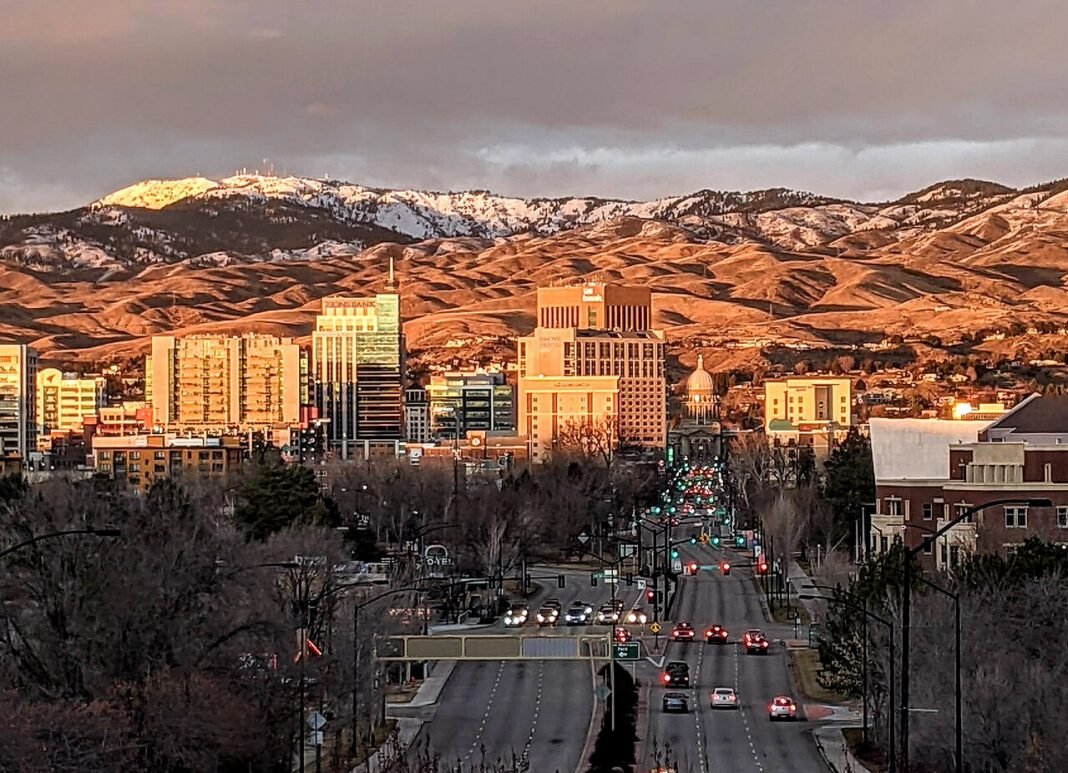
Boise, Idaho’s capital and largest city, has come into its own over the past decade as one of the more livable mid-sized cities in the western United States. The Basque Block in downtown Boise — a compact run of Basque restaurants, bars, a cultural center, and a frontón (handball court) — reflects Idaho’s outsized Basque community, descendants of sheepherders who immigrated in the late 19th century and have held onto their cultural identity more firmly than any other Basque diaspora in North America. The Boise River Greenbelt, a 25-mile paved pathway along the Boise River through the heart of the city, gives downtown an outdoor recreation corridor that few western cities of its size can match.
The Idaho State Capitol, completed in 1920 and built from local sandstone, stands at the head of Capitol Boulevard in a setting that preserves the original civic vision of downtown Boise. The Boise Art Museum and the Discovery Center of Idaho anchor a downtown that has drawn heavy restaurant and retail investment in recent years. To the south, the Owyhee Mountains — a vast, remote high-desert range with little visitor infrastructure and deep solitude — open a backcountry wilderness that few of the city’s residents have fully explored.

Shoshone Falls and the Snake River Canyon
Shoshone Falls, on the Snake River near Twin Falls, drops 212 feet — 45 feet higher than Niagara Falls — over a basalt ledge nearly 1,000 feet wide. During spring runoff the falls run at full volume, producing one of the great waterfall spectacles in the western United States. By midsummer, upstream irrigation diversions cut the flow sharply, so spring (typically March through May) is the prime viewing window. The Snake River Canyon at Twin Falls also holds the site of Evel Knievel’s 1974 attempted motorcycle jump across the gorge — the launch ramp is still visible on the canyon’s south rim.

Idaho’s tourist attractions share a characteristic that distinguishes the state from its more marketed neighbors: they exist at a scale and with an access structure that rewards independent exploration over guided tours. The visitor who drives Idaho’s highways with a willingness to detour — down a dirt road toward a river access, up a canyon toward a trailhead, through a small town with an unexpectedly excellent coffee shop — discovers a western landscape that is as rewarding as anything in the continental United States, and more genuinely wild than most of it.
Frequently Asked Questions
What makes Sun Valley one of the best mountain resort destinations in the United States?
Sun Valley opened in 1936 as America’s first destination ski resort, created by the Union Pacific Railroad, and has maintained its standing as one of the finest mountain experiences in North America ever since. Bald Mountain (Baldy) offers 3,400 vertical feet with runs that begin above treeline and open onto panoramic views of the Pioneer Mountains — unusual among major American ski mountains, its runs descend directly from summit to base without losing terrain to flat sections. The adjacent town of Ketchum provides excellent restaurants, galleries, and lodging in a walkable mountain town. Beyond skiing, Sun Valley hosts the Sun Valley Music Festival (free outdoor classical concerts that have run each summer since 1985, staged at the Sun Valley Pavilion since it opened in 2008), exceptional fly fishing on Silver Creek (considered one of the most technically demanding spring-fed trout streams in the West), and the literary legacy of Ernest Hemingway, who spent his final years in Ketchum and is buried in the town cemetery.
What is Craters of the Moon National Monument and why did NASA send astronauts there?
Craters of the Moon National Monument and Preserve protects a 618-square-mile lava field on the Snake River Plain — lava flows, cinder cones, spatter cones, and lava tubes formed by eruptions beginning approximately 15,000 years ago and continuing as recently as 2,000 years ago. NASA astronauts trained at Craters of the Moon before the Apollo missions because its geological environment was the most similar to what they expected on the lunar surface. The 7-mile loop drive passes the most accessible features: North Crater Flow, Inferno Cone (a 180-foot cinder cone with summit views), and access to lava tube caves (Indian Tunnel, Boy Scout Cave, Beauty Cave) that maintain a constant 40°F year-round and require flashlights and occasionally helmets. In spring, wildflowers bloom across the apparently barren lava plain in extraordinary quantities.
What is Hells Canyon and why is it significant?
Hells Canyon, on the Idaho-Oregon border where the Snake River cuts through the Seven Devils Mountains, is the deepest river gorge in North America — with a maximum depth of 7,993 feet, it is nearly 2,000 feet deeper than the Grand Canyon. The canyon’s remote character is preserved by the absence of a road crossing for 100 miles; access is primarily by jet boat from the Oregon side or by trail from the Idaho rim. Bighorn sheep are commonly seen on the canyon walls; golden and bald eagles nest throughout the system. Lewiston, Idaho, at the foot of the canyon system, is the furthest inland seaport on the Pacific coast — 465 miles from the ocean via the Columbia and Snake River system. Whitewater rafting through the main canyon runs Class IV-V rapids, and multi-day float trips are among the most spectacular river experiences in the continental United States.
What are the Sawtooth Mountains and what do they offer visitors?
The Sawtooth Range in central Idaho contains 57 peaks exceeding 10,000 feet and nearly 400 alpine lakes in the Sawtooth Wilderness — some of the most striking mountain scenery in the Rocky Mountains. The small town of Stanley (population approximately 100 year-round) sits at 6,290 feet in the Stanley Basin with the Sawtooth peaks rising on three sides, creating a panorama regularly cited as one of the most spectacular vistas in the American West. The Salmon River begins near Stanley and flows for 425 miles before joining the Snake, providing the main artery for multi-day float trips through the Frank Church–River of No Return Wilderness. The Sawtooth National Recreation Area trail system sees dramatically less visitor traffic than comparable terrain in Colorado or Utah.
What makes Shoshone Falls and Coeur d’Alene worth visiting in Idaho?
Shoshone Falls on the Snake River near Twin Falls drops 212 feet — 45 feet higher than Niagara Falls — over a basalt ledge nearly 1,000 feet wide. Spring runoff (typically March through May) brings peak volume; in summer, upstream irrigation diversion sharply reduces the falls. The Snake River Canyon at Twin Falls also contains the site of Evel Knievel’s 1974 attempted motorcycle jump — the launch ramp remains visible on the canyon’s south rim. Coeur d’Alene in northern Idaho offers a different experience: a glacially carved lake (25 miles long, 109 miles of shoreline) with a walkable lakefront downtown. The Coeur d’Alene Resort operates a famous floating golf green accessible only by boat. The Trail of the Coeur d’Alenes, a 73-mile paved rail-trail through the historic Silver Valley mining country, is one of the finest cycling rail-trails in the Pacific Northwest.