Tasmania is Australia’s island state — separated from the mainland by the roughly 250-kilometre-wide Bass Strait — and one of the most rewarding travel destinations in the Southern Hemisphere. With 42% of its land protected in national parks, World Heritage wilderness reserves, and conservation areas, Tasmania has a higher proportion of protected land per capita than virtually any other place on earth. Add to this one of the world’s most confronting and captivating private art museums, a food and wine culture that consistently ranks among the country’s best, and a population that is warm, unpretentious, and quietly proud of their remarkable island, and the result is one of the most compelling places to travel on the continent. A week here barely scratches the surface.
Getting to Tasmania
Flights connect Hobart (the capital, in the south) and Launceston (the northern city) to all Australian mainland capitals. Qantas, Virgin Australia, and Jetstar all serve the routes; advance booking gets Sydney–Hobart from AUD $79. The alternative — and for many visitors the preferred option — is the Spirit of Tasmania ferry from Geelong (Spirit of Tasmania Quay) to Devonport on Tasmania’s north coast. The crossing takes approximately 10.5 hours (overnight, with day sailings also available in peak season); cabins range from aircraft-style reclining seats to private en-suite cabins. The ferry allows you to bring your own car, which is the best way to explore Tasmania’s dispersed landscapes. Book several months ahead for December–January sailings.
MONA: Museum of Old and New Art
MONA is the private museum built by gambler-mathematician David Walsh 11 kilometres north of Hobart — possibly the most extraordinary private art institution in the world. Built into the sandstone cliffs above the Derwent River, the subterranean complex houses Walsh’s vast collection, built to “create a museum that will unsettle people.” He largely succeeds: the collection includes ancient Egyptian artefacts alongside contemporary works that provoke, disturb, and occasionally delight. Cloaca Professional (a machine that digests food and produces faeces, displayed behind glass), The Library of Babel (a full-scale recreation of Borges’ fictional library), and the rotating contemporary exhibitions all serve Walsh’s anti-museum philosophy. The museum app (used instead of labels) provides multiple perspectives on each work, including Walsh’s own frequently irreverent commentary.
MONA is accessed from Hobart’s Brooke Street Pier via the MONA Roma ferry — a sleek catamaran that runs hourly and is itself a work of design. The ferry journey through Sullivan’s Cove and up the Derwent is a genuine pleasure. Allow a full day; the restaurant, bar, and cellar door on-site justify staying past closing time of the galleries. Admission: AUD $39 for adults; Tasmanian residents free. Closed Tuesdays and Wednesdays.
The Wilderness: Cradle Mountain and the Overland Track
Cradle Mountain is Tasmania‘s most iconic landscape — a jagged dolerite peak rising above the Dove Lake plain, reflected in the still water at dawn in an image that has appeared on countless travel brochures. The mountain sits at the northern end of Cradle Mountain–Lake St Clair National Park, which contains the Overland Track (65km, 6 days minimum, bookings required October–May) — widely regarded as one of Australia’s great multi-day wilderness walks, traversing the heart of the Tasmanian highlands from Cradle Mountain south to Lake St Clair, the deepest lake in Australia. Day walks from the Cradle Mountain Visitor Centre include the Dove Lake Circuit (6km, 2–3 hours, excellent for all fitness levels) and the more challenging Cradle Mountain Summit (5–7 hours, requiring good weather and experience).

Freycinet Peninsula and Wineglass Bay
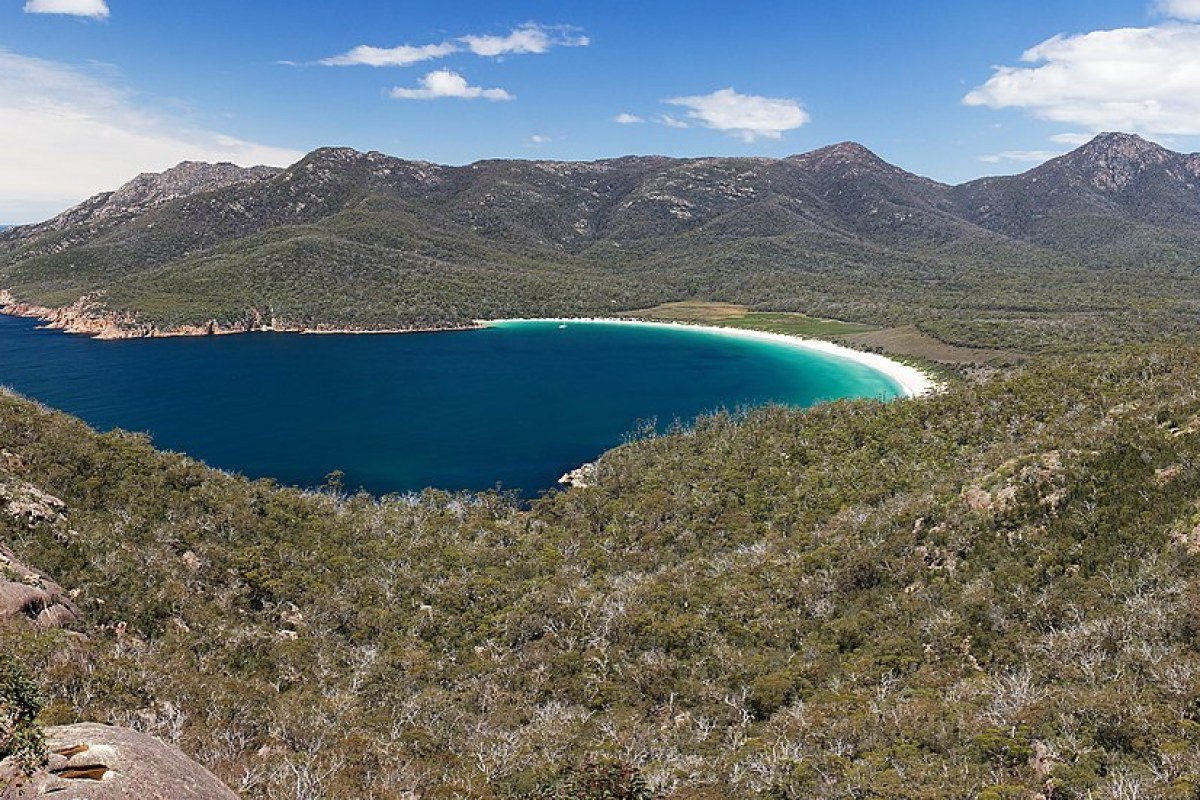
On Tasmania’s east coast, Freycinet National Park protects a rugged granite peninsula with its centrepiece attraction: Wineglass Bay, a perfect horseshoe arc of white sand and remarkably clear turquoise water consistently rated among the world’s most beautiful beaches. The Wineglass Bay Lookout hike (about 1.5 hours return from the car park) provides the famous aerial view from the col between the Hazards mountains — one of the most photographed views in Australia. The descent to the beach (an additional 40 minutes each way) is well worth the effort; you’re rarely alone but the beach is long enough to find space. The Freycinet Peninsula Circuit (3 days, camping required) traverses the full length of the peninsula past the dazzling white quartzite arcs of Hazards Beach and Cooks Beach — among the finest multi-day coastal walks in the country.
Hobart: Australia’s Most Liveable Small City
Hobart is Australia’s second-oldest capital city — founded in 1804, it retains a remarkable concentration of Georgian and Victorian sandstone architecture in the Sullivan’s Cove precinct around the waterfront. Salamanca Place — a row of Georgian sandstone warehouses now containing galleries, restaurants, and the Saturday morning Salamanca Market (one of Australia’s best outdoor markets, with exceptional local food producers, artisan crafts, and a warm community atmosphere) — is the social heart of the city. Battery Point above the waterfront is a preserved colonial neighbourhood of cottages, pubs, and artisan workshops that conveys a vivid sense of early colonial Australia. Mount Wellington (officially kunanyi / Mount Wellington) rises directly behind the city to 1,271 metres — the summit drive (or thrilling mountain bike descent) opens up sweeping panoramic views across Hobart, the Derwent, and the surrounding wilderness.
.jpg?width=1200)
Tasmanian Food and Wine
Tasmania’s food culture is arguably the most exciting in the country — a product of outstanding local produce and a passionate community of producers, chefs, and winemakers. The cold, clean waters of Bass Strait produce exceptional Pacific oysters (Bruny Island and Freycinet are the most celebrated growing areas), Atlantic salmon (farmed in the Huon Valley), abalone, and sea urchin. The Huon Valley produces superb apples and stone fruit; the island’s cool climate is ideal for truffles (harvested July–September, when Tasmanian black truffles are exported globally). The Tamar Valley north of Launceston is Tasmania’s primary wine country — refined Pinot Noir and Chardonnay from producers including Pipers Brook, Josef Chromy, and Tamar Ridge. The Coal River Valley (between Hobart and Richmond) has a growing cluster of outstanding cellar doors including Pooley Wines and Frogmore Creek. For dining in Hobart, Franklin (wood-fire cooking, seasonal menu), Fico (Italian-inflected fine dining), and Aloft (harbourside, excellent local produce) rank among the country’s finest tables.
Frequently Asked Questions
What is MONA and why does it polarise visitors so sharply?
The Museum of Old and New Art opened in January 2011 on the Berriedale peninsula north of Hobart, financed by professional gambler David Walsh as a vehicle for a collection he had been assembling since the 1990s. The architecture, by Melbourne firm Fender Katsalidis, descends three levels into Triassic sandstone, so visitors enter at the top and spiral downward through galleries that deliberately avoid the white-cube conventions of mainstream institutions. Walsh has described the building as a “subversive adult Disneyland,” and the curatorial logic favours juxtaposition over chronology: a Sidney Nolan canvas might share a wall with a Roman coin or a Wim Delvoye tattooed pigskin. Programming extends well beyond the galleries through the twin festivals Dark Mofo in June and Mona Foma in summer. Worth planning around: ticketing now runs on timed entry windows during peak season, and turning up without a pre-booked slot between December and February frequently means waiting hours or being turned away.
What should walkers know before tackling the Overland Track?
Cutting roughly 65 kilometres through the spine of Cradle Mountain-Lake St Clair National Park, the Overland Track is rationed by the Parks and Wildlife Service to limit erosion on its boardwalks and button-grass plains. Between 1 October and 31 May the route runs north to south only, and walkers must book a permit before setting off from Ronny Creek. Most parties spread the trek across six days, sleeping in unheated timber huts spaced a half-day apart, although tent platforms are available when bunks fill. The terrain shifts from glaciated alpine country around Cradle Cirque into myrtle-beech forest near Pelion Plains, then drops through eucalypt woodland to the Narcissus Hut jetty at Lake St Clair. Walkers who finish there usually catch the ferry across rather than add the 17.5-kilometre lakeside slog. One sobering reality: weather on the plateau can produce snow in any month of the year, and parties without four-season sleeping gear and waterproof shells regularly request emergency evacuations even in January.
How does Wineglass Bay fit into a Freycinet itinerary?
The bay sits on the eastern flank of the Freycinet Peninsula, framed by the pink-granite ridge known locally as The Hazards. Its name has nothing to do with the curve of the shoreline: nineteenth-century whalers tipped the cove red with blood when processing southern right whales, which from a distance resembled wine in a glass. That history sits awkwardly with the postcard imagery, and several local guides now include the whaling context on their interpretive walks. Most day visitors only manage the steep climb to the saddle lookout, taking the standard photograph and turning back at the bench. Those who continue down to the sand find a beach that is less crowded by mid-afternoon and noticeably warmer for swimming on the northern end. Beyond the bay itself, the Friendly Beaches stretch north for 25 kilometres of empty Tasman Sea coastline that almost nobody visits. A logistical note: the Wineglass Bay car park reaches capacity by 9am during school holidays, and overflow parking sits a steep kilometre back down the road.
Where can visitors encounter Tasmanian devils, and why does it matter?
The Tasmanian devil, the world’s largest surviving carnivorous marsupial, has been pushed to endangered status by Devil Facial Tumour Disease, a transmissible cancer first documented in the mid-1990s that spreads when devils bite each other during feeding and mating. The disease has erased more than 80 percent of the wild population in parts of the state’s north-east. Visitors looking for healthy individuals should head to Maria Island, a national park off the east coast that was seeded with disease-free devils from 2012 onward as an insurance population, and where they now roam free across former farmland and convict ruins. The Bonorong Wildlife Sanctuary outside Hobart and Devils@Cradle near the Cradle Mountain Visitor Centre run captive breeding programmes with twilight feeding tours. There is a darker footnote for Maria Island walkers: the introduced devils have eaten through the island’s once-famous breeding colonies of little penguins and short-tailed shearwaters, an unintended consequence conservation managers are still wrestling with.
How has Tasmania built its reputation as Australia’s premier food island?
The transformation traces to the 1990s, when a wave of mainland refugees and returning Tasmanians began acquiring smallholdings around the Huon Valley and the Coal River and treating produce as a craft rather than a commodity. Cool waters and a 42nd-parallel latitude that mirrors Burgundy and Oregon gave the island natural advantages, and the closure of mainland abalone fisheries in the 2000s pushed restaurants further toward Tasmanian sources. A handful of brands now anchor the export story: King Island dairy products, Bruny Island Cheese Co founded by Nick Haddow in 2003, Cape Grim grass-fed beef from the north-west tip, and leatherwood honey gathered from rainforest stands inaccessible to mainland apiarists. The wine map keeps expanding too, with sparkling specialists Jansz and Arras producing methode traditionnelle bottles that frequently outperform their Champagne pricing in blind tastings. One thing travellers should plan around: most boutique producers operate cellar doors by appointment only outside peak season, and several of the Huon Valley orchards close entirely between June and August.