Edinburgh is simultaneously one of the most beautiful cities in Europe and one of the most atmospheric — a place where medieval Old Town and Georgian New Town face each other across a valley of gardens, where an ancient castle looks down from a volcanic crag over streets that have barely changed in centuries, and where the city transforms every August into the world’s largest arts festival. It’s compact enough to explore on foot, rich enough in history and culture to fill a week without exhausting the possibilities, and blessed with a warmth of welcome — the particular warmth of Scots who know their city is exceptional but would never be so crass as to say so directly — that makes it among the most enjoyable cities in Britain to spend time in.
Edinburgh Castle: The City’s Ancient Heart
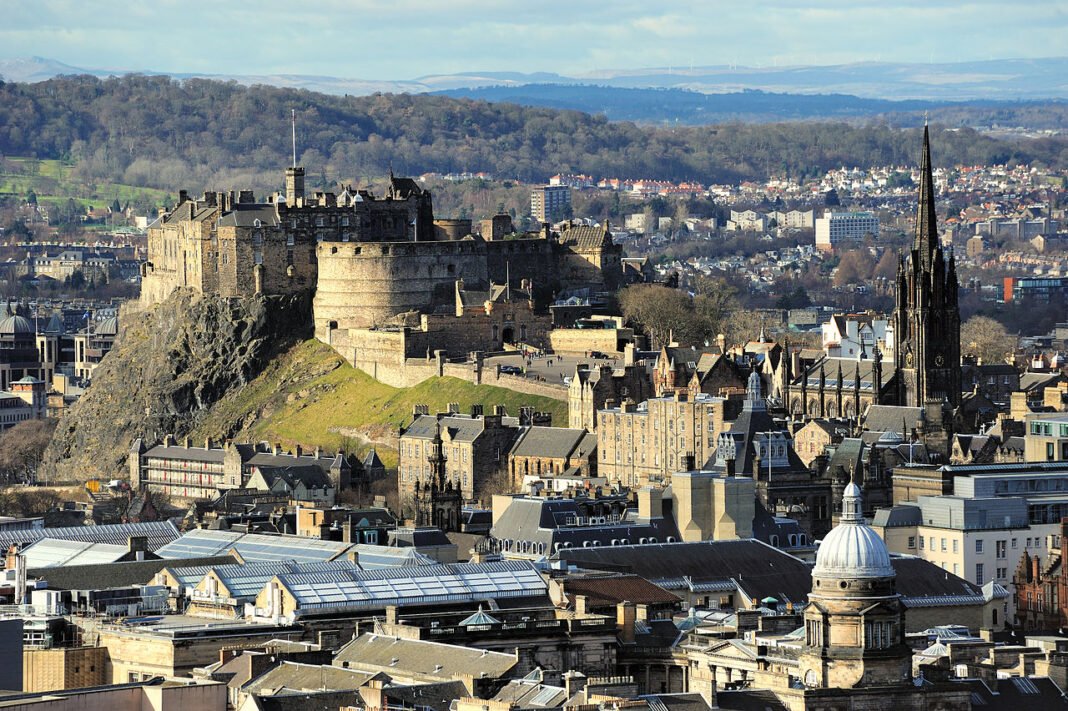
Edinburgh Castle sits on Castle Rock — the plug of an ancient volcano that formed around 340 million years ago and now provides the most dramatic urban viewpoint in Scotland. The castle has served as royal residence, military fortress, prison, and national monument over its 3,000-year history. Inside, the Scottish Crown Jewels (the Honours of Scotland — older than the English Crown Jewels, and with a more dramatic history involving burial under church floors to prevent seizure by Cromwell’s forces) and the Stone of Destiny (on which Scottish monarchs were crowned for centuries, seized by Edward I in 1296, and returned to Scotland in 1996) were long kept here together, though since March 2024 the Stone has moved to Perth Museum, leaving the Honours in the Crown Room. The National War Museum of Scotland is outstanding — among Britain’s strongest regimental collections, and free with castle admission. The One O’Clock Gun fires from the castle walls every day except Sunday, at precisely 1pm — a maritime tradition that has continued since 1861, originally allowing ships in the Firth of Forth to set their chronometers. The discharge is startling at close range, no matter how many times one has heard it.
The Royal Mile and Old Town
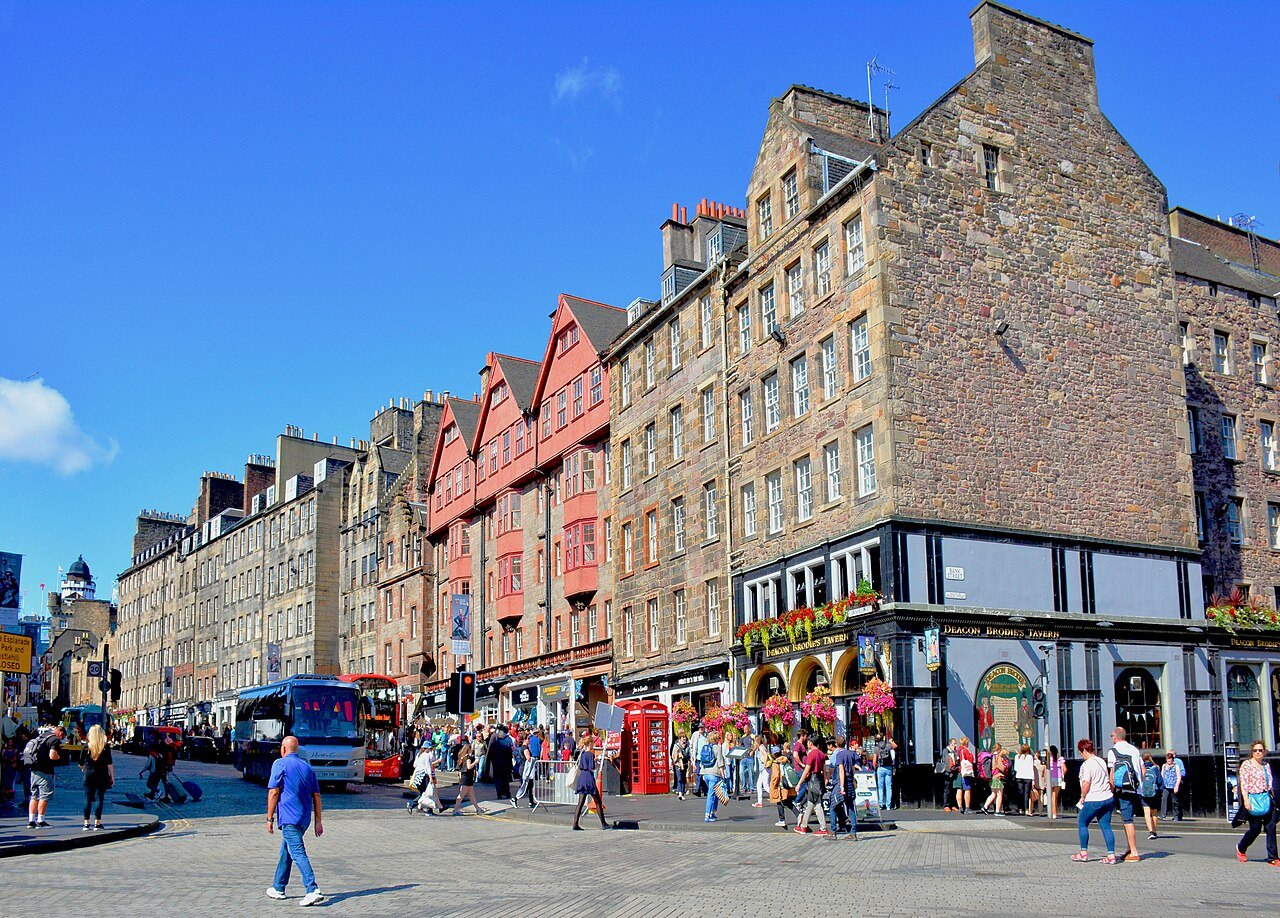
The Royal Mile runs from Edinburgh Castle down the spine of the volcanic ridge to the Palace of Holyroodhouse — the official Scottish residence of the King — at the bottom, roughly one Scottish mile (1.8km) of medieval and 16th-century buildings, closes (narrow alleyways leading to hidden courtyards), and the concentrated history of a city that was, for centuries, one of the most important in Europe. The closes are worth exploring in detail: Advocates’ Close has one of the best views of the castle from street level. Dunbar’s Close has a beautiful 17th-century formal garden hidden behind an entirely inconspicuous door in the Royal Mile. Mary King’s Close, now a visitor attraction running beneath the current street level, preserves the buried remains of a 17th-century Edinburgh street. The Museum of Edinburgh in Canongate and the Scottish Parliament building at the bottom of the Mile (Enric Miralles’s controversial but extraordinary design, opened 2004) are both worth the time.
The Georgian New Town
Edinburgh’s New Town was designed in 1766 by the 26-year-old architect James Craig as a planned residential development to relieve the overcrowding of the medieval Old Town. The result — elegant Georgian terraces and squares centred on Charlotte Square, George Street, and the shops of Princes Street — is one of the finest examples of 18th-century urban planning in the world, designated a UNESCO World Heritage Site alongside the Old Town. The Scottish National Portrait Gallery on Queen Street (free admission) holds an outstanding collection of Scottish portraiture and history. The Scottish National Gallery on The Mound (also free) holds the national collection of fine art, including exceptional works by Velázquez, El Greco, Titian, Rembrandt, and a deep Scottish collection. The Georgian House on Charlotte Square, run by the National Trust for Scotland, shows a fully restored New Town interior exactly as it would have appeared in 1796.
Arthur’s Seat and Calton Hill
Few cities fold this much wild landscape inside their own boundaries. Arthur’s Seat — the main peak of Holyrood Park, an ancient volcano rising 251 metres directly behind the Palace of Holyroodhouse — can be climbed from the city centre in about 45 minutes and rewards with panoramic views across the city, the Firth of Forth, and the hills of Fife. The walk is steep but entirely accessible, and the summit views rank with any urban panorama in Europe. Calton Hill, closer to the New Town, is a 15-minute walk from Princes Street and offers a different perspective — the view from here, with the National Monument (a Parthenon imitation begun in 1826 and never completed, known as “Edinburgh’s Disgrace”) and Nelson’s Monument in the foreground and the city spread below, is the classic Edinburgh vista. Both are free, both are spectacular, and both are significantly underused by visitors who spend all their time on the Royal Mile.
Food, Drink, and Whisky
The food scene here has developed into something remarkable over the past decade. The Grassmarket area and the cluster of restaurants around Victoria Street have excellent independent options at every price point. Leith — the port area 15 minutes by bus from the centre — has some of Scotland’s best dining: Restaurant Martin Wishart (one Michelin star, widely considered the best fine dining in Scotland), The Kitchin (also one star, with a brilliant “from nature to plate” philosophy using Scottish produce), and Roti (superb Indian cooking in an improbable location). For something more casual, Dishoom on St Andrew Square brings its acclaimed Irani café–inspired cooking from London; The Gardener’s Cottage serves beautiful seasonal Scottish food in a particularly charming setting; and Timberyard in the Grassmarket offers some of the most creative cooking in the city. The Bow Bar on Victoria Street has one of the deepest selections of Scotch single malt whisky in Edinburgh — the Scotch Whisky Experience on the Royal Mile is excellent for those new to the spirit, while the Whisky Shop on Victoria Street stocks over 750 expressions for those already converted.

The Edinburgh Festival: August in Another World
The Edinburgh Festival in August is not one festival but a constellation of overlapping events that together constitute the greatest arts celebration on earth. The International Festival (opera, classical music, theatre, and dance of the highest calibre) runs alongside the Edinburgh Fringe (the world’s largest arts festival, with over 3,500 shows from stand-up comedy to experimental theatre performed in every available space in the city), the Edinburgh International Book Festival (the world’s largest public celebration of books and ideas, held in Charlotte Square Gardens), the Edinburgh International Film Festival, and the Royal Edinburgh Military Tattoo (a spectacular performance of massed pipes and drums on the Castle Esplanade). The city’s population roughly doubles during August. Accommodation sells out a year in advance for the peak Festival weeks. If you visit in August, book everything 12 months ahead — no exaggeration — and expect higher prices, extraordinary crowds, and an atmosphere unlike anything else in Europe. If this seems excessive, Edinburgh in any other month is quieter, more affordable, and gives you the city more or less to yourself.
Getting There and Getting Around
Edinburgh Airport has direct connections from London (1 hour, multiple airlines, multiple daily frequencies), European cities, and transatlantic destinations including New York, Toronto, and Dubai. The Airlink 100 express bus (£6 single) connects the airport to Waverley Bridge in the city centre in about 30 minutes. Direct trains to Edinburgh from London King’s Cross take about 4 hours 20 minutes on the fastest East Coast Main Line services (advance tickets from £30 one-way); from Manchester, about 2 hours 40 minutes. The city centre is entirely walkable — the Old Town and New Town are both compact and best explored on foot. Edinburgh’s tram line connects the airport, city centre, and Leith. Local buses (Lothian Buses) are excellent and cover the wider city. The best time to visit, if you’re not coming for the August festival, is May–June (long evenings, spring flowers) or September–October (autumn light, fewer crowds).
Frequently Asked Questions
What is Edinburgh Castle and why is it worth visiting?
The fortress crowns Castle Rock, a 340-million-year-old volcanic plug that gives Edinburgh its unmistakable skyline. Three thousand years of occupation are layered into the site — royal household, garrison, state prison, and now Scotland’s most visited paid attraction. Crowds gather here for several reasons. The Honours of Scotland, older than England’s Crown Jewels, survived the 17th century because loyalists hid them beneath a rural church floor while Cromwell’s army hunted them down. Beside them sits the Stone of Destiny, used in Scottish coronations for centuries, carried south by Edward I in 1296, and finally repatriated in 1996 after seven hundred years in Westminster Abbey. The National War Museum of Scotland — included with the ticket — is widely rated among Britain’s best regimental collections, and most visitors underestimate how much time it warrants. At 1pm sharp, every day but Sunday, the One O’Clock Gun discharges from the Mills Mount Battery, a signal in continuous use since 1861, when it allowed ships anchored in the Firth of Forth to calibrate their chronometers. First-time visitors are advised to time the visit carefully or buy tickets online in advance, since same-day entry frequently sells out in summer.
What is the Royal Mile and what should you see along it?
Stretching 1.8km along the spine of the volcanic ridge, the Royal Mile threads four interconnected streets — Castlehill, Lawnmarket, High Street, and Canongate — between the fortress and Holyroodhouse. The thoroughfare looks linear on a map. In practice the real interest lies sideways, in the closes that branch off it. These narrow alleys, often barely shoulder-wide, are remnants of a city that once squeezed 80,000 people into a single ridge. Riddle’s Court has a restored 16th-century townhouse and a quiet courtyard most visitors walk past. Tweeddale Court drops to a hidden lawyer’s yard with a sedan-chair house. The Real Mary King’s Close runs subterranean tours through a 17th-century street sealed beneath the Royal Exchange in 1753. Holyroodhouse, at the foot, opens to the public outside royal occupancy and includes the ruined 12th-century abbey behind it. Visitors should be aware of one practical reality: the Mile concentrates a high density of tartan-and-shortbread tourist traps, and the better closes, museums, and pubs all require turning off it deliberately.
What does Edinburgh’s New Town offer?
The New Town is the Old Town’s deliberate opposite. Where the medieval ridge piled families ten storeys high in dim wynds, James Craig’s 1766 grid imposed Enlightenment order: open squares, wide pavements, classical proportions, light. He was 26 when his plan won the city competition. Two centuries later UNESCO listed Old and New Towns together as a single World Heritage Site precisely because the contrast between them defines the city. Visitors who skip the New Town miss roughly half of Edinburgh. Charlotte Square is the architectural high point, anchored by Robert Adam’s north terrace from 1791. George Street runs east-west between St Andrew Square and Charlotte Square and now houses upscale retail in former bank halls. Three free national galleries cluster here — the Scottish National Gallery on The Mound, the Portrait Gallery on Queen Street, and the Royal Scottish Academy. Travellers prone to museum fatigue should plan two short visits rather than one long one. The Georgian House on Charlotte Square is a 30-minute walk-through of a fully furnished 1796 townhouse and works well as a compact alternative.
What viewpoints and outdoor experiences does Edinburgh offer?
Few European capitals deliver real hill-walking inside the ring road. Edinburgh does. Arthur’s Seat rises 251 metres from Holyrood Park, the remnant cone of a Carboniferous volcano now embedded in residential streets. Routes up vary in difficulty. The Dunsapie Loch approach is the gentlest and reaches the trig point in under 40 minutes. The Salisbury Crags traverse is more exposed and offers the more cinematic skyline shot. Both routes are unpaved and turn slick in rain — proper footwear matters, and the wind at the top is consistently colder and stronger than at street level. Calton Hill is the easier alternative for travellers short on time or stamina, a five-minute climb from Waterloo Place. Its summit holds the unfinished National Monument, a Parthenon copy abandoned in 1829 when funds ran out, locally nicknamed Edinburgh’s Disgrace. Nelson’s Monument beside it can be climbed for an extra fee. Both hills are free. Sunrise and the hour before dusk reward the climb most, when the low Scottish light rakes across the Old Town silhouette below.
What is the Edinburgh Festival and how do you experience it?
August in Edinburgh is its own weather system. Five separate festivals run in parallel, programmed independently but treated as one cultural event by everyone in the city. The Edinburgh International Festival, founded 1947, books opera, ballet, and major theatre at curated venues. The Fringe is its uninvited offspring and now dwarfs the parent — 3,500-plus shows across pubs, basements, attics, churches, and converted toilets, ticketed and free, polished and chaotic. The Book Festival pitches in Charlotte Square Gardens. The Film Festival screens across the city. The Royal Edinburgh Military Tattoo lights up the Castle Esplanade nightly with massed pipes, drums, and international military bands. Practically: the population roughly doubles, walking pace halves, restaurant tables vanish, and accommodation prices in the centre run two to four times normal rates. Booking less than nine months ahead for any decent option is a gamble. The other consideration is December: Hogmanay turns the city into a three-day street party with a torchlit procession, a Princes Street ticketed concert, and a 6am Loony Dook in the Firth of Forth at South Queensferry on New Year’s Day.