New Brunswick — “Canada’s Picture Province” — is the only officially bilingual province in Canada, a place of deep cultural complexity and natural variety where French-speaking Acadians (about one-third of the population) and English-speaking New Brunswickers share government services, cultural institutions, and a single landscape that holds the world’s highest tides on the Bay of Fundy, the Loyalist port heritage of Saint John, the Victorian capital streetscape of Fredericton, and the Fundy Trail Parkway — one of Canada’s finest coastal wilderness drives, set on the Fundy cliffs east of St. Martins. The province’s small cities (Greater Moncton at around 196,000 the largest metropolitan area, Fredericton the capital, Saint John the historic port) carry an arts, music, and community life out of all proportion to their size, reflecting the provincial pride of a population near 870,000 that has built its own culture rather than importing it from Toronto.
Moncton: The Bilingual Hub
Moncton, New Brunswick‘s largest city (population around 102,000, metropolitan area around 196,000) at the geographic centre of the Maritimes, drives more commerce and culture than anywhere else in the province — the historic CN rail junction, the Route 2 Trans-Canada Highway corridor, and the Petitcodiac River tidal bore (a wave that runs from roughly 0.5 m to over 1 m on spring tides, visible from Bore Park on the riverbank) shape its geography. Magnetic Hill (an optical-illusion road where cars seem to roll uphill), the Magnetic Hill Zoo, and the Resurgo Place transportation museum draw most visitors; the Main Street revitalization and the Avenir Centre concert program anchor downtown life. The Acadian seaside town of Shediac (the self-styled “Lobster Capital of the World”) and Parlee Beach Provincial Park (among the warmest ocean swimming in Atlantic Canada, into the low 20s°C in summer) lie about 30 minutes southeast.
Fredericton: The Capital City
Fredericton (population around 79,000) on the Saint John River completes the province’s trio of cities — a Victorian-era town of elm-lined streets, the Beaverbrook Art Gallery (among the strongest regional collections in the country, built around Salvador Dalí’s monumental “Santiago el Grande” and bequests from Lord Beaverbrook), the Legislative Assembly Building (a Second Empire landmark opened in 1882, the most elaborately decorated provincial legislature in Atlantic Canada), the University of New Brunswick (founded 1785, the oldest English-language university in Canada), and the Officers’ Square summer programming. The Historic Garrison District’s heritage commercial strip, the Boyce Farmers’ Market, and the riverfront cycling trail along the water round out a stay here.

Saint John and the Fundy Trail
Saint John (population around 81,000) — New Brunswick’s historic port and the first incorporated city in Canada (Royal Charter, 1785) — pairs a working harbour heritage (the Reversing Falls, where the Saint John River turns back twice daily under the pressure of the Fundy tide), the Loyalist Uptown district (the King Street heritage corridor), and the Saint John City Market (Canada’s oldest continuously operating farmers’ market, in an 1876 timber-vaulted hall) with the gateway to the Fundy Trail Parkway. The Parkway — about 30 km of low-speed coastal road paralleled by more than 35 km of hiking and mountain-biking trail on the Bay of Fundy cliffs east of St. Martins — opens up the best accessible coastal wilderness in southern New Brunswick: the Big Salmon River suspension bridge, the Melvin Beach viewpoint, and the Long Beach backcountry shore repay even moderate preparation. The eastern extension opened in 2020, linking through to the Sussex area and on to Fundy National Park.
The Acadian Peninsula: Francophone New Brunswick
The Acadian Peninsula in northeastern New Brunswick — the Caraquet, Shippagan, and Miscou Island communities reaching from Chaleur Bay toward the Gulf of St. Lawrence — keeps the most intact Acadian French culture in Canada outside Quebec: the Village Historique Acadien at Bertrand near Caraquet (a living-history site of more than 40 restored buildings depicting Acadian life from 1770 to 1949), the Festival Acadien de Caraquet (among the world’s largest Acadian festivals, held in early August around National Acadian Day on the 15th), and the working-harbour feel of the coastal towns (lobster, snow crab, and herring from the small-boat fleets that dock at Caraquet and Shippagan) together build something with no equivalent in anglophone Atlantic Canada.
Planning Your New Brunswick Visit
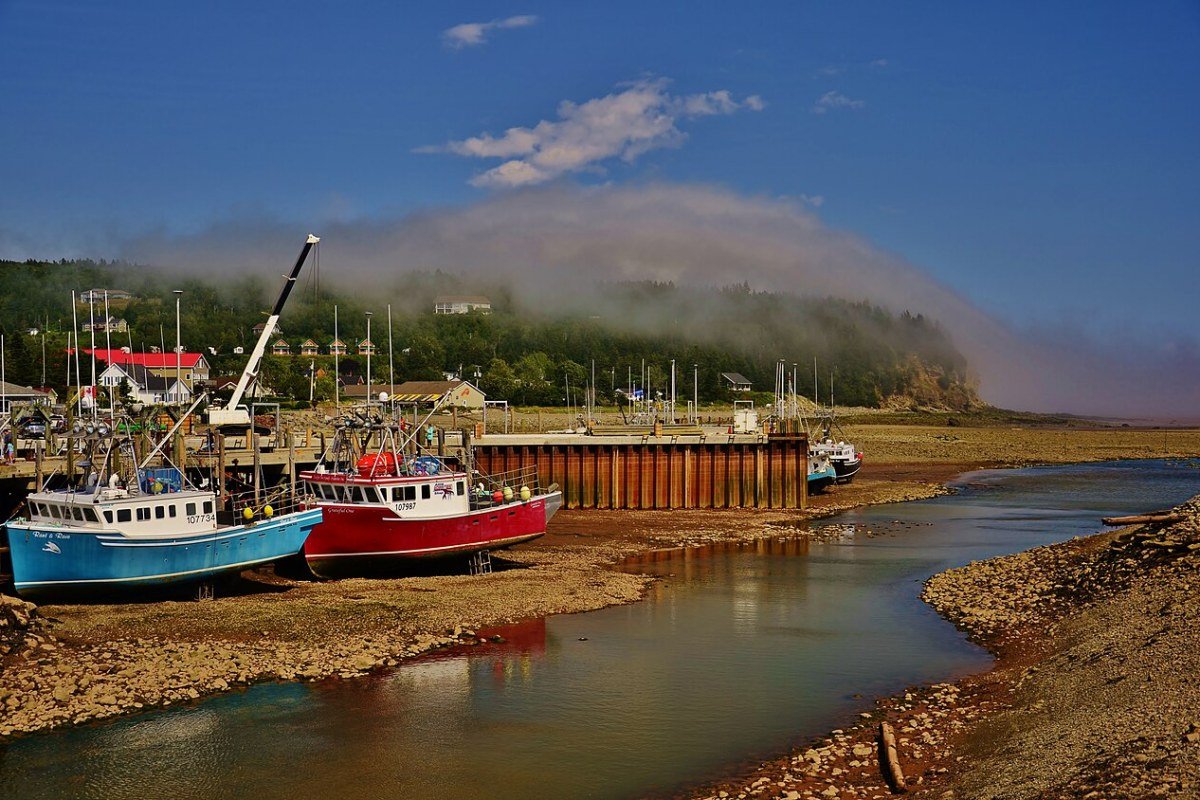
New Brunswick’s circular highway system (Route 2 Trans-Canada plus the Fundy and Acadian Coastal Drive routes forming a loop) suits a 7–10 day circumnavigation — Moncton as the entry point from Nova Scotia or PEI, southeast through Fundy National Park and the Fundy Trail Parkway to Saint John, north through the Saint John River Valley (Route 2, with its potato fields and covered bridges, including the Hartland Covered Bridge, the longest of its kind in the world at 391 m) to Fredericton, northeast through the Miramichi and the Acadian Peninsula, and back to Moncton via Kouchibouguac National Park. The Bay of Fundy’s extreme tides are the province’s signature draw — timing any Fundy shore visit to coincide with the twice-daily low tide reveals a landscape that lies underwater six hours later, with no equal anywhere else on Earth.
Getting the Most Out of Your Visit
A few practical points will improve any trip to New Brunswick. Book accommodation and major attractions — particularly Fundy National Park and Hopewell Rocks reservations, popular hiking trails, and well-known restaurants — as far in advance as possible; the best options can fill weeks or months ahead, especially in July and August. A car gives you the freedom to explore beyond the main centres, and many of New Brunswick’s richest experiences sit in places public transport does not reach. The sharpest local knowledge tends to come from regional visitor centres, independent bookshops, and conversations with residents — the discoveries you remember are rarely the ones in the guidebooks. Allow more time than you think you need: New Brunswick rewards travellers who slow down and go deep rather than racing to cover the maximum ground.
Frequently Asked Questions
What defines New Brunswick as a Canadian province?
New Brunswick — one of the three Maritime provinces, with a population near 870,000 in 2025, and the only officially bilingual province in Canada (about one-third Francophone Acadian, about two-thirds English-speaking by first official language) — sits on the southwestern edge of the Gulf of St. Lawrence and the Bay of Fundy, giving it a coast-and-forest landscape that is the least-visited of Atlantic Canada’s provinces despite its broad cultural range. The Acadian identity — descendants of the French settlers who arrived in the 1600s and survived the 1755 Deportation (the forced expulsion of the Acadian population by British forces, one of the most traumatic events in Canadian history, commemorated at the Grand-Pré National Historic Site in Nova Scotia) — gives the north and east coasts (the Acadian Peninsula, Caraquet, and Shippagan) a character closer to Quebec than to the predominantly English Maritime communities. The provincial economy rests on forestry and wood products, fishing, food processing, and a growing information-technology sector centred in Fredericton (the capital, about 79,000) and Greater Moncton (the largest metropolitan area, around 196,000).
Why is the Bay of Fundy such a natural wonder?
The Bay of Fundy — the inlet separating New Brunswick from Nova Scotia — has the highest tidal range of any body of water on Earth: tides at the Minas Basin (the bay’s upper end, near Wolfville, Nova Scotia) reach around 16 m, the equivalent of a four-storey building rising and falling twice daily. The tidal bore — the leading edge of the incoming tide — travels up the Petitcodiac River into Moncton as a visible wave, one of the strangest urban natural sights in Canada (best viewed from Bore Park on the Moncton riverfront, where the wave can run from 0.5 m to over 1 m on spring tides). The Fundy Trail Parkway (New Brunswick side, east of St. Martins, around 30 km of coastal road with more than 35 km of hiking and biking trail along the Bay of Fundy cliffs) delivers the most dramatic coastal driving in the province and superb cliff-top views of the tidal phenomenon. The Hopewell Rocks (Hopewell Cape, near Moncton) — massive formations with arched bases carved by tidal erosion into mushroom-shaped “flowerpots” — let you walk on the ocean floor at low tide, then kayak among them at high tide. The bay also ranks among the world’s leading whale-watching grounds: humpback, fin, and the critically endangered North Atlantic right whale feed in its krill- and herring-rich waters in July and August.
Why is Moncton New Brunswick’s leading city?
Greater Moncton — about 196,000 people, in the geographic heart of New Brunswick at the head of the Northumberland Strait — has grown into the province’s busiest urban region, driven by a bilingual workforce (one of the most consistently bilingual labour markets in Canada, with French and English at near parity), its role as Atlantic Canada’s transportation hub (the Route 2 Trans-Canada Highway corridor and the Via Rail Ocean route), and a contact-centre and financial-services sector that draws on that bilingual base. Downtown’s revival (Main Street, Resurgo Place, and the Avenir Centre arena and conference complex) has reshaped the core after decades of decline that followed the closure of CN Rail’s locomotive shops. Dieppe (adjacent, predominantly French-speaking, one of the fastest-growing municipalities in Atlantic Canada) gives the area a lively Acadian commercial streetscape along Champlain Street. Magnetic Hill (an optical illusion where cars seem to roll uphill — one of the most visited attractions in Atlantic Canada) and the Petitcodiac tidal bore are the city’s signature sights. The Magnetic Hill Concert Site has hosted some of the largest outdoor concerts in eastern Canada, drawing crowds of 80,000-plus for festival headliners.
Why visit the Acadian Peninsula in northeastern New Brunswick?
The Acadian Peninsula — the northeastern corner of New Brunswick, jutting toward the Gulf of St. Lawrence between Bathurst and Shippagan — is the heartland of the province’s Acadian Francophone population and the most culturally distinct region of the Maritimes. Caraquet (the cultural capital of Acadian New Brunswick, on Chaleur Bay) hosts the Festival Acadien de Caraquet (early August, among the world’s largest Acadian festivals, with the Tintamarre procession on 15 August — National Acadian Day — when thousands of Acadians march making noise with any implement at hand, marking survival after the Deportation) and neighbours the Village Historique Acadien (in Bertrand, just west of Caraquet, a living-history museum recreating the settlement period from 1770 to 1949 with costumed interpreters across more than 40 historic buildings). Kouchibouguac National Park (on the Northumberland Strait coast, between Moncton and the peninsula) protects one of the Atlantic coast’s significant lagoon and barrier-island systems, with one of the longest warm-water beaches in Canada at this latitude (Kellys Beach, with water into the low 20s°C in August) and an accessible Atlantic grey seal colony on the Canadian mainland.
What awaits travellers in the Saint John River Valley?
The Saint John River — the dominant feature of western and central New Brunswick, flowing roughly 673 km from the Maine border south through Edmundston, Fredericton, and into the Bay of Fundy at Saint John — carves a valley of rare beauty that ranks among the province’s least-visited yet most historically important landscapes. The Upper Saint John Valley (Edmundston, the most strongly French-speaking town in New Brunswick outside the Acadian Peninsula, and the wider Madawaska region) has kept a Brayon Acadian culture distinct from both Quebec and the coastal Acadian communities. Fredericton (capital, around 79,000, on the river) preserves the finest garrison-town streetscape in Atlantic Canada: the Historic Garrison District (a British military compound established in 1784 and garrisoned until 1869), Officers’ Square, the Beaverbrook Art Gallery (a leading Atlantic Canadian collection, including Salvador Dalí’s “Santiago el Grande,” a roughly 4-by-3-metre canvas donated by Lady Dunn (later Lady Beaverbrook)), and Christ Church Cathedral (1853, Gothic Revival). The Reversing Falls at Saint John — where the river meets the Bay of Fundy tidal surge, creating rapids that switch direction with each tide — is the strangest natural sight at any New Brunswick city.