


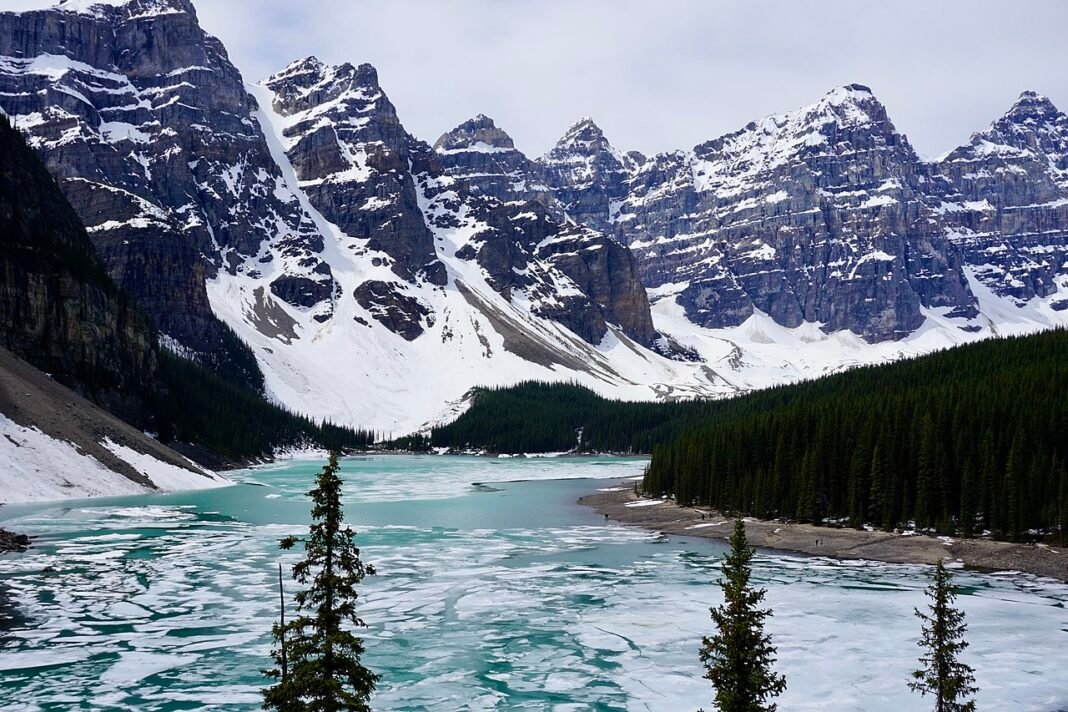
Moving to Alberta means joining one of Canada’s most distinctive provincial economies — a place whose absence of sales tax, lower overall tax burden compared with British Columbia or Ontario, and resource-rich revenue base shape an after-tax income reality unlike anywhere else in the country. For households relocating from Vancouver or Toronto with professional or trades incomes above CAD $100,000, the combination of no PST (only the 5% federal GST applies) and Alberta’s lower-bracket income tax can produce meaningful annual savings on consumption and earnings together. The practical relocation process is straightforward — Alberta’s network of private registry agents handles driver’s licences and vehicle registration, and the Alberta Health Care Insurance Plan (AHCIP) covers health enrolment. The harder part, most newcomers find, is the cultural adaptation: the oil-patch work rhythm, the boom-bust economic cycle, and the genuine outdoor culture built around the Rocky Mountains tend to require more adjustment than people anticipate.
Driver’s Licence and Vehicle Registration
- Alberta driver’s licence: New residents from other Canadian provinces must exchange their existing licence for an Alberta Class 5 within 90 days of establishing residency; registry agents (a network of private businesses authorized by Service Alberta) handle the transaction, and most Canadian provincial licences are exchanged directly without a knowledge or road test for the standard Class 5
- Registry agents: Alberta’s privatized registry network runs through more than 200 agent offices across the province; all licence, registration, and most provincial administrative transactions happen at these agents rather than at government offices; locate offices through alberta.ca or Service Alberta directories
- Vehicle registration: Out-of-province vehicles must be registered within 90 days of residency; an out-of-province inspection is typically required, and the inspection certificate is only valid for 14 days, so coordinate the inspection and registry visit closely; under Alberta’s plate rules, plates stay with the owner (not the vehicle) upon sale
- Auto insurance: Alberta runs a regulated private auto insurance market (unlike BC’s ICBC government monopoly or Quebec’s SAAQ public scheme); mandatory third-party liability and accident benefits coverage is purchased from private insurers; a grid rating system sets baseline premiums that insurers can adjust within regulated bounds
- Winter driving: Alberta’s winter road conditions (the Trans-Canada Highway 1 through the Rocky Mountains, the long Highway 63 corridor to Fort McMurray, and the general winter maintenance standard on secondary highways) make winter tires strongly advisable; all-season tires remain legal but are not recommended for Calgary, Edmonton, or mountain-corridor winter driving
Alberta Health Care Insurance Plan
- Eligibility: Canadian citizens and permanent residents who establish Alberta residency and intend to remain for 12 months or more qualify for Alberta Health Care Insurance Plan (AHCIP) coverage; apply through alberta.ca/ahcip as soon as you arrive
- Waiting period: AHCIP coverage begins on the first day of the third month following the date residency is established (for example, residency on 12 July means coverage from 1 October); during the wait, maintain your originating province’s coverage or buy private bridge insurance
- What AHCIP covers: Physician services, hospital services (inpatient and outpatient), surgical services, and most diagnostic tests — the standard Canadian provincial health package
- What is not covered: Prescription drugs (Alberta Blue Cross runs a supplemental drug benefit for some populations; others need private cover), dental and vision (private insurance required), and ambulance services (a significant gap for backcountry and rural Alberta travel)
- No health premiums: Alberta has not charged provincial health-care premiums since 2009, which keeps the headline cost of public health coverage at zero for residents — though private supplemental insurance remains common

Schools and Education
Alberta’s education system delivers some of the strongest academic results in Canada, and it gives parents an unusually broad set of choices for a publicly funded system:
- Public boards: Calgary Board of Education (CBE) and Edmonton Public Schools rank among the largest boards in Western Canada; alongside traditional neighbourhood schools, they offer Francophone schools and diverse specialty programs in arts, sports, and language immersion
- French immersion: Both Calgary and Edmonton run strong French immersion pathways (the CBE pathway is heavily subscribed); early immersion begins in Kindergarten and late immersion in Grade 4
- Catholic schools: Alberta funds Catholic education through the separate school system; the Calgary Catholic School District and Edmonton Catholic Schools offer full K–12 Catholic education with no tuition fees for eligible students
- Charter schools: Alberta is the only Canadian province with publicly funded charter schools — independently operated, tuition-free schools with distinct educational philosophies; several rank among the most academically rigorous public alternatives in the province (Foundations for the Future Charter Academy is the largest)
- Private schools: Strathcona-Tweedsmuir School (STS) and Webber Academy in Calgary, plus established independent schools in Edmonton across academic and faith-based traditions; private fees typically run CAD $15,000–$35,000 per year, with accredited institutions receiving partial provincial funding
- Universities: University of Alberta (Edmonton, ranked 5th in Canada in the 2026 Times Higher Education World University Rankings, research-intensive), University of Calgary (strong engineering, law, and medicine), Mount Royal University (Calgary, teaching-focused undergraduate), and MacEwan University (Edmonton)
The Oil Patch Culture and Employment
Alberta’s oil and gas economy is impossible to separate from its culture. The swing of global crude prices is no abstract theory here — it is a lived rhythm that has shaped the aspirations, anxieties, and community bonds of Albertans across generations:
- Energy sector employment: The Calgary head offices of Cenovus Energy, Canadian Natural Resources, Suncor Energy, Enbridge, TC Energy, and the service companies that supply them are the province’s dominant private-sector employers; petroleum engineers, geologists, drilling engineers, project managers, and finance professionals in the sector earn salaries well above the national average
- Fort McMurray (oil sands): The Athabasca Oil Sands operations around Fort McMurray employ thousands of trades workers, engineers, and operators on rotational shift schedules; wages are exceptional, but the roughly 740 km drive from Calgary (via Highway 63 through Edmonton) and the remote setting call for a clear-eyed look at the lifestyle trade-offs
- Technology sector: Calgary’s tech scene (Benevity, Symend, Helcim, Neo Financial, and a deep bench of funded startups) and Edmonton’s growing tech community (Jobber, Intuit Edmonton, and the University of Alberta’s AI research spinoffs) are emerging as serious alternatives to the energy sector’s traditional dominance
- Agriculture: Southern Alberta’s canola, wheat, and beef-cattle production make agriculture the province’s second-largest goods-producing industry; Lethbridge and Red Deer anchor the sector’s input, processing, and logistics network
Preparing for Your Move
The logistics of relocating to Alberta follow a familiar sequence no matter where you are coming from: secure housing before or just after arrival, transfer any professional licences your occupation requires, register your vehicle and exchange your driver’s licence within the 90-day window set by provincial law, and update voter registration with Elections Alberta and Elections Canada at your new address. Connecting early with community leagues in Edmonton, community associations in Calgary, neighbourhood groups, sports clubs, or professional networks can dramatically accelerate the sense of belonging. Many parts of Alberta have grown quickly over the past decade, and a large share of residents arrived from elsewhere themselves — so newcomers are genuinely the norm, and the infrastructure for meeting people and building a life from scratch is well established in the major centres.
Frequently Asked Questions
What are the driver’s licence and vehicle registration requirements when moving to Alberta?
Alberta uses a privatized registry network — more than 200 privately operated agent offices across the province handle all licence, registration, and most provincial administrative transactions; office directories are available through alberta.ca. New residents from other Canadian provinces must exchange their existing licence for an Alberta Class 5 within 90 days, and most Canadian provincial licences exchange directly without a knowledge or road test. Vehicle registration: out-of-province vehicles must be registered within 90 days; an out-of-province inspection is typically required and the inspection certificate is only valid for 14 days, so coordinate inspection and registry visits closely. Auto insurance: Alberta has a regulated private market — mandatory third-party liability and accident benefit coverage is purchased from private insurers (unlike BC’s ICBC monopoly or Quebec’s SAAQ public scheme). Winter tires are not legally required in Alberta but are strongly recommended for Calgary, Edmonton, and Rocky Mountain corridor winter driving.
What is Alberta’s provincial health insurance waiting period?
Alberta Health Care Insurance Plan (AHCIP) coverage begins on the first day of the third month following the date residency is established — for example, residency on 12 July means coverage from 1 October. This is one of the most significant administrative differences from provinces such as British Columbia, which provide immediate coverage for interprovincial transfers. Apply for AHCIP through alberta.ca/ahcip as soon as you establish residency; the waiting clock starts at your arrival date. During the wait, maintain your originating province’s health coverage if possible or buy private bridge insurance. AHCIP covers physician services, hospital services, surgical services, and most diagnostic tests, and Alberta has not charged provincial health-care premiums since 2009. AHCIP does not cover prescription drugs (Alberta Blue Cross provides supplemental drug benefits for some populations; others require private insurance), dental, vision, or ambulance services.
What are Alberta’s tax advantages for new residents?
Alberta is the only Canadian province with no provincial sales tax — only the 5% federal GST applies on retail purchases, with no PST or HST layered on top. On earned income, Alberta does levy provincial income tax (brackets of 8%, 10%, 12%, 13%, 14%, and 15% for 2026, with the 8% bracket applying to the first roughly CAD $61,200 of taxable income), but the overall burden is lower than in British Columbia or Ontario at most income levels, particularly for higher earners. For households relocating from Vancouver or Toronto with professional or trades incomes above CAD $100,000, no PST combined with a lower income tax bracket structure produces meaningful annual savings on both consumption and earned income. This framework remains one of the financial drivers of Alberta’s steady in-migration from higher-tax provinces.
What is Alberta’s oil patch economy and employment landscape?
Alberta’s energy sector is the province’s defining economic engine, and understanding the boom-bust cycle is essential preparation for anyone settling here. The Calgary head offices of Cenovus Energy, Canadian Natural Resources, Suncor Energy, Enbridge, and TC Energy concentrate Canada’s petroleum industry leadership; petroleum engineers, geologists, drilling engineers, project managers, and finance professionals earn salaries well above national averages. The Athabasca Oil Sands operations around Fort McMurray (roughly 740 km north of Calgary via Highway 63 through Edmonton) employ thousands of trades workers, engineers, and operators on shift schedules with exceptional wages — but the remote setting and rotational lifestyle call for a clear assessment of the personal trade-offs. The oil price crashes of 2015–16 and 2020 produced significant Alberta layoffs and economic contraction, a reminder of how cyclical energy-dependent income can be. Growing alternatives include Calgary’s tech scene (Benevity, Symend, Helcim, Neo Financial, and dozens of funded startups) and Edmonton’s tech community (Jobber, Intuit Edmonton, and University of Alberta AI research spinoffs), which are diversifying the province’s private-sector employment base.
What are Alberta’s school system and charter school advantages?
Alberta is the only Canadian province with publicly funded charter schools — independently operated schools with distinct educational philosophies, funded by the province with no tuition fees for resident students. Charter schools such as Foundations for the Future Charter Academy in Calgary deliver some of the province’s most academically rigorous tuition-free public alternatives. Alberta also funds Catholic education through its separate school system — the Calgary Catholic School District and Edmonton Catholic Schools provide full K–12 Catholic education with no tuition fees for eligible students. French immersion is available in both the public and Catholic systems in Calgary and Edmonton, with early immersion from Kindergarten heavily subscribed. Major private schools (Strathcona-Tweedsmuir School and Webber Academy in Calgary; established independent schools in Edmonton) charge CAD $15,000–$35,000 per year and receive partial provincial funding when accredited. The University of Alberta (Edmonton) is ranked 5th in Canada in the 2026 Times Higher Education World University Rankings; the University of Calgary has strong engineering, law, and medicine.