San Francisco packs an almost absurd amount of personality into 49 square miles. It’s a city of genuine contradictions — tech wealth and visible poverty, Victorian gingerbread houses next to glass towers, world-class restaurants steps from tent encampments — and understanding those contradictions is part of understanding why the city is so compelling. The hills are steep, the fog is real and often beautiful, the sourdough is legendary, the burritos are enormous, and the Golden Gate Bridge holds up in person exactly as it does in every photograph. Here’s how to experience it properly.
Getting Around San Francisco
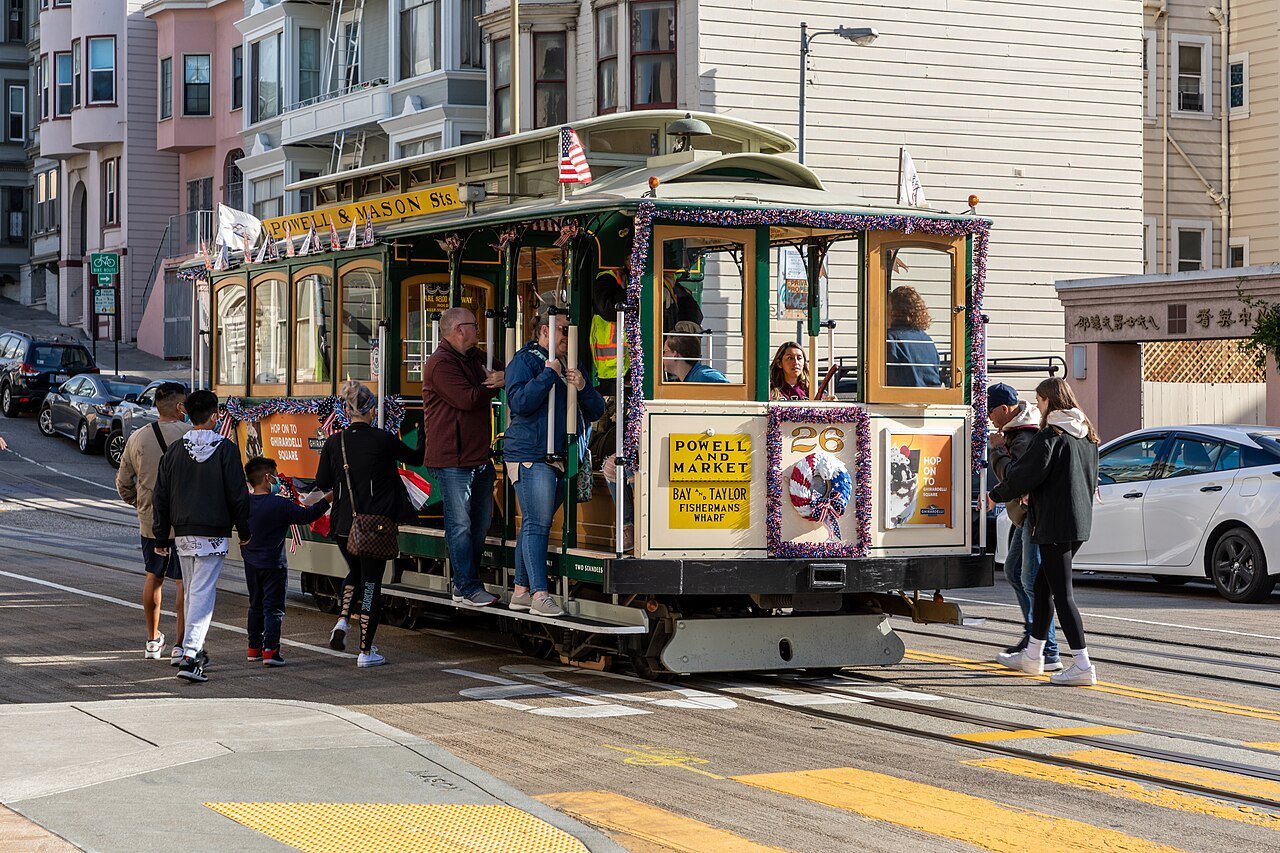
San Francisco’s public transit (Muni) is reasonably comprehensive and the cable cars — tourist attraction that they are — are also genuinely useful for navigating the city’s steepest hills. A single cable car ride is $9 (no transfers), and the Powell-Hyde line offers the best views, connecting Union Square to Fisherman’s Wharf via Russian Hill; the F Market streetcar (historic vintage cars from cities around the world) runs along Market Street and the Embarcadero. BART connects the city to Oakland, Berkeley, the East Bay, and the airport. Electric bikes (available from multiple rental companies) are the revelation for getting around San Francisco — the hills that defeat regular cyclists disappear entirely on an e-bike, and you can cover distances that would be brutal on foot.
The Neighborhoods
The Mission District
The Mission is the cultural and culinary heart of San Francisco — the city’s Latin American neighborhood and the home of the Mission-style burrito, a San Francisco invention that has spread across the world but is still best experienced here. A Mission burrito is a meal: rice, beans, meat, cheese, sour cream, and salsa wrapped in a large flour tortilla and foil. La Taqueria (no rice, denser, arguably the best) and El Farolito (with rice, greasier, open late) are the perennial adversaries in this debate, and you should try both. The 24th Street corridor has excellent coffee shops, independent bookstores, and taquerias. Clarion Alley and Balmy Alley are open-air galleries of murals that change regularly — some of the most politically charged and visually striking street art in the country.
Haight-Ashbury
The Haight is permanently associated with the Summer of Love of 1967, and while the neighborhood has gentrified considerably, it retains a distinct counterculture energy. Amoeba Music — the greatest used record store in America, with a collection that takes hours to properly explore — anchors the upper Haight. Vintage clothing shops, head shops, and the Grateful Dead house at 710 Ashbury Street are the main draws. Buena Vista Park, just above the neighborhood, has panoramic city views and is significantly less crowded than Dolores Park.
Chinatown and North Beach
San Francisco’s Chinatown is the oldest in North America. Stockton Street — rather than the tourist-facing Grant Avenue — is where locals do their daily shopping, and the contrast between the two is instructive. Dim sum at City View Restaurant or Yank Sing is an essential San Francisco weekend experience; go between 10 AM and 1 PM when the carts are running at full capacity.
North Beach, adjacent to Chinatown, is the Italian neighborhood and the birthplace of the Beat Generation literary movement. City Lights Bookstore — founded by Lawrence Ferlinghetti in 1953 and the publisher of Allen Ginsberg’s Howl — is still open and still excellent, with a particularly strong poetry section and a downstairs reading room that functions as a quiet refuge. Caffe Trieste, where Coppola reportedly wrote much of The Godfather screenplay, has been serving espresso to writers and dreamers since 1956.
Essential Experiences
The Golden Gate Bridge
Walk or cycle across the bridge rather than just photographing it from the shore. The 1.7-mile pedestrian walkway offers views that are extraordinary — the bay to the east, the Pacific to the west, and the city skyline when the fog cooperates. Fort Point, at the base of the bridge on the city side, provides the unusual perspective of looking straight up at the structure from below (it’s also the location of a Civil War-era fort that rarely gets the attention it deserves). For the classic postcard view of the bridge with the city skyline behind it, take the 10-minute drive to the Marin Headlands on the north side — the viewpoint at Battery Spencer is the one you’ve seen in a hundred photographs.
Alcatraz
Alcatraz is significantly more interesting than its reputation as a tourist trap suggests. The audio tour — narrated by former inmates and guards — brings the prison’s history to life with a vividness and humanity that makes it far more absorbing than you’d expect. The island also has remarkable views of the bay, an unexpected garden (prisoners maintained it), and a historically significant Native American occupation that lasted from 1969 to 1971. Book tickets weeks in advance; they sell out consistently. Night tours are occasionally available and are particularly atmospheric.
Ferry Building and Farmers Market
The Ferry Building Marketplace is both a working ferry terminal and one of the best food markets in the country. The Saturday farmers market (6 AM to 2 PM) draws the best local produce, artisan cheesemakers, bread bakers, and specialty food vendors in Northern California. Year-round vendors inside include Acme Bread Company, Blue Bottle Coffee (the original kiosk location), Cowgirl Creamery, Humphry Slocombe ice cream, and a dozen other exceptional purveyors. The views of the Bay Bridge from the ferry dock are outstanding, particularly at golden hour.

Day Trips from San Francisco
- Muir Woods (45 minutes north): Ancient coastal redwoods just across the Golden Gate — the tallest reach over 250 feet, the oldest have stood for more than 1,000 years, and walking among them quietly recalibrates your sense of scale. Book a timed entry permit at gomuirwoods.com or take the Muir Woods shuttle from Sausalito (accessible by ferry from the Ferry Building).
- Wine Country (1–1.5 hours north): The Napa Valley and Sonoma County wine regions are among the best in the world. Sonoma is more relaxed and less expensive than Napa — the wineries are more spread out and the whole experience is less performative. Booking a guided wine country tour from San Francisco is often more practical than driving (California’s open-container laws are strict).
- Big Sur (3 hours south): Highway 1 through Big Sur is one of the most dramatic coastal drives on earth. McWay Falls (a waterfall dropping directly onto a beach), Pfeiffer Beach (purple sand from manganese garnet in the cliffs), and Bixby Creek Bridge (the most photographed bridge in California after the Golden Gate) are the highlights. Check road conditions — sections occasionally close due to landslides.
- Yosemite National Park (3.5 hours east): El Capitan, Half Dome, Bridalveil Fall — the valley is one of the most spectacular landscapes on earth, and roughly 3.5 hours from San Francisco is close enough for a two-day trip. Summer requires advance entry reservations; spring (April–May) with waterfalls at full flow is the best time.
Practical Information
San Francisco International Airport (SFO) is 30 minutes from downtown by BART ($11.15) — the most convenient airport rail connection in the United States. Oakland Airport (OAK), across the bay, often has cheaper flights to San Francisco and is equally convenient via BART. Hotels in San Francisco vary wildly in price — the Union Square area has the densest concentration of options at a range of budgets, while the Mission and Haight offer boutique options with more neighborhood character. The city has a 14% hotel tax, which adds meaningfully to quoted rates. Tipping and local prices generally run higher than most American cities. San Francisco weather is legendary for its peculiarity: the fog can make July and August feel like October, while October and November are often the warmest, clearest months of the year. Pack layers regardless of the season.
Frequently Asked Questions
What are the best neighborhoods to explore in San Francisco?
The Mission District is the cultural and culinary heart of the city — Latin American in heritage, home of the Mission-style burrito (La Taqueria and El Farolito are the perennial rivals), and the open-air mural galleries of Clarion Alley and Balmy Alley (some of the most politically charged street art in the country). Haight-Ashbury retains its counterculture energy: Amoeba Music (the greatest used record store in America) anchors the neighborhood alongside the Grateful Dead house at 710 Ashbury. North Beach is the Italian neighborhood and birthplace of the Beat Generation: City Lights Bookstore (founded 1953 by Lawrence Ferlinghetti, publisher of Ginsberg’s Howl) and Caffe Trieste (open since 1956) are literary landmarks still worth visiting. Chinatown’s Stockton Street — rather than tourist-facing Grant Avenue — is where locals actually shop, and is the oldest Chinatown in North America.
What are the must-see attractions in San Francisco?
Walking across the Golden Gate Bridge (1.7-mile pedestrian walkway) provides extraordinary views of the bay and Pacific that photographs don’t capture — Fort Point at the bridge’s base offers the unusual perspective of looking straight up at the structure. For the classic postcard view with the city skyline behind the bridge, the viewpoint at Battery Spencer in the Marin Headlands (10-minute drive) is the location used in a hundred photographs. Alcatraz is significantly more interesting than its reputation suggests: the audio tour narrated by former inmates and guards is genuinely compelling, and the island has bay views, an unexpected garden, and a historically significant Native American occupation (1969–1971). The Ferry Building Marketplace on the Embarcadero hosts the finest Saturday farmers market in Northern California (6 AM–2 PM) with Acme Bread, Blue Bottle Coffee, and Cowgirl Creamery.
What is San Francisco’s food scene like and where should visitors eat?
San Francisco is one of the world’s great food cities, with a food culture built on its deep immigrant heritage, proximity to Northern California produce, and the Bay Area’s innovation culture. Essential experiences: a Mission burrito from La Taqueria (dense, no rice, arguably the best) or El Farolito (with rice, open late); dim sum at City View Restaurant or Yank Sing (Chinatown area, weekends between 10 AM–1 PM when carts are running); fresh Dungeness crab from the Fisherman’s Wharf vendors (in season November–June); Ferry Building sourdough from Acme Bread Company. For fine dining, the Mission and Hayes Valley have the highest concentration of acclaimed chef-driven restaurants. Zuni Café (roast chicken for two, wood-fired oven) and State Bird Provisions (innovative small plates) are San Francisco institutions worth booking ahead.
How do you get around San Francisco?
San Francisco’s Muni transit system covers the city comprehensively. The Powell-Hyde cable car line (tourist attraction and genuinely useful transport) connects Union Square to Fisherman’s Wharf via Russian Hill — a single ride is $9, and buying at the cable car turnaround avoids the on-board surcharge. The F Market streetcar (vintage historic cars from cities around the world) runs along Market Street and the Embarcadero. BART connects San Francisco to Oakland, Berkeley, and the airport ($11.15 from SFO to downtown, 30 minutes). Electric bike rental is the revelation for San Francisco: the hills that defeat regular cyclists disappear entirely, and distances that would be brutal on foot become easy. The city’s parking is extremely limited and expensive — most visitors are better served by transit and walking within neighborhoods.
When is the best time to visit San Francisco and what should visitors know?
San Francisco’s climate surprises most visitors. The city’s famous fog (Mark Twain allegedly remarked: “The coldest winter I ever spent was a summer in San Francisco”) is most prevalent June through August, particularly in the morning — the western neighborhoods (Sunset, Richmond, Ocean Beach) are frequently 10–15°F cooler and foggier than downtown and the Mission. September and October are the city’s warmest and sunniest months — often the best time to visit. Always bring a layer regardless of forecast. The city is expensive: average hotel rates exceed $250/night; dining at mid-range restaurants costs $50–$80/person. Booking accommodation 6–8 weeks ahead consistently delivers better rates. The Golden Gate Bridge is free to walk; crossing by car (southbound only) costs $9.75 with FasTrak or $10 by license-plate billing. San Francisco’s 8.625% sales tax applies to all purchases.