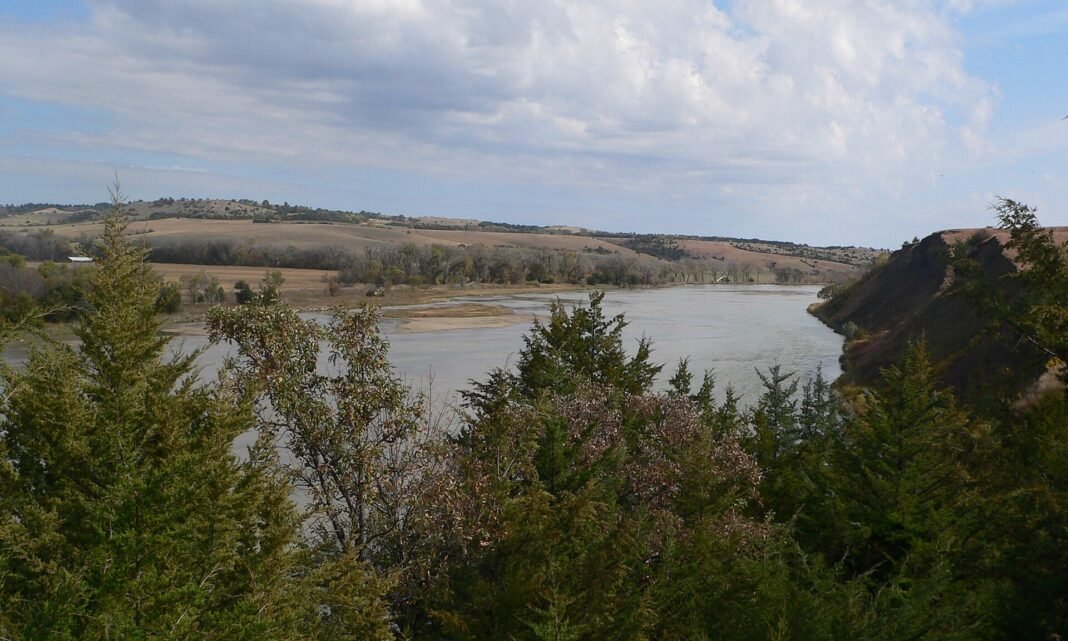
Nebraska’s outdoor recreation is shaped by Great Plains ecology — country that rewards patience and a willingness to look past the absence of mountains. Once you stop measuring the state against the Rockies, the specific richness of prairie, river, and sky comes into focus: the sandhill crane migration on the Platte, the solitude of the Sandhills by kayak or horseback, the canyon hiking of the Pine Ridge, and a night sky so dark, out in the western counties, that the Milky Way throws a shadow. None of it has an equivalent in the more obviously dramatic landscapes of the American West, and that is precisely the point.
.jpg?width=1200)
The Crane Migration: Nebraska’s Signature Event
The sandhill crane migration through the central Platte River valley is Nebraska‘s defining outdoor draw, and one of the great wildlife spectacles on the continent. Between mid-February and mid-April, 500,000 to 600,000 sandhill cranes — roughly 80 percent of the world’s population — pack onto the Platte’s shallow, braided channels near Kearney and Grand Island, fattening on waste corn left in harvested fields before pushing on to Arctic nesting grounds. The birds roost on the river’s sandbars overnight and fan out to the cornfields by day. The dawn and dusk flights, when hundreds of thousands of cranes lift off the water or wheel back to roost at once, are the kind of thing that leaves even seasoned wildlife watchers without much to say.
The Rowe Sanctuary, run by the National Audubon Society near Gibbon, offers the finest crane viewing of all — guided morning and evening blind visits put you within 20 feet of the river as the birds land and rise around you, a proximity to mass wildlife movement available almost nowhere else in the country. The blinds book up fast for peak weekends (mid-March is usually the height of it), so book the moment reservations open early in the year for a March visit. The Crane Trust south of Grand Island adds more viewing access along with educational programming. If you can’t get a blind slot, the highway bridges over the Platte in the Kearney–Grand Island corridor are free and open to anyone — pullouts on the bridge approaches let dozens of onlookers watch the evening return flights from March into early April.
Hiking and Cycling: Nebraska’s Trail Network
Nebraska’s trail network runs deeper than most visitors expect. The Cowboy Trail — slated to span 321 miles from Norfolk to Chadron and already the longest rail-trail in the United States — carries cyclists and hikers across the northern Sandhills on a multi-day route unmatched for distance and prairie immersion. About 187 miles, from Norfolk west to Valentine, are surfaced and open; the Pine Ridge section toward Chadron in the Panhandle is still being finished. Along the way the trail crosses grass-covered dunes, skirts the Niobrara canyon country near Valentine, and edges into the high terrain of the western Panhandle — a cross-section of Nebraska landscapes on one continuous surface. Tread quality shifts from cinder to packed grass (a gravel or hybrid bike beats a road bike here), and services are thin, so map out overnight stops and water resupply before any multi-day push.
The Niobrara National Scenic River, running east through north-central Nebraska from Valentine to the Missouri, is the state’s most complete outdoor corridor — 76 designated scenic miles with more than 230 waterfalls, concentrated in the Valentine-to-Norden stretch where the river slices through the Sandhills-to-Pine-Ridge transition. The fishing is good for smallmouth bass and channel catfish, but the real distinction is ecological: six major habitat types — eastern deciduous forest, western ponderosa pine, northern boreal forest, and the tallgrass, mixed-grass, and Sandhills prairies — converge here, drawn together by the canyon’s sheltered microclimate. The classic float from the Cornell bridge down to Rocky Ford, passing Smith Falls State Park and Nebraska’s tallest waterfall at 63 feet, is a 2-day, 22-mile canoe trip and the finest river run in the state.
.jpg?width=1200)
Hunting and Fishing
Hunting sits close to the center of Nebraska’s outdoor identity — pheasant, whitetail deer, pronghorn, turkey, and waterfowl all carry deep community roots. The state’s best wild-pheasant range is the southwest and the Panhandle, where wheat and milo stubble and Conservation Reserve grassland hold the birds that intensive row-crop farming has pushed out elsewhere. The Sandhills are upland terrain of a different stripe: better known for greater prairie chickens and sharp-tailed grouse, the grass-and-wet-meadow mosaic of the ranching belt also gives non-resident hunters reasonable public access on Wildlife Management Areas, with guided hunts on private ranches for those after premium ground.
Fishing leans on the big reservoirs. Lake McConaughy — “Big Mac” to locals, the state’s largest at 22 miles long and 76 miles of shoreline — sits near Ogallala on the North Platte River, offering sailing, powerboating, and white-sand beaches that read more like a freshwater sea than a High Plains lake. Its walleye, white bass, and tiger muskie draw anglers from across the Great Plains. The Sandhills lakes and the Niobrara’s smallmouth fishery deliver quality angling in richer, wilder settings than the reservoirs. And along the eastern border, the Missouri River — recovered from its channelized past — now holds channel and flathead catfish big enough to keep dedicated catfishers coming from across the region.
Dark Sky and Stargazing
Nebraska’s wide-open country and thin population give it some of the darkest skies in the eastern half of the United States — an asset that grows scarcer every year as urban glow erases the stars for most Americans. Out in the central and western Sandhills, far from any meaningful light source, the Milky Way comes through with a clarity usually reserved for the designated dark-sky parks of the famous West. Merritt Reservoir southwest of Valentine and the backcountry of Cherry County — the largest county east of the Rockies, with roughly 5,500 residents spread across nearly 6,000 square miles — put that darkness within easy reach. The Nebraska Star Party, held each summer near Merritt, has pulled hundreds of amateur astronomers to the central Sandhills for more than 30 years, building a small community around the state’s most underrated natural asset.
Frequently Asked Questions
What is the sandhill crane migration and when can you see it in Nebraska?
The sandhill crane migration through Nebraska’s central Platte River valley is one of the great wildlife spectacles on the continent. Between mid-February and mid-April, 500,000 to 600,000 sandhill cranes — roughly 80 percent of the world’s population — pack onto the Platte’s shallow braided channels near Kearney and Grand Island to fatten on waste corn before pushing on to Arctic nesting grounds. The dawn and dusk flights, when hundreds of thousands of cranes lift off the water or wheel back to roost at once, are genuinely overwhelming. The Rowe Sanctuary (National Audubon Society, near Gibbon) runs guided blind visits that put you within 20 feet of the river as the birds land and rise around you — reserve in November or December for mid-March peak viewing. Free public viewing is available from the highway bridges over the Platte in the Kearney–Grand Island corridor.
What is the Cowboy Trail and what does Nebraska’s cycling network offer?
The Cowboy Trail is the longest rail-trail in the United States — planned to run 321 miles from Norfolk to Chadron across the northern Nebraska Sandhills, with about 187 miles surfaced and open from Norfolk to Valentine and the Pine Ridge section toward Chadron still being finished. The open stretch traverses grass-covered dunes, the Niobrara canyon country near Valentine, and the approach to the Panhandle — a multi-day cycling and hiking route with no rival for sheer distance across open grassland. Tread quality varies (some sections call for a gravel or hybrid bike), and services are sparse, so plan overnight stops and water resupply in advance. It anchors a wider gravel-cycling scene across the Sandhills ranch country, where quiet county roads link the trailheads.
What does the Niobrara National Scenic River offer?
The Niobrara National Scenic River, running east through north-central Nebraska from Valentine to the Missouri, is the state’s most complete outdoor corridor — 76 designated scenic miles with more than 230 waterfalls (concentrated in the Valentine-to-Norden stretch), good smallmouth bass and catfish fishing, and the rare convergence of six major habitat types: eastern deciduous forest, western ponderosa pine, northern boreal forest, and the tallgrass, mixed-grass, and Sandhills prairies, drawn together by the canyon’s sheltered microclimate. The classic float from the Cornell bridge to Rocky Ford, passing Smith Falls State Park (Nebraska’s tallest waterfall, 63 feet), is a 2-day, 22-mile canoe trip and the finest river run in the state. Outfitters in Valentine rent canoes and tubes for the most popular sections.
What is Lake McConaughy and what outdoor activities does it offer?
Lake McConaughy (“Big Mac” to locals), near Ogallala on the North Platte River, is Nebraska’s largest lake — 22 miles long with 76 miles of shoreline, its white-sand beaches reading more like a freshwater sea than a High Plains reservoir, with sailing, powerboating, and camping that make it one of the state’s most popular summer recreation areas. Its walleye, white bass, and tiger muskie draw anglers from across the Great Plains. The North Platte River below Kingsley Dam (the lake’s tailwater) holds premium trout supported by Nebraska Game and Parks. The Sandhills lakes of Cherry, Thomas, and Grant Counties add fishing for largemouth bass, walleye, and northern pike in the remote heart of the Sandhills.
Why is Nebraska one of the best dark sky destinations in the eastern half of the US?
Nebraska’s wide-open country and thin population — Cherry County, the largest county east of the Rockies, holds roughly 5,500 people across nearly 6,000 square miles — give it some of the darkest skies in the eastern half of the United States. In the central and western Sandhills, far from any meaningful light source, the Milky Way comes through with a clarity usually reserved for the designated dark-sky parks of the famous West. The Nebraska Star Party, held each summer near Merritt Reservoir southwest of Valentine, has drawn hundreds of amateur astronomers for more than 30 years for the exceptional viewing. Merritt Reservoir itself is a certified International Dark Sky Park, an easy drive from the Valentine accommodation base.