The Northwest Territories is one of the last places in North America where the word wilderness keeps its full weight — a territory of 1.35 million km² where the vast majority of the land has never been logged, farmed, or developed, where grizzly bears and wolves move through ecosystems intact since the last ice age, and where the scale of the natural world dwarfs anything in southern Canada. The NWT’s outdoor experiences are not packaged for easy consumption: Nahanni National Park Reserve requires floatplane access and expedition planning; the Thelon Wildlife Sanctuary’s caribou herds can be reached only by floatplane or multi-week canoe; the Arctic Ocean shore at Tuktoyaktuk sits 1,500km from the nearest major city. For travellers willing to meet the territory on its own terms, though, the Northwest Territories delivers a calibre of wild-country travel that has grown genuinely rare on the planet by 2026.
Nahanni National Park Reserve: Canada’s Greatest Wilderness Canyon
Nahanni National Park Reserve (30,000km² in the Mackenzie Mountains of the western NWT, a UNESCO World Heritage Site since 1978 — one of the original 12 places ever inscribed on the World Heritage List) anchors the NWT’s wild-country reputation — a canyon system of remarkable geological drama built around the South Nahanni River’s 550km descent from the Yukon border to the Liard River lowlands. Its signature sight is Virginia Falls, a 96-metre plunge of the South Nahanni (twice the height of Niagara Falls) onto a midstream rock pillar (Mason’s Rock, named for Canadian canoeist and filmmaker Bill Mason) that splits the cataract into two curtains of white water, with canyon walls rising 300 metres above the river. Reaching the falls means a floatplane flight from Fort Simpson or Watson Lake (Yukon), which is why one of the continent’s most extraordinary waterfalls remains one of its least crowded.
- South Nahanni River canoe: The full route from Moose Ponds (near the Yukon border) to Nahanni Butte (at the Liard confluence) covers 550km over 3–4 weeks of paddling. It takes in Class IV whitewater in the First and Second Canyons, the Rabbitkettle Hotsprings (the largest tufa mound in Canada, where a natural spring has built a 30m calcium carbonate dome over thousands of years), Kraus Hot Springs (thermal pools reached straight from the river), and the 300m canyon walls of First Canyon. Most guided Nahanni trips fly in by floatplane at Virginia Falls and paddle the lower canyon — 7–14 days on the water with no road access at any point
- Access and logistics: Nahanni demands real expedition planning — a floatplane charter from Fort Simpson or Watson Lake ($800–$1,500+ per person for entry flights), Parks Canada registration, bear canisters, and self-sufficient gear. No services exist inside the park; all food, fuel, and emergency equipment travels in with the party. The park office in Fort Simpson handles trip-planning essentials
- The Ragged Range and the 2009 park expansion: The 2009 expansion roughly sextupled the protected area, adding the headwaters of the Nahanni watershed — the Ragged Range, the Cirque of the Unclimbables (a granite spire formation in the Logan Mountains of the Ragged Range, anchored by the Lotus Flower Tower of Fifty Classic Climbs of North America fame), and the headwaters of the Flat, Caribou, and Nahanni rivers — one of the largest wilderness preservation gains added to the Canadian national park system since the 1970s. The Cirque is reached by floatplane to Glacier Lake and offers technical rock climbing on world-class granite
Great Slave Lake: North America’s Deepest Lake
Great Slave Lake (614m deep, 27,200km² of surface, the tenth-largest lake in the world and the deepest in North America) anchors Yellowknife’s outdoor recreation — a body of water so large it brews its own weather systems, so deep it never fully stratifies thermally, and so productive that it sustains trophy-class sport fishing for lake trout and northern pike.
- Lake trout fishing: The East Arm of Great Slave Lake — the deep, rocky fjord-like extension northeast of Yellowknife, reached by charter floatplane or, with a very long boat ride, by private vessel — produces lake trout of 30–50+ pounds, with fish over 60 pounds taken in most seasons. Great Slave ranks alongside neighbouring Great Bear Lake (where the IGFA world-record lake trout of 72 pounds was caught in 1995) as one of the planet’s two finest lake trout fisheries. Summer trolling in deep water and winter jigging through the ice (in the East Arm’s clear water, where trout can be seen at 20–30m depth) are the main techniques
- Northern pike: The shallower bays and river outlets around Yellowknife yield northern pike to 20–30 pounds — an aggressive predator that hammers surface lures and gives terrific sport from shore or small boat. The Yellowknife River and the systems entering Great Slave Lake to the west hold productive pike water you can fish without a guide
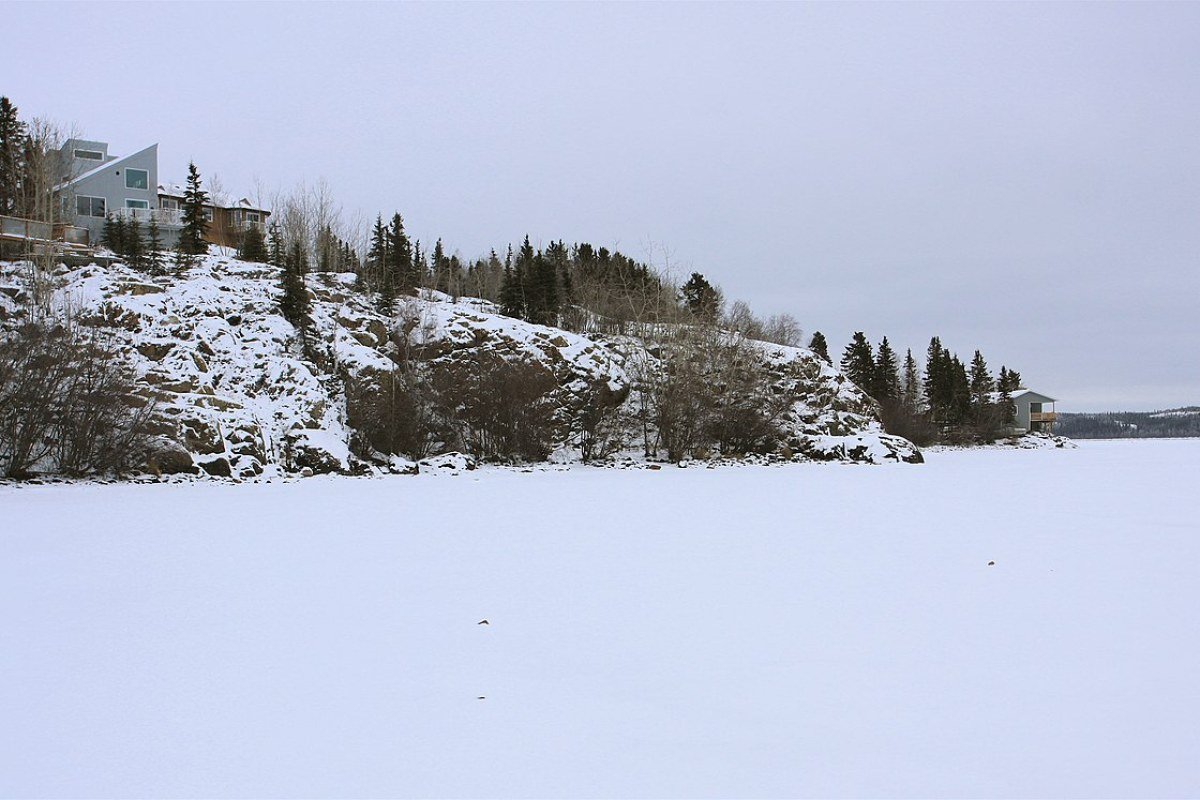
- Ice road travel: The winter ice road on Great Slave Lake — typically open late January through late March — links the communities of the south shore (Detah, N’Dilo) and runs toward Hay River. Driving across the frozen lake (on a marked, surveyed route managed by the territorial government) is an experience unlike any in southern Canada: the ice groans and cracks as it shifts with temperature, pressure ridges build along stress lines, and the frozen expanse under the winter sun is a sight worth the trip
Wildlife Viewing: Arctic and Boreal Species
The Northwest Territories carries wildlife at densities the southern provinces cannot match — intact ecosystems under light human pressure produce large, visible, naturally behaving animals that feel truly wild rather than managed:
- Barren ground caribou: The Beverly-Qamanirjuaq and Bathurst herds (numbering in the hundreds of thousands at peak population) cross the NWT’s tundra each spring and fall. That migration — a landscape-scale movement of animals across the barren lands — is one of the continent’s great wildlife events; it can be seen from the tundra lodges east of Yellowknife (Bathurst Inlet Lodge, Plummer’s Arctic Lodges) during the September and October passage
- Wood bison: The Wood Buffalo National Park herd (roughly 3,000 animals according to Parks Canada aerial surveys) is the world’s largest free-roaming, self-regulating wood bison herd. The animals show themselves along the park road system north of Fort Smith, especially in the Salt Plains, where they gather in summer to reach the salt licks and escape the insects. This population supplied the source stock for reintroduction programs that have restored wood bison to ranges across Yukon, Alaska, and Russia
- Grizzly bear: Grizzlies range throughout the NWT’s boreal and tundra zones. You are most likely to meet them in the Mackenzie Mountains, along the Dempster Highway, and around the tundra lakes east of Yellowknife. The NWT grizzly population is healthy and growing — sightings peak in berry season (August–September) and during the caribou migration
- Musk ox: Musk ox (which rode out the last ice age on the NWT’s tundra and were reintroduced to Banks Island after near-extirpation in the early 20th century) are now resident on Banks Island and the mainland tundra north of Yellowknife. The Banks Island herd (one of the largest in the world) can be visited on guided wildlife tours from Sachs Harbour
- Beluga whales: Beluga whales summer in the Mackenzie Delta and the Beaufort Sea, using the Mackenzie’s fresh-water plume to rub off winter parasites and to calve. Beluga tours from Tuktoyaktuk (by boat into the Mackenzie’s nearshore Beaufort Sea) in July and August reliably find pods in shallow water

The Dempster Highway: Canada’s Arctic Road
The Dempster Highway (736km of gravel from the Klondike Highway junction near Dawson City, Yukon, to Inuvik, NWT) is one of North America’s great road trips — the only public highway to cross the Arctic Circle in Canada, threading four mountain ranges, two major river crossings, and the tundra of the Richardson Mountains and the Mackenzie Delta. The Inuvik-to-Tuktoyaktuk Highway (138km, opened November 2017) carries the system onward from Inuvik to the Arctic Ocean shore at Tuktoyaktuk, so that for the first time in history you can drive from any point in North America to the Arctic Ocean on an all-season road.
- Logistics: The Dempster calls for a well-maintained, high-clearance vehicle with two full-size spare tires (the gravel surface is hard on rubber), a jerry can of extra fuel (stops are sparse — Eagle Plains is the only mid-route service), and real wilderness preparedness (breakdown help is hours away on most stretches). The Peel River and Mackenzie River crossings (by ferry in summer, ice road in winter, and no crossing during breakup and freeze-up) add scheduling to the mix
- Wildlife: The Dempster is among North America’s best wildlife roads — grizzly bear, Dall’s sheep (the Richardson Mountains hold the northeasternmost Dall’s sheep population in the species’ range), moose, and the Porcupine caribou herd all turn up regularly. The fall migration window (August–September) brings the highest animal density and the tundra’s fall colour peak at the same time
- Midnight sun: Driving the Dempster in June or July means 24 hours of daylight above the Arctic Circle — a phenomenon that reorders your sense of time and light in ways hard to anticipate before you live it
Winter Wilderness: Skidoo, Ice Fishing, and Aurora
The NWT’s winter outdoor culture runs as deep as its summer one — the territory’s residents do not retreat from the land in the cold months but engage it differently, with snow machines, ice fishing gear, and the knowledge that -30°C poses no danger to anyone equipped and competent. Snowmobile (skidoo) travel across Great Slave Lake’s frozen surface, ice fishing for lake trout in the East Arm, and aurora watching from lodges east of Yellowknife have no southern-Canadian equivalent. Blachford Lake Lodge (fly-in, 100km east of Yellowknife), Aurora Village, and the Prelude Lake Territorial Park cabins all open up structured winter access for visitors and residents alike. The NWT winter season, from the first ice in late November through the spring equinox in late March, runs four months — a stretch of cold-country travel that rewards the prepared and the willing.
Frequently Asked Questions
What does Nahanni National Park Reserve offer as Canada’s greatest wilderness canyon?
Nahanni National Park Reserve — 30,000 square kilometres in the Mackenzie Mountains of the western Northwest Territories, a UNESCO World Heritage Site since 1978 (one of the original 12 places ever inscribed on the World Heritage List, a marker of the landscape’s global significance) — anchors the territory’s wild-country travel. Virginia Falls (the park’s signature waterfall) drops 96 metres — twice the height of Niagara Falls — onto Mason’s Rock, a midstream pillar that splits the falls into two curtains of white water, with canyon walls rising 300 metres above the South Nahanni River. Reaching it means a floatplane flight from Fort Simpson or Watson Lake (Yukon), which keeps it one of the continent’s least crowded major waterfalls. The South Nahanni River canoe route (550km descent from the Yukon border to the Liard River lowlands) passes through four canyons (First Canyon, Second Canyon, Third Canyon — the deepest of the four at 1,200m wall height — and Fourth Canyon) and reaches the Cirque of the Unclimbables (a vertical granite massif in the Logan Mountains of the Ragged Range, reached by floatplane to Glacier Lake, with rock-climbing routes among the world’s most demanding). Hot springs (Rabbitkettle, the largest tufa mound in Canada, and Kraus Hot Springs near the park’s southern boundary) occur throughout.
What does Great Slave Lake offer for wilderness recreation?
Great Slave Lake — at 27,200 square kilometres the tenth-largest lake in the world and the deepest in North America at 614 metres — delivers fishing and boating of outstanding quality, reached from Yellowknife (on the northern shore) and Hay River (on the southern shore). The lake’s East Arm holds trophy lake trout, northern pike, and walleye in waters that see far less angling pressure than comparable southern Canadian destinations. McLeod Bay (within the East Arm, east of Yellowknife) opens up in summer by boat and in winter by ice road, the most convenient remote fishing from Yellowknife. Paddling the East Arm (a wilderness canoe route through the uninhabited eastern reaches, launched from Fort Resolution) is one of Canada’s finest backcountry canoe journeys: vertical granite walls rising from the lake, untouched boreal forest, and a complete absence of other travellers, all within close reach of a territorial capital. The Stark Lake and Nonacho Lake areas to the southeast offer premium remote fishing by floatplane from Yellowknife or Fort Smith.
What does the Mackenzie River system offer for wilderness travel?
The Mackenzie River — 1,738km from its source at the outlet of Great Slave Lake to the Mackenzie Delta on the Beaufort Sea, the longest river in Canada and the second-longest river system in North America — carries the NWT’s most reachable backcountry water travel, navigable by canoe, motorboat, or barge along its entire length. It runs past the communities of Fort Providence, Wrigley, Tulita, Norman Wells, Fort Good Hope, Tsiigehtchic (Arctic Red River), and Inuvik, a living geography lesson in the diversity of NWT Indigenous communities — Dene, Métis, and Inuvialuit peoples have used this river corridor for thousands of years. Norman Wells (reached by air from Yellowknife or Inuvik, or by the Mackenzie River barge service) is the only oil-producing community on the river and the gateway to the Canol Heritage Trail (372km, the Second World War-era pipeline trail from Norman Wells to the Yukon border, one of the most remote wilderness trails in Canada, demanding 2–3 weeks and serious logistics). The northern section passes the Ramparts (a gorge where the Mackenzie constricts through limestone cliffs above Fort Good Hope) and the Bear Rock formation above the Bear River confluence — geological landmarks of the upper river’s most dramatic stretch.
What does the Thelon Wildlife Sanctuary offer?
The Thelon Wildlife Sanctuary — 52,000 square kilometres of subarctic tundra and boreal forest in the eastern NWT, straddling the NWT-Nunavut border, reached only by floatplane from Yellowknife or Baker Lake — ranks among Canada’s most remote and most rewarding wild places: a country of tundra rivers, eskers (glacially deposited gravel ridges rising from the flat tundra like raised highways), and boreal forest stands (among the most northerly spruce in Canada) that supports the Beverly and Qamanirjuaq barren-ground caribou herds (together numbering in the hundreds of thousands) and a musk ox population that has recovered to one of the highest densities in the world since the sanctuary’s original protection in 1927 as the Thelon Game Sanctuary (created specifically to conserve the species, then expanded to its current 52,000km² in 1956). The Thelon River canoe route (3–4 weeks, 600km from Artillery Lake to Baker Lake in Nunavut) is one of the finest backcountry canoe journeys in North America: clear water, musk oxen standing on the banks, caribou crossing the river in August, and no human infrastructure for the entire run — a quality of solitude available on fewer than a dozen rivers on the continent.
What aurora borealis and dark sky experiences does the Northwest Territories offer?
The Northwest Territories — sitting directly beneath the auroral oval, with vast areas of complete darkness untouched by artificial light — delivers aurora borealis of exceptional intensity from mid-August through April. Yellowknife is the territory’s aurora hub, marketed internationally as one of the world’s leading aurora destinations (the lights show on roughly 240 nights a year when skies are clear), with Aurora Village (a heated-dome viewing facility 25 minutes from downtown) and operators pairing snowmobile, dog sled, and ice fishing trips with aurora viewing. The Canadian Shield lakes outside town (Prelude Lake, Hidden Lake, and the Cameron Falls area) frame the aurora over frozen surfaces that mirror the northern lights in conditions of rare beauty. Inuvik (on the Mackenzie Delta, 68°N latitude) puts extreme-latitude aurora within reach in an accessible NWT community — at this latitude, on clear winter nights, the lights often appear straight overhead rather than only on the northern horizon. The territory’s remote Thelon and Nahanni country offers aurora in total darkness found nowhere else in North America at these latitudes.