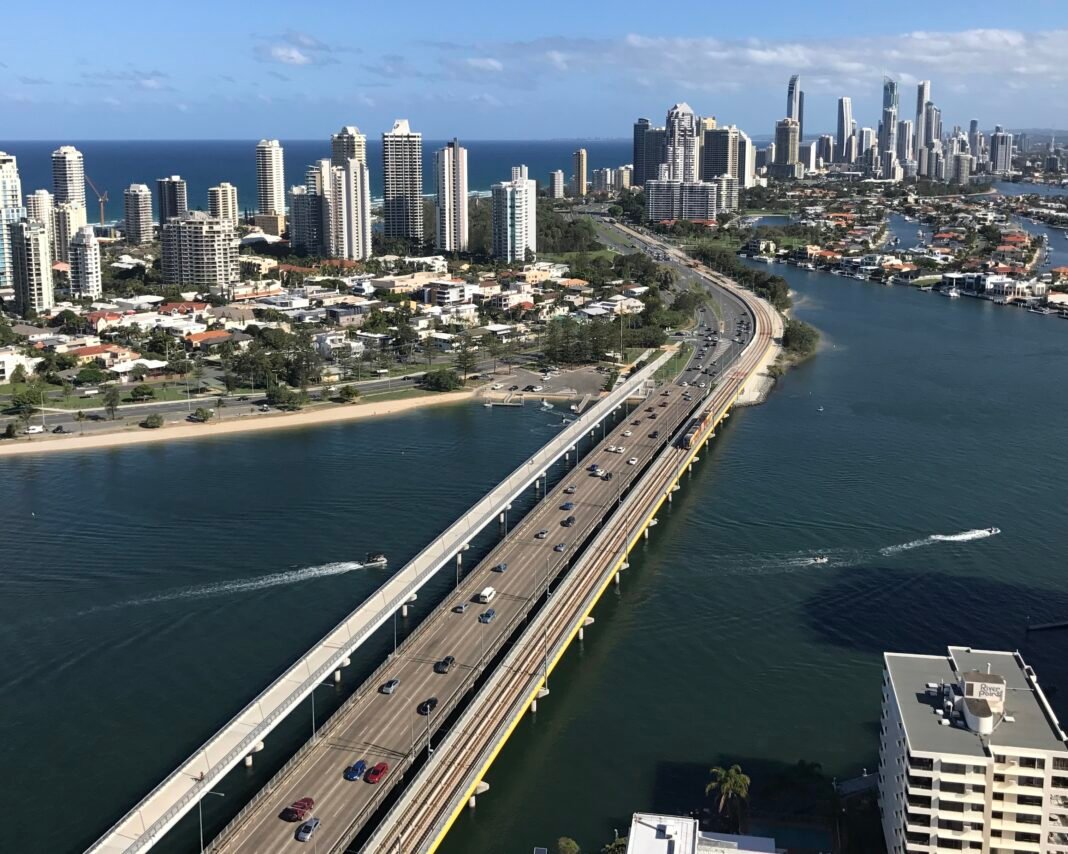
The Gold Coast is Australia’s beach holiday in its purest form — 57 kilometres of near-continuous sand backed by a high-rise skyline, with subtropical sun on tap for most of the year. Crowded into this one stretch of Queensland coast are the country’s busiest theme parks, some of the best surf in the Southern Hemisphere, a food and nightlife scene that has grown up fast, and ancient Hinterland rainforest rising barely 45 minutes inland. Families, surfers, and anyone simply after reliable sunshine all find their version of it here. Here is how to plan a trip that makes the most of it.
The Beaches: From Surfers Paradise to Coolangatta
Surfers Paradise is the loud, glitzy centre of it all — packed with tourists and unapologetic about it. The patrolled main beach is excellent, the Esplanade walkway runs for kilometres, and the energy of the strip is pure Queensland holiday. Overhead, the 322-metre Q1 Tower anchors the skyline; its SkyPoint observation deck on level 77 delivers 360-degree views from the tallest residential building in Australia. The beaches immediately north and south of the strip tend to be calmer. Broadbeach, two kilometres south, feels more grown-up — less neon, better restaurants, the same fine stretch of sand. Burleigh Heads has a national park headland with coastal walking tracks, one of the most reliable point breaks on the coast, and a weekend market every second and fourth Sunday at Burleigh Heads TAFE.
At the southern tip, Coolangatta is the least flashy stretch and, for many, the most appealing — a relaxed, local-feeling town with the famous Snapper Rocks point break around the headland, good fish and chips, and a Thursday farmers market trading local produce. Push north past the city toward Brisbane and the Sunshine Coast — Noosa, Mooloolaba, Caloundra — offers a more natural, less crowded alternative, with Noosa National Park sitting directly behind Noosa Main Beach.
Surfing the Gold Coast
Queensland’s Gold Coast ranks among the world’s great surf destinations. Snapper Rocks at Coolangatta is the headline break, sitting at the northern end of what surfers call the “Superbank” — a continuous sand bar running from Snapper Rocks to Kirra Point that, after the right sand transport, can throw up rides of 200 metres and more. The Gold Coast Pro, a World Surf League event held at Snapper Rocks in autumn, returned to the Championship Tour here in 2026 after several years away, drawing the world’s best professionals. Kirra Point, when it fires, produces some of the most hollow waves in the country. Duranbah, just across the border in New South Wales, is a high-performance beach break for experienced surfers. Beginners are well looked after too — surf schools run at several beaches along the coast, with the gentler waves off Surfers Paradise main beach and Kurrawa Beach ideal for a first lesson.

Theme Parks: Australia’s Entertainment Capital
Nowhere else in Australia concentrates major attractions the way the Gold Coast does. Dreamworld (Coomera) is the country’s largest theme park and includes the WhiteWater World water park next door; its line-up runs from towering drop rides to gentle family options, and Tiger Island holds Australia’s biggest population of Bengal and Sumatran tigers. Warner Bros. Movie World pairs Hollywood theming with rides and live shows, headlined by the DC Comics section — the Justice League 3D dark ride and the DC Rivals HyperCoaster among them. Sea World (Main Beach) centres on marine animals and exhibits alongside its rides, with the water-drenched Storm Coaster and the New Atlantis precinct — home to the Leviathan wooden coaster — among the headline thrills.
If you plan to visit more than two parks, the Village Roadshow Theme Parks annual pass — covering Movie World, Sea World, and Wet’n’Wild — pays for itself quickly. Currumbin Wildlife Sanctuary is not a theme park, but it offers the most genuine wildlife encounter on the coast: hand-feeding wild rainbow lorikeets at the morning session, a ritual running here since 1947, is twenty of the most cheerful minutes you can spend in Queensland, and the koala and reptile encounters hold up well.
The Gold Coast Hinterland
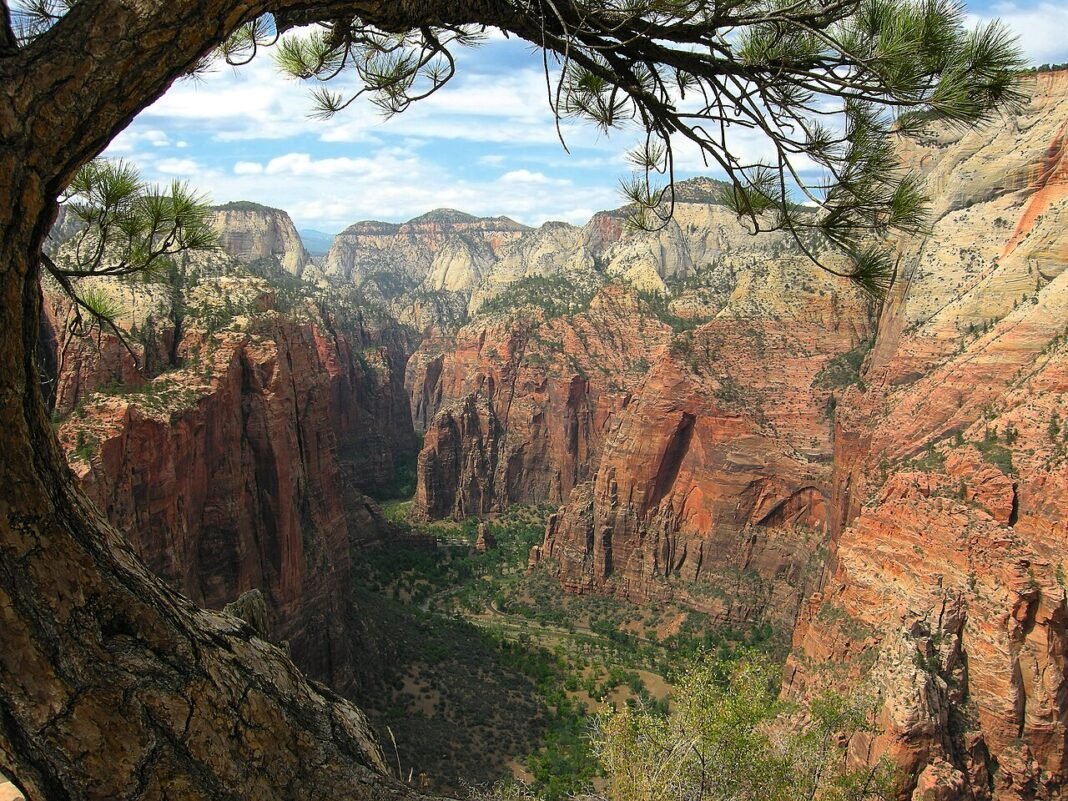
Barely 45 minutes from Surfers Paradise, the Hinterland is the coast’s quiet counterpoint — ancient volcanic calderas now cloaked in subtropical and temperate rainforest, threaded with waterfalls, lookouts, and a surprisingly good food scene in the villages above the plain. Springbrook National Park holds the Natural Bridge, a rock arch carved by the stream that still falls through it, with a cave below sheltering a glow-worm colony best seen after dark, and the Best of All Lookout, one of the most far-reaching panoramas on the coast. Purling Brook Falls drops 106 metres in Springbrook and is at its most impressive after rain, reached by an easy circuit walk.
Tamborine Mountain is the most visited Hinterland stop — a plateau village of craft galleries, food producers, and winery cellar doors, plus the Tamborine Rainforest Skywalk, a 1.5-kilometre elevated walkway through the forest canopy. The climb up via the scenic Tamborine Mountain Road opens up wide views back to the coast. Across the border in northern New South Wales, Mount Warning (Wollumbin) is the first point on mainland Australia to catch the sunrise — though the summit track has been closed since 2020 out of respect for its significance to the Bundjalung people, so the peak is admired today from lookouts around its base rather than climbed.

Food and Nightlife
The Gold Coast table has changed almost beyond recognition over the past decade. Broadbeach is the strongest dining precinct — a walkable run of restaurants that takes in Kiyomi (contemporary Japanese at The Star Gold Coast), Mamasan Kitchen and Bar (South-East Asian), and the consistently sharp Etsu Izakaya. Burleigh Heads has become the coast’s most interesting food neighbourhood — Justin Lane for wood-fired pizza, Borough Barista for coffee, and the waterfront Burleigh Pavilion for cocktails all reward a detour.
The markets are the other way to eat well here. Burleigh Heads Market (second and fourth Sunday), the Surfers Paradise Beachfront Markets (Wednesday, Friday, and Saturday evenings), and Miami Marketta (Friday and Saturday evenings) all turn out street food and fresh produce worth grazing through.
When to Visit and Getting There
For warm sun, low humidity, and comfortable beach temperatures, aim for April to October — the stretch that sidesteps the heat and afternoon thunderstorms of the summer wet season. December and January are the busiest and priciest months, and the school-holiday windows (June–July, September–October) draw crowds too. Gold Coast Airport (Coolangatta) is well served by Jetstar, Virgin Australia, and Qantas from Sydney, Melbourne, Adelaide, and Brisbane, with advance fares from Sydney sometimes dipping to around AUD $49. The coast also sits an hour south of Brisbane by car, or by Airtrain to Helensvale, where the G:link light rail takes over.
Frequently Asked Questions
What are the best beaches and surf on the Gold Coast?
The Gold Coast runs 57km of near-continuous beach from South Stradbroke Island in the north to Coolangatta in the south — one of the longest stretches of surf beach on Australia’s east coast. Surfers Paradise Beach is the most iconic: wide, golden, patrolled, and framed by the high-rise towers that define the skyline. For swimming, locals favour the patrolled sand at Broadbeach, Mermaid Beach, and Burleigh Heads — quieter and less tourist-oriented. Burleigh Heads National Park, a small headland reserve between the beach and the Tallebudgera Creek mouth, has an excellent walking trail with views along the surf coast and through coastal dry rainforest. Snapper Rocks at Coolangatta is the site of one of the world’s most famous waves — the Superbank, a sand-bottom point break fed by sand pumped from the Tweed River, which can link into a continuous ride from Snapper Rocks to Kirra (up to 2km, with rides exceeding 200 metres). The Gold Coast Pro, a World Surf League event, is held at Snapper Rocks in autumn — it returned to the elite Championship Tour here in 2026 after several years away, bringing the world’s top surfers.
What theme parks does the Gold Coast offer and which are worth visiting?
The Gold Coast has the largest concentration of theme parks in Australia — four major parks run by two operators (Village Roadshow and Coast Entertainment, formerly Ardent Leisure), plus WhiteWater World and Sea World. Dreamworld (Coomera, run by Coast Entertainment) is the largest theme park in the country, with a deep line-up of thrill rides — among them the Giant Drop, Steel Taipan, and the newer Rivertown precinct — alongside family rides; Tiger Island holds Australia’s largest population of Bengal and Sumatran tigers. Warner Bros. Movie World is the pick for older children and adults — the DC rollercoasters, including DC Rivals HyperCoaster, Superman Escape, and Green Lantern, are genuinely big-league. Sea World (Main Beach) pairs animal exhibits with rides. WhiteWater World, beside Dreamworld, is a full water park. Multi-park passes (Village Roadshow’s three-park combo, roughly AUD$160–$180 per adult) are the best value across 2+ days, while a single-day adult ticket runs about AUD$100–$120 at the gate — cheaper booked online.
What does the Gold Coast Hinterland offer beyond the beach?
The Hinterland — ranges rising to around 1,000 metres just 30km inland — trades sand for subtropical rainforest, waterfalls, and mountain villages, all within day-trip reach. Springbrook National Park (part of the UNESCO Gondwana Rainforests of Australia World Heritage Area) is the standout: at the Natural Bridge, a collapsed cave roof forms an arch through which a stream falls, and the cave below is one of the few places on earth where a glow-worm colony gathers behind a waterfall. Purling Brook Falls (106m) in Springbrook is the highest waterfall accessible on the coast, looped by a 4km circuit walk above and below the drop through subtropical rainforest. Mount Warning (Wollumbin), the eroded core of an ancient shield volcano at 1,157m, is the first mainland point in Australia to catch the sunrise; its summit track has been closed since 2020 as a sacred site of the Bundjalung people, so it is now viewed from lookouts around its base rather than climbed. Tamborine Mountain adds galleries, boutique food producers, and national-park walking.
What wildlife experiences are available on the Gold Coast?
Currumbin Wildlife Sanctuary (Currumbin, 25km south of Surfers Paradise) is one of Queensland’s most popular wildlife attractions — and one of the few places where wild rainbow lorikeets (brilliantly coloured parrots) still come to be hand-fed at scheduled morning and afternoon sessions, a tradition running since 1947. The sanctuary also has koala photo experiences, a saltwater crocodile display, a free-flight bird show, and strong native reptile and mammal enclosures. David Fleay Wildlife Park (West Burleigh), run by the Queensland Parks and Wildlife Service, is a quieter, less commercial alternative, with platypus, cassowaries, kangaroos, and one of the largest collections of Queensland fauna in the state. Offshore, Queensland waters support loggerhead sea turtles, migrating humpback whales (June–November), dolphins, and manta rays seen on reef dive trips. The Tweed River estuary and Coombabah Lake Conservation Park at Runaway Bay shelter significant wading-bird populations, including ibis, spoonbills, and egrets.
How do you get to and around the Gold Coast?
Gold Coast Airport (Coolangatta, OOL) takes domestic flights from Sydney from around AUD$49–$79 with advance booking on Jetstar, plus international services from Auckland, Singapore, and other regional hubs. From Brisbane Airport (about 50km north), the Airtrain runs direct to Helensvale station, where you can change to the Gold Coast G:link tram, or take a Coachtrans bus straight to Surfers Paradise (around AUD$35 one-way). The G:link light rail covers roughly 20km from Helensvale to Broadbeach South, linking the main beach strip — a cheap, convenient way to move between accommodation and attractions without a car. North of Helensvale, the Queensland Rail Beenleigh line connects through to Brisbane CBD (Brisbane to Helensvale takes about 80 minutes). You will want a car or rideshare to reach the Hinterland (Springbrook, Tamborine Mountain) and the southern beaches (Coolangatta) off the tram line. The coast is busiest during Australian school holidays (late December–late January, April, June–July, September–October), so sidestep those windows for lower prices and quieter beaches and parks.