Alaska: The Last Frontier Lives Up to Its Name
There is no destination quite like Alaska. The largest state in the United States by a dramatic margin — it is larger than Texas, California, and Montana combined — Alaska serves up raw wilderness, wildlife encounters, and natural spectacles that have no real parallel anywhere else in North America. Active volcanoes, glaciers that stretch for hundreds of miles, rivers teeming with five species of salmon, mountain ranges that dwarf anything in the contiguous 48 states, and night skies that erupt in curtains of aurora borealis — Alaska delivers on the grandest possible scale.

But Alaska requires serious planning. The state’s infrastructure is deliberately limited: many communities have no road access and are served only by small aircraft or boat. The weather can change with unsettling speed. The distances between attractions are vast. Done right, however, a trip to Alaska is the kind of experience that rewires your sense of what is possible in the natural world.

Denali National Park: Alaska’s Centerpiece
Denali National Park is the crown jewel of Alaska’s park system and, in many respects, one of the most remarkable protected areas on earth. The park encompasses 6 million acres of pristine wilderness centered on Denali itself — at 20,310 feet, the highest peak in North America and one that dominates the landscape with an authority that no photograph fully captures. The summit sits 18,000 vertical feet above the surrounding lowlands, a relief differential that is greater than Mount Everest above its base. On the rare clear days when the mountain stands fully revealed from the park entrance, the sight is humbling.

The park’s single road runs 92 miles through terrain that shifts from boreal forest to open tundra as you gain elevation, and private vehicles are restricted beyond the first 15 miles. Access deeper into the park requires bus transportation — a feature that has preserved the park’s wilderness character far more effectively than the road-accessible parks of the lower 48. The Pretty Rocks Landslide has limited bus service to Mile 43 since 2021. The National Park Service expects the new bridge spanning the slide zone to open by mid-2026, with full bus service across the entire 92-mile road resuming in 2027 after a further realignment near the adjacent Bear Cave slide. The Denali bus system carries visitors past grizzly bears digging for ground squirrels, moose browsing willow thickets, caribou herds crossing open ridgelines, wolves trotting across the tundra, and Dall sheep perched on impossibly steep slopes above the valley floor. Wildlife sightings here are not guaranteed, but they are far more frequent and far less staged than at virtually any other roadside wildlife-viewing destination in North America.
Hiking in Denali is largely off-trail — the park has very few maintained hiking paths, and visitors are instead encouraged to navigate the open tundra using topographic maps and their own judgment. This approach, unusual among major national parks, creates a self-reliant backcountry experience available nowhere else in the American park system. Backcountry camping permits are required for overnight stays and are limited by zone to control impact.
Best time to visit: Mid-June through mid-August for maximum wildlife activity and road bus access. September brings fall color (tundra reds and golds) and far thinner crowds but less consistent wildlife viewing. The park is accessible but deeply limited from October through April.
.jpg?width=1200)
Kenai Fjords National Park: Ice, Sea, and Wildlife
Reached from the town of Seward on the Kenai Peninsula, Kenai Fjords is among the most accessible of Alaska’s great wild places. Its defining feature is the Harding Icefield — one of the largest in the United States, covering over 700 square miles at elevations above 5,000 feet — and the dozens of glaciers that spill from it down to the sea. Exit Glacier, the park’s only road-accessible glacier, has retreated sharply over the past century; the markers along the trail documenting its former extent are one of the most visceral portraits of climate change in any American national park.
The fjord coastline below the glaciers supports an extraordinary concentration of marine wildlife. Day cruises from Seward traverse the fjords past tidewater glaciers that calve house-sized chunks of ice into the water with thunderous booms, while humpback whales breach and feed in the offshore waters, orca pods patrol the shallower fjord channels, sea otters wrap themselves in kelp beds to sleep, Steller sea lions haul out on rocky outcrops, and puffins — both horned and tufted — nest in their millions on the sea cliffs of the Chiswell Islands just offshore. A full-day fjord cruise from Seward ranks among the finest wildlife outings in North America and belongs on any Alaska itinerary.
Glacier Bay National Park: UNESCO World Heritage Wilderness
Glacier Bay is a place of geological superlatives. Two hundred and fifty years ago, the entire bay was buried under a glacier more than 4,000 feet thick. Today, that glacier has retreated over 65 miles — one of the fastest glacial retreats recorded anywhere on earth — revealing a landscape in the active process of succession from bare rock to dense forest. The ecological diversity created by this process, with habitats ranging from freshly exposed rock where seals pup to old-growth Sitka spruce forest, makes Glacier Bay a destination of singular scientific and natural significance.
Reaching Glacier Bay takes effort — the park has no road connection to the Alaska highway system, and the nearest town of Gustavus (population roughly 600) is served only by small aircraft and ferry from Juneau. Cruise ships are the dominant mode of access for most visitors, though independent travelers can book passage aboard the Alaska Marine Highway ferry and make their way to the park by smaller vessel. The experience of moving through the bay on a calm morning with glaciers on every side, humpback whales surfacing alongside, and the silence broken only by the distant thunder of calving ice, is one of the defining Alaska experiences.

Juneau: The Capital You Can’t Drive To
Juneau is one of only two US state capitals with no road connection to the rest of the country (Honolulu is the other), reachable only by air or sea. This geographic isolation has preserved an unusual character — the city feels more like a well-provisioned wilderness outpost than a capital city, with hiking trails leading directly from downtown neighborhoods into the steep Tongass National Forest that rises above the town.
The Mendenhall Glacier, roughly 13 miles from downtown Juneau and about a 20-minute drive by car or shuttle, is one of Alaska’s most visited natural attractions. The glacier descends from the Juneau Icefield into a terminal lake that has expanded dramatically as the ice has retreated over recent decades, opening a window onto glacial change that requires no mountaineering skill to witness. The East Glacier Loop Trail offers the best combination of glacier views and old-growth forest, while the more demanding Nugget Falls Trail goes all the way to the base of the waterfall that drops beside the glacier’s face.
Juneau’s compact, walkable downtown features excellent seafood restaurants, independent bookshops, and a museum system that does justice to both Alaska’s indigenous cultures and its gold rush history. The Mount Roberts Tramway rises from just outside downtown to the alpine tundra above the city in minutes, providing panoramic views over Gastineau Channel and the island-studded waters of Southeast Alaska. Day trips to the Tracy Arm Fjord — a narrow, iceberg-choked channel with sheer rock walls 3,000 feet high and tidewater glaciers at the far end — deliver some of the most arresting scenery in a region already full of it.
Fairbanks: Gateway to the Interior and the Aurora
Fairbanks anchors Alaska’s interior, 360 miles north of Anchorage and within 200 miles of the Arctic Circle. It is a city defined by extremes: winter temperatures that regularly fall to -40°F and below, summer days with 21 hours of sunlight, and a sky that produces the most reliably viewable aurora borealis of any settled community in Alaska.
The northern lights — aurora borealis — are caused by charged particles from the sun interacting with the Earth’s magnetic field in the upper atmosphere, producing curtains and sheets of green, purple, and sometimes red light that can last for hours and cover the entire sky. Fairbanks sits directly under the auroral oval, the geographic band where auroras appear most frequently, making it one of the best places in the world to witness the phenomenon. The season runs from late August through April, with peak activity in the winter months. Clear, cold nights (which are plentiful in Fairbanks) provide the best viewing conditions.
Beyond the aurora, Fairbanks offers access to Denali (about a 2.5-hour drive south), gold panning operations that still function as working mines and offer tourist experiences, the University of Alaska Fairbanks with its excellent Museum of the North, and the Chena Hot Springs — a geothermal resort 56 miles outside the city that provides a quintessentially Alaskan experience of soaking in outdoor hot springs while aurora light ripples overhead.
Anchorage: Alaska’s Gateway City
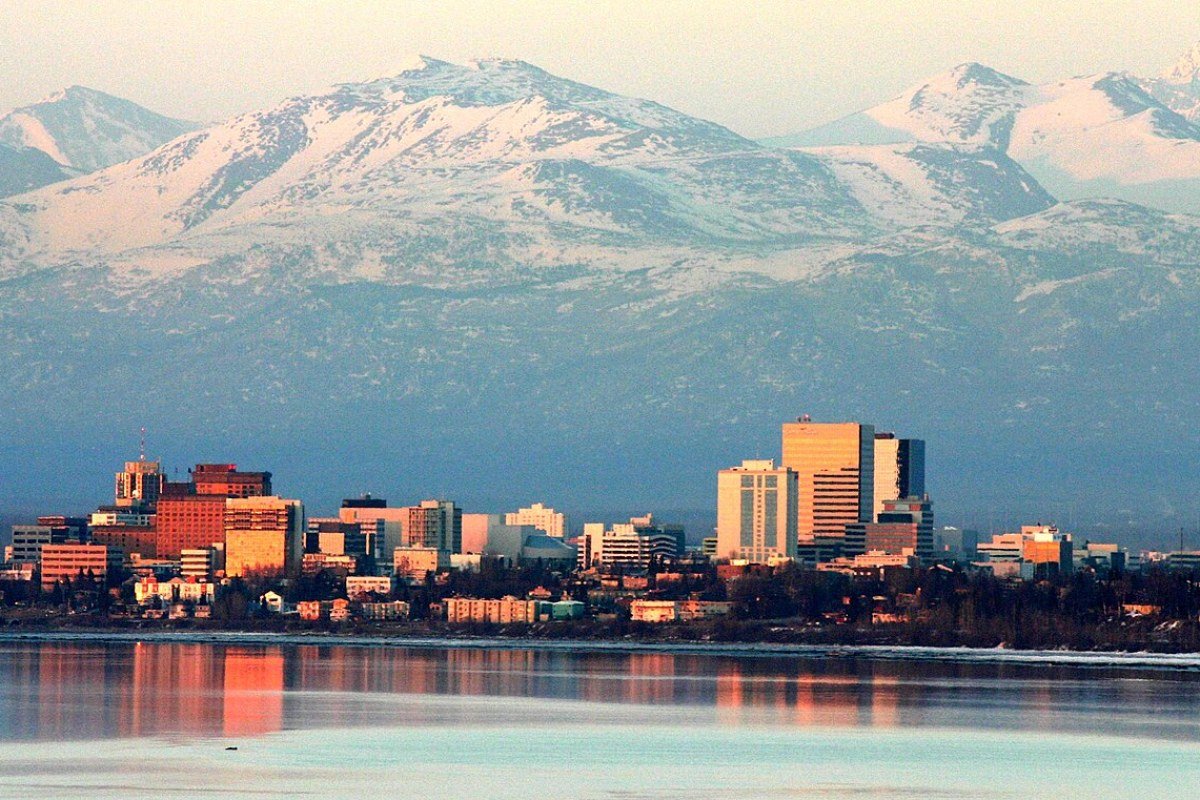
Anchorage is home to nearly 40% of Alaska’s entire population and serves as the practical entry point for most visitors to the state. Ted Stevens Anchorage International Airport receives flights from major US cities and from multiple Asian destinations, and the city’s road connections extend south to the Kenai Peninsula and north toward Fairbanks and Denali.
Anchorage surprises many visitors with how livable it feels. The city has excellent restaurants representing Alaska’s diverse immigrant communities, a serious museum in the Anchorage Museum at Rasmuson Center (with world-class collections on Alaska Native art and history), and a trail network that integrates urban and wilderness experiences in unusual ways. The Tony Knowles Coastal Trail runs 11 miles along the city’s western shoreline past views of Denali on clear days and moose browsing the adjacent wetlands year-round. Flattop Mountain, reachable by city bus and a short trail, opens onto sweeping views across the Anchorage bowl and Cook Inlet.
Homer: The Cosmic Hamlet on Kachemak Bay
Homer, at the southern end of the Kenai Peninsula, styles itself as “the cosmic hamlet at the end of the road” — a description that captures its remote charm and its character as a community of artists, commercial fishermen, environmentalists, and backcountry guides who have chosen a very particular kind of life at the edge of the map. The town itself sits above a dramatic bluff overlooking Kachemak Bay, with the Kenai Mountains rising behind it and Kachemak Bay State Park — one of Alaska’s wildest road-free preserves — visible across the water.
Homer Spit, the narrow strip of land that extends 4.5 miles into the bay, concentrates the town’s fishing docks, restaurants, galleries, and visitor services into a delightfully compact space. Halibut fishing from Homer is among the best in the state; the bay is one of the most productive Pacific halibut grounds in Alaska, and fishing charters operate throughout the summer season. Water taxis cross to Kachemak Bay State Park for hiking, kayaking, and bear viewing on beaches where the tides expose an enormous intertidal richness of sea stars, anemones, and other marine life.
Alaska Native Heritage: The First Peoples of the Last Frontier
Alaska’s cultural landscape is shaped by Indigenous peoples whose presence on this land long predates statehood — the Iñupiat and Yup’ik of the north and west, the Aleut and Alutiiq of the southwest coast and islands, the Athabascan peoples of the interior, and the Tlingit, Haida, and Tsimshian of the southeast panhandle. Travelers interested in this living heritage have several substantive options. The Alaska Native Heritage Center in Anchorage presents reconstructed dwellings from six cultural groups across a wooded 26-acre site, with daily demonstrations of dance, storytelling, and traditional craft. In Juneau, the Sealaska Heritage Institute anchors a serious program of Tlingit, Haida, and Tsimshian scholarship and exhibits inside the Walter Soboleff Building. Sitka National Historical Park preserves Tlingit totem poles along a coastal forest trail at the site of the 1804 battle between the Tlingit and Russian colonizers, while Wrangell-St. Elias National Park sits within the traditional homeland of the Ahtna Athabascan people, whose communities remain active partners in park management.
Practical Guide to Visiting Alaska
- Best overall time: Mid-June through late August. The Alaska State Fair in Palmer in late August marks the unofficial end of tourist season. September is spectacular but some services close.
- Getting around: Alaska Airlines is the dominant carrier with good coverage of Southeast Alaska. The Alaska Marine Highway ferry system connects coastal communities from Bellingham, WA to Dutch Harbor. The road system connects Anchorage to Fairbanks and the Kenai Peninsula but does not reach Southeast Alaska or many remote areas.
- Mosquitoes: Alaska’s summer mosquitoes are legendary and real. Pack quality repellent and consider a head net for any significant time outdoors away from wind.
- Bear safety: Bear encounters are a real consideration anywhere outside urban centers. Carry bear spray, know how to use it, and follow Leave No Trace food storage practices.
- Budget: Alaska is expensive. Food, accommodation, tours, and transportation all run 20–40% above lower-48 prices. Budget generously and book boats, tours, and lodges well in advance — popular options in peak season sell out months ahead.
- Daylight: Summer daylight in Alaska is dramatic and beautiful but can disrupt sleep. Bring a sleep mask if you are sensitive to light. Fairbanks gets close to 22 hours of direct sunlight around the summer solstice, with civil twilight keeping the sky usable for the remaining hours; Anchorage approaches 19 hours. The sun barely sets, and the light has a quality you will find almost nowhere else.
Why Alaska Is Worth the Effort
Alaska demands more preparation, more budget, and more flexibility than most destinations. It will also deliver more — more wildlife in a single day than some people see in a lifetime of nature travel, landscapes that exist at a scale the human brain struggles to process, and a sense of true wilderness that is nearly impossible to find anywhere else you can actually get to. The travelers who go once almost universally return. That is probably the most honest endorsement any destination can receive.
Frequently Asked Questions
What makes Denali National Park the crown jewel of Alaska?
Denali National Park encompasses 6 million acres of pristine wilderness centered on Denali — at 20,310 feet, the highest peak in North America, with a vertical relief of 18,000 feet above the surrounding lowlands that is greater than Mount Everest above its base. The park’s single road runs 92 miles through terrain shifting from boreal forest to open tundra, but private vehicles are restricted beyond the first 15 miles — access deeper into the park requires bus transportation that has preserved the wilderness character far more effectively than road-accessible parks elsewhere. The Pretty Rocks Landslide has limited buses to Mile 43 since 2021; the new bridge across the slide zone is expected to open by mid-2026, with full bus service along the entire 92-mile road resuming in 2027. The Denali bus system carries visitors past grizzly bears, moose, caribou, wolves, and Dall sheep in a wildlife viewing experience that is far more frequent and less staged than virtually any other accessible destination in North America. Hiking in Denali is largely off-trail across open tundra with topographic navigation, creating an authentic wilderness experience available nowhere else in the American park system.
What does Kenai Fjords National Park offer visitors?
Kenai Fjords National Park, accessible from Seward on the Kenai Peninsula, offers one of Alaska’s most accessible wilderness experiences. The park’s defining feature is the Harding Icefield — one of the largest icefields in the United States at over 700 square miles at elevations above 5,000 feet — and the dozens of glaciers that flow from it to the sea. Exit Glacier, the park’s only road-accessible glacier, has retreated sharply over the past century, and markers along the trail documenting its past extent provide one of the most visceral representations of climate change in any American national park. Full-day fjord cruises from Seward traverse the coastline past calving tidewater glaciers, humpback whales, orca pods, sea otters, Steller sea lions, and puffin colonies at the Chiswell Islands — a wildlife experience that stands with the finest in North America and is an essential part of any Alaska itinerary. For hikers, the Harding Icefield Trail climbs 8.2 miles round-trip from the Exit Glacier area to a viewpoint above the icefield itself.
What is Glacier Bay National Park and how do you access it?
Glacier Bay is a place of geological superlatives. Two hundred and fifty years ago, the entire bay was buried under a glacier more than 4,000 feet thick. Today that glacier has retreated over 65 miles — one of the fastest glacial retreats recorded on earth — revealing a landscape in active ecological succession from bare rock to dense forest. The park has no road connection to the Alaska highway system; the nearest community of Gustavus (population approximately 600) is served only by small aircraft and ferry from Juneau. Cruise ships are the dominant mode of access for most visitors, though independent travelers can book passage via the Alaska Marine Highway ferry. The experience of moving through the bay on a calm morning — glaciers on every side, humpback whales surfacing nearby, the silence broken only by the distant thunder of calving ice — is one of Alaska’s defining experiences.
What does Juneau offer visitors and why is it unusual as a capital city?
Juneau is one of only two US state capitals not reachable by road (Honolulu is the other), accessible only by air or sea. The Mendenhall Glacier, about 13 miles from downtown and a 20-minute drive by car or shuttle, is one of Alaska’s most visited natural attractions — descending from the Juneau Icefield into an expanding terminal lake that provides an accessible window onto glacial change requiring no mountaineering experience. The East Glacier Loop Trail provides the best glacier views combined with old-growth forest. The Mount Roberts Tramway rises from just outside downtown to alpine tundra with panoramic views over Gastineau Channel and Southeast Alaska. Day trips to Tracy Arm Fjord — a narrow iceberg-choked channel with 3,000-foot sheer rock walls and tidewater glaciers — offer some of the most arresting scenery in a region already full of it.
What are the practical details for planning an Alaska trip?
Alaska requires serious planning. The state is larger than Texas, California, and Montana combined, and many communities have no road access — served only by small aircraft or boat. The best time to visit most destinations is mid-June through mid-August for maximum wildlife activity, road access, and favorable weather; September brings spectacular fall color (tundra reds and golds) and noticeably fewer crowds but less consistent wildlife viewing. The Alaska Marine Highway ferry system connects communities throughout Southeast and Southcentral Alaska with vehicle-capable ferries — a scenic and affordable alternative to flying for those with time flexibility. Fairbanks is the premier destination for aurora borealis viewing, positioned nearly under the auroral oval — the Chena Hot Springs Resort (56 miles northeast) is the most popular aurora-viewing base, where guests soak in outdoor geothermal pools while aurora light ripples overhead. Activity tends to peak around the equinoxes — September through October and February through March.