Texas has been one of the premier relocation destinations in the United States for a decade, driven primarily by its no-income-tax status and the Sun Belt growth economy that has made Dallas-Fort Worth and Austin two of the largest and fastest-growing metropolitan areas in the United States. The financial case for Texas needs a more nuanced presentation than the “no income tax” headline suggests: the state recovers much of the revenue difference through property taxes that rank among the highest effective rates in the nation, and the housing market in the big metros has appreciated sharply as in-migration from California and the Northeast pushed demand well above what Texas’s abundant land supply would imply. The honest answer is that Texas delivers strong financial advantages for most households, but the property tax structure requires specific budgeting that many newcomers underestimate.
Texas Cost Overview 2026
- No state income tax — fully in effect
- Property tax effective rate: roughly 1.5–1.8% statewide — among the highest in the nation, and the highest of the no-income-tax states (homestead exemptions reduce this for primary residences)
- Sales tax: 6.25% state + up to 2% local = 8.25% maximum combined
- Austin metro median home price: $420,000–$460,000 (down sharply from the 2022 peak near $550,000)
- Dallas-Fort Worth metro median: $380,000–$420,000
- Houston metro median: $320,000–$360,000
- San Antonio metro median: $280,000–$320,000
The Property Tax Reality
Texas‘s property tax rates are the cost-of-living factor that newcomers from California or the Northeast most often underestimate. On a $400,000 home in a typical Dallas suburban school district, an effective rate near 2% produces an annual tax bill of roughly $8,000 — the equivalent of paying a 5.5% income tax on $145,000 of earnings. As of 2026, the Texas homestead exemption removes $140,000 from a home’s taxable value for school district taxes (raised from $100,000 under Proposition 13, approved by voters in November 2025), which provides real relief on primary residences, but the underlying rate structure still produces bills that surprise buyers from low-property-tax states. The exemption must be applied for at the county appraisal district and takes effect the following tax year, so new Texas homeowners should file right away.
Austin’s Market Correction
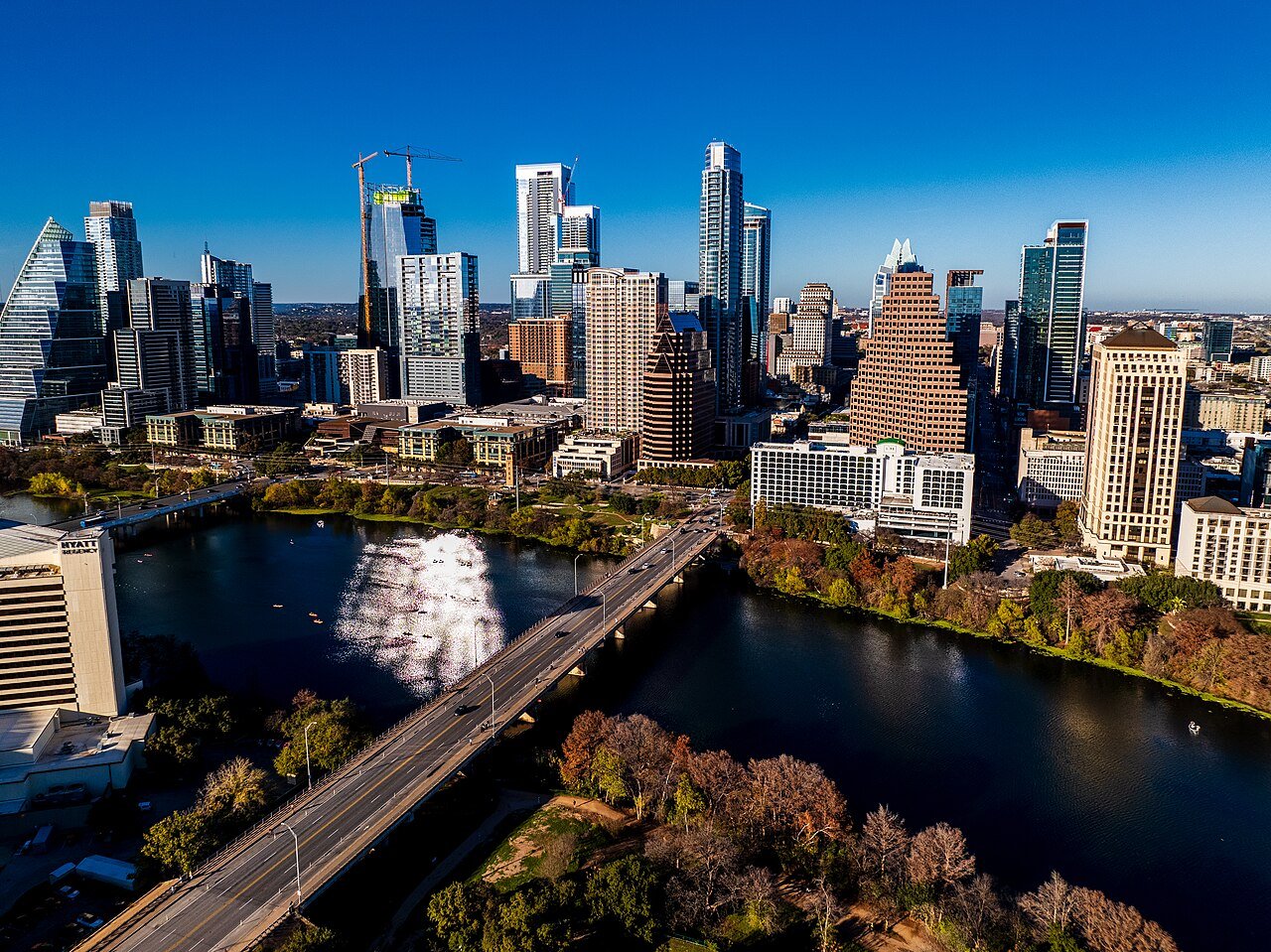
Austin saw the steepest housing run-up and the sharpest pullback of any large US market between 2020 and 2023. Median prices in the metro climbed about 70% from 2019 to a 2022 peak near $550,000, then fell roughly 16–20% off that high. The 2026 market has settled into a $420,000–$460,000 median — well below the peak but still elevated against historical Austin norms. On the rental side, a one-bedroom apartment in desirable central neighborhoods runs $1,500–$2,000 a month, while outer suburbs such as Round Rock, Cedar Park, Pflugerville, and Kyle offer $1,200–$1,600. The correction has made Austin competitive again for tech workers earning coastal salaries remotely.
Dallas-Fort Worth: Corporate Headquarters Value
The DFW metroplex — the fourth-largest metro in the United States and home to 24 Fortune 500 headquarters, among them McKesson, AT&T, American Airlines, Southwest Airlines, and Caterpillar — offers one of the strongest employer-base-to-housing-cost ratios anywhere in the nation. The $380,000–$420,000 metro median hides a wide spread by submarket: the most sought-after Plano, Southlake, and Colleyville suburbs clear $500,000, while far-out communities like Rockwall, Forney, and Wylie start around $300,000. The DART light rail gives inner-suburb commuters a genuine alternative to driving, though a car remains essential for most residents.
Houston: The Affordable Giant
Houston has the most affordable housing market of Texas’s big cities, a reflection of both its enormous geographic footprint and the abundance of developable land under no zoning code (Houston is the only major US city without zoning, and the fourth-largest city in the country by population). Metro-wide prices of $320,000–$360,000 conceal sharp contrasts: the desirable inner-loop neighborhoods — Heights, Montrose, River Oaks, West University — clear $500,000, while suburban communities like Katy, Pearland, and Sugar Land run $280,000–$380,000. Flooding is the single most important factor in evaluating a Houston property: Hurricane Harvey inundated more than 100,000 homes in 2017, and a FEMA flood map review is essential before any purchase here.
Utilities and Insurance
Texas runs a deregulated electricity market, letting consumers choose among retail providers — but the February 2021 winter storm Uri, which knocked out power across the state and sent prices spiking under the ERCOT market structure, turned energy resilience into a real residential concern. Backup power, whether generators or batteries, has become common in newer construction, and natural gas remains cheap. Homeowners insurance in Texas ranks among the priciest in the country, reflecting hail, hurricane, and tornado exposure — Gulf Coast properties can face premiums of $3,000–$10,000-plus a year for flood and wind coverage. Inland homes carry mainly hail and tornado risk, with premiums closer to $2,000–$4,000 for a standard house.
San Antonio: The Underrated Value Metro
San Antonio, Texas’s second-largest city and the sixth-largest in the United States after passing Philadelphia in 2026, gets consistently overlooked in the Texas relocation conversation despite offering the strongest financial value in the state’s big metros. Its $280,000–$320,000 median reflects a market under less pressure than Austin or Dallas, since the city has drawn fewer corporate-headquarters relocations — but its economy is genuinely diverse: a large military presence anchored by Joint Base San Antonio, USAA in financial services, healthcare centered on the South Texas Medical Center, and a substantial tourism industry built around the Alamo and River Walk. For remote workers and retirees, the math is hard to beat: no income tax, mid-range housing, mild winters, an authentic Tex-Mex food culture, and easy access to the Hill Country wine country make San Antonio one of the most livable big metros in the country at its price point.

Budgeting Practically for Texas
Understanding the cost of living in Texas is the foundation; the next step is knowing which costs are fixed and which you can optimize for your own lifestyle. Housing is the biggest variable in almost any budget, and the right neighborhood within Texas can shift your monthly costs dramatically while still keeping you close to the places and amenities you care about. Utilities, transport, and food compound over time, so even modest differences per month add up over a year. The cost advantages of Texas against high-cost cities like New York, San Francisco, or Sydney are real and measurable, and many people who relocate report a clear improvement in their financial position alongside a better overall quality of life. Treat these figures as a starting framework and verify current rental and property prices for your specific target area, since local markets can move faster than annual cost-of-living studies.
Frequently Asked Questions
Does Texas have a state income tax?
No — Texas has no state income tax. It recovers much of the difference through property taxes that rank among the highest effective rates in the country at roughly 1.5–1.8% statewide. A $400,000 home in a typical Dallas suburban school district carries about $8,000 a year in property taxes. As of 2026, the Texas homestead exemption removes $140,000 from a home’s taxable value for school district taxes on primary residences (raised from $100,000 under Proposition 13 in November 2025) — file right away at your county appraisal district.
Is Austin still affordable after its price run-up?
More affordable than the 2022 peak, but not cheap. Austin metro medians have settled around $420,000–$460,000 after a roughly 70% run-up to a peak near $550,000, followed by a 16–20% correction. One-bedroom apartments in central Austin run $1,500–$2,000 a month; outer suburbs (Round Rock, Cedar Park, Kyle) run $1,200–$1,600. The city is competitive again for tech workers earning coastal salaries remotely, but it remains pricier than San Antonio or Houston.
What is the most affordable major Texas city?
San Antonio — metro medians run $280,000–$320,000, the lowest among Texas’s big cities. The economy is diverse (Joint Base San Antonio, USAA, the South Texas Medical Center, tourism), winters are mild, and the Hill Country wine country is close by. For remote workers and retirees, San Antonio delivers the strongest value-to-lifestyle ratio of the Texas big metros.
What are property taxes like in Texas compared to other states?
Among the highest effective rates in the country — roughly 1.5–1.8% statewide, against a national average near 0.9%. In dollar terms, a $500,000 Texas home carries roughly $8,000–$10,000 a year in taxes. That meaningfully shrinks the net advantage of no income tax for households at this level. The homestead exemption ($140,000 off school district taxable value as of 2026) and senior freeze programs provide real relief for qualifying primary-residence owners.
Is Houston prone to flooding?
Flooding is the single most important factor in evaluating a Houston property. Hurricane Harvey (2017) inundated more than 100,000 homes. Review FEMA flood maps before buying — properties in flood zones require separate flood insurance, which can add $1,000–$5,000-plus a year to carrying costs. Homes above base flood elevation in historically dry neighborhoods command a rational premium that reflects lower insurance costs and reduced risk.