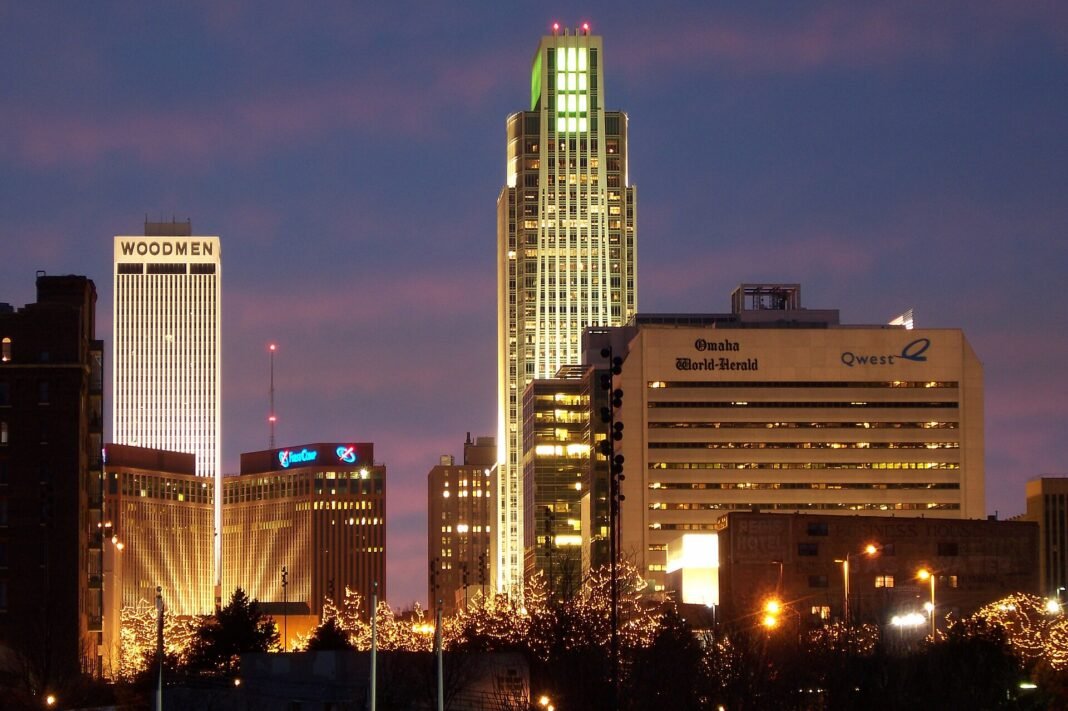
Nebraska offers one of the most straightforward cost-of-living value propositions in the Midwest — housing well below the national median, a state income tax that is being actively reduced, and everyday costs that track the state’s agricultural output and a competitive retail market. For households working in Nebraska’s core economic sectors — insurance and financial services in Omaha, agriculture and its allied industries statewide, and the technology firms clustering around Omaha’s Financial District — good wages paired with low costs produce a quality of life that rivals far pricier metros at twice the income requirement.

Housing: Omaha’s Competitive Affordability
Omaha, Nebraska’s largest city with roughly 480,000 residents (metropolitan area now above one million), holds some of the most affordable major-city housing in the United States. Median home prices in Omaha proper run $200,000–$310,000, with the most sought-after neighborhoods sitting well above that range. The Dundee neighborhood — early 20th-century bungalows and foursquares near the Dundee-Memorial Park commercial district — runs $280,000–$420,000. Midtown Omaha around the Creighton University campus, the Aksarben Village redevelopment near the University of Nebraska-Omaha, and the historic Benson and Minne Lusa neighborhoods sit at $200,000–$350,000. The western suburbs — Elkhorn, Papillion, La Vista, and Bellevue — mix new construction with established subdivisions at $220,000–$380,000, while the newer west Omaha communities of Gretna and Papillion reach $280,000–$400,000 on the strength of school-district quality and new-build premiums.
Lincoln, the state capital and home to the University of Nebraska (the state’s flagship campus with about 24,000 students), shows median home prices of $200,000–$300,000 — slightly under Omaha and reflecting a smaller but similarly well-served metropolitan market. The Near South neighborhood (historic homes near the Haymarket), the older Near North and Northeast districts, and the newer subdivisions of southern Lincoln cover a wide span of options. The Haymarket — Lincoln’s most walkable commercial quarter, a renovated warehouse district beside the Pinnacle Bank Arena and Haymarket Park — offers the most urban residential experience in the city at loft and apartment prices comparable to Omaha’s Old Market.
The smaller Nebraska cities — Grand Island, Kearney, Norfolk, Columbus, and Scottsbluff — carry housing at $150,000–$240,000 that tracks local wages in agricultural and manufacturing economies. These towns deliver genuine affordability for households working in local industries, though amenity access is limited for anyone accustomed to metropolitan services. In rural Nebraska and the smaller county-seat towns — where $100,000–$150,000 can buy a substantial older home — affordability is extreme, but it demands an honest read on available services and employment.

State Income Tax
Nebraska’s state income tax is in the middle of a multi-year reduction — laws passed in 2022 and 2023 are phasing the top rate down from 6.84% toward 3.99% by 2027. For the 2026 tax year the structure collapses to three brackets, and the top rate falls to 4.55%, reaching most filers on taxable income above roughly $18,000 (single). That keeps Nebraska’s income-tax burden in the moderate range nationally — below the high-tax states, though still above the zero-income-tax states it increasingly competes with for business and residents. The final step down to 3.99% in 2027 will leave Nebraska with one of the more competitive income-tax rates in the Midwest.
One caveat that sets Nebraska apart: it remains one of only a handful of states that still levies an inheritance tax, and the only one that collects it at the county level rather than the state level. Rates run from 1% for close relatives (after a $100,000 exemption) up to 15% for unrelated heirs. Repeal and reduction bills have surfaced repeatedly in the legislature — most recently in 2025 — but none has cleared, so estate planning in Nebraska still warrants attention to the county inheritance tax.
Property Taxes
Nebraska’s property taxes sit above the national average — an effective statewide rate of roughly 1.4–1.5% of assessed value ranks among the highest in the country, not just the Midwest. Applied to the state’s relatively low home values, that produces bills that look steep in percentage terms but stay modest in absolute dollars: a $250,000 Omaha home carries annual taxes of about $3,500–$4,000. Agricultural land is assessed at a different ratio than residential property, so farmers and ranchers have long shouldered a heavy share of the local tax burden — a tension that has driven recurring attempts at property tax reform.
Everyday Costs
Everyday costs in Nebraska land below the national average in most categories. Grocery prices run 3–6% under the national figure, helped by the state’s agricultural output and a crowded retail market (Hy-Vee, Baker’s/Kroger, ALDI, and Walmart anchor the grocery scene). Restaurant dining in Omaha has matured to a level that yields nationally recognized kitchens at prices 30–40% below comparable quality on the coasts. Energy costs hover near the national average — Nebraska’s power mix leans on coal, with a sizable share of wind that supplies close to a third of the state’s electricity, plus nuclear and natural gas. Its flat terrain and steady wind have made it one of the more active wind-farm states, and renewables make up a meaningful slice of generation.
The Nebraska Value Case
The cost-of-living advantage is sharpest in Omaha — a metro where Fortune 500 headquarters (Berkshire Hathaway, Union Pacific, Kiewit, and Mutual of Omaha are all based here), major healthcare systems (Nebraska Medicine, CHI Health, and Methodist Health System), and a growing technology sector pay professional salaries on par with much larger metros at housing costs 50–70% lower. A household earning $120,000 in Omaha stretches that income much further than the same household would in Denver, Chicago, or any coastal market — not because Nebraska wages are low, but because the cost base lets the paycheck go further. For families, the suburban school districts of the Omaha metro (Millard, Westside, and Elkhorn in particular) are strong, and the pairing of good schools with affordable housing in the western suburbs is essentially unavailable at comparable quality in high-cost metros.
Frequently Asked Questions
Is Omaha, Nebraska affordable?
Yes — Omaha holds some of the most affordable major-city housing in the United States. Median home prices in Omaha proper run $200,000–$310,000. Sought-after neighborhoods like Dundee run $280,000–$420,000. Western suburbs (Elkhorn, Papillion, La Vista) sit at $220,000–$380,000. Omaha is home to multiple Fortune 500 headquarters (Berkshire Hathaway, Union Pacific, Kiewit, Mutual of Omaha) paying competitive professional salaries against this low cost base.
What is Nebraska’s income tax rate?
Nebraska’s top income tax rate is being phased down — from 6.84% toward 3.99% by 2027. For the 2026 tax year the brackets simplify to three and the top rate falls to 4.55%. Note that Nebraska still levies a county-level inheritance tax, with rates from 1% for close relatives up to 15% for unrelated heirs, so estate planning warrants attention.
Are Nebraska property taxes high?
Nebraska property taxes are above the national average — effective rates of roughly 1.4–1.5% statewide, among the highest in the country. A $250,000 Omaha home carries about $3,500–$4,000 a year. In absolute dollar terms these stay manageable given Nebraska’s low home prices, but the rates themselves are high, and property tax reform is a recurring issue in the legislature.
Is Lincoln, Nebraska cheaper than Omaha?
Slightly — Lincoln shows median home prices of $200,000–$300,000, just under Omaha’s $200,000–$310,000. Lincoln is the state capital and home to the University of Nebraska, with a lively Haymarket district (a renovated warehouse quarter beside the Pinnacle Bank Arena). Both cities offer excellent urban value relative to coastal equivalents.
What are everyday costs like in Nebraska?
Below the national average in most categories. Grocery prices run 3–6% under average, helped by the state’s agricultural output. Restaurant dining in Omaha runs 30–40% below comparable quality in coastal cities. Energy costs sit near the national average, and wind supplies close to a third of Nebraska’s electricity, behind coal.