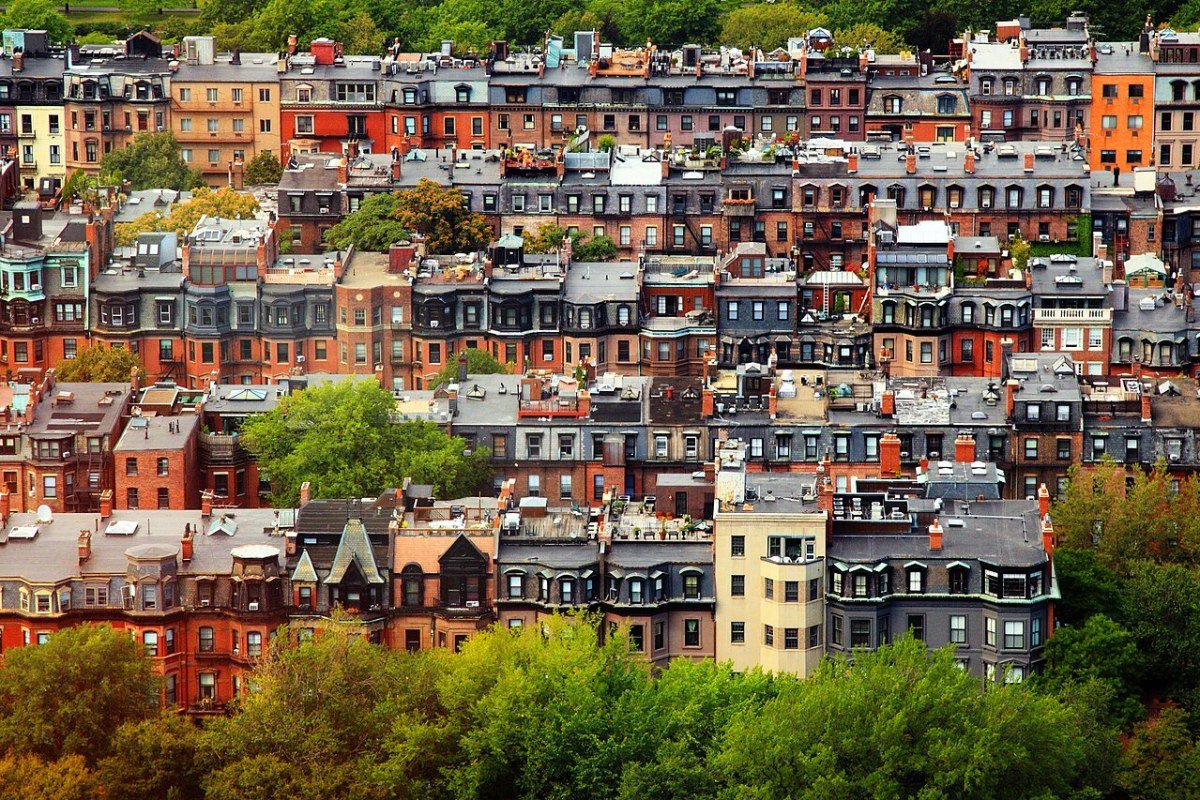
Massachusetts carries one of the highest costs of living in the United States — a reality driven mainly by housing, healthcare, and energy, all concentrated in the Greater Boston metropolitan area, which routinely ranks among the five priciest housing markets in the country. Reading the state’s price tag means separating three very different places: Boston and its inner suburbs, where costs reach extremes; the mid-tier suburban and secondary-city markets, where they stay high but manageable; and the cheaper communities of central and western Massachusetts, where the profile resembles a mid-sized Midwestern city more than a coastal elite enclave. The payoffs justify the premium: world-class universities, top-tier healthcare, strong suburban public schools, and a knowledge economy that pushes wages upward for households whose paychecks come from the Massachusetts economy. For remote workers or retirees, the math gets trickier.

Housing: The Boston Premium
Greater Boston‘s housing market is defined by scarcity — a dense, historically developed metropolitan area with limited land for new construction, strict zoning that has historically restricted multifamily development, and relentless demand from the university-hospital-technology employment complex that makes Boston one of the most desirable labor markets in the country. The result is real estate that has appreciated faster than almost any major American city over the past two decades.
Boston proper shows median home prices of $700,000–$900,000 for condominiums and single-family homes, with significant variation by neighborhood. The South End, Back Bay, Beacon Hill, and the Seaport District command prices of $1 million to well over $2 million for larger units and townhouses. Areas like Jamaica Plain, Roslindale, and Hyde Park, once lower in prestige but rich in urban character, have climbed steeply and now post medians of $650,000–$800,000 that would have been unthinkable a decade ago.
The inner suburbs (Cambridge, Somerville, Brookline, Newton, and Lexington) are as expensive as or more expensive than Boston proper. Cambridge, home to Harvard and MIT, posts median prices of $1 million–$1.2 million, fueled by steady demand from academic and tech buyers who treat a Cambridge address as an investment as much as a residence. Brookline’s school system, among the strongest in the state, pushes medians to $1.2 million–$1.5 million for single-family homes. Newton, pairing top schools with easy transit into Boston, runs $900,000–$1.3 million.
The second ring of suburbs, communities like Framingham, Natick, Waltham, Malden, Medford, and Woburn, provides more accessible entry points at $550,000–$750,000, with the trade-off of longer commutes and less walkable environments. The North Shore (Salem, Beverly, Gloucester, Newburyport) and South Shore (Quincy, Braintree, Weymouth, Plymouth) offer coastal living at $450,000–$650,000 — above the national average, but realistic for households earning Boston-area salaries.
The truly affordable Massachusetts lies west of Route 495 — the outer beltway that roughly marks the edge of the Boston metropolitan premium. Worcester, the state’s second-largest city and one of the fastest-appreciating markets in the country, posts median prices of $420,000–$490,000. Springfield and the Pioneer Valley towns of Northampton, Amherst, and Holyoke run $280,000–$400,000. Out in the Berkshires, places like Pittsfield, Adams, and North Adams sell for $190,000–$300,000 — about as cheap as housing gets anywhere in New England.
Rental Market: Boston’s Particular Challenge
Boston’s rental market behaves in ways that catch newcomers off guard. The academic calendar bends the whole cycle: most city leases begin on September 1, set by the university schedule and the huge student population that turns over each year. Apartment hunting therefore peaks between April and August, when nearly every available unit changes hands at once. Looking outside that window, say, moving to Boston in January, is hard going, with thin inventory and landlords who have little reason to bargain. New residents who can time their move to the fall cycle will find far more to choose from.
Median rents in Boston proper run $2,750–$3,100 for a one-bedroom apartment and $3,400–$4,200 for a two-bedroom — figures that rival San Francisco, Seattle, and Washington D.C. Cambridge one-bedrooms run $3,200–$3,500 and Somerville $2,500–$2,800. The inner suburbs offer modest relief at $2,200–$2,800 for one-bedrooms. In Worcester, one-bedrooms at $1,500–$1,900 are the best deal in any Massachusetts city that still comes with true urban amenities.

State Income Tax
Massachusetts levies a flat income tax rate of 5% on most income — a relatively simple structure compared to the graduated systems of neighboring states. A 4% “Fair Share” surtax applies to taxable income above the inflation-adjusted threshold of $1,107,750 for tax year 2026 (the “millionaire’s tax” passed by voters in 2022 and effective from January 1, 2023), bringing the effective top rate to 9% on income above that threshold. There is no local income tax in Massachusetts — unlike New York City or Maryland’s county levies, Boston residents pay only the state rate. Because the structure is flat, middle-income earners face roughly the same rate as high earners (the surtax aside), which lands well below the top marginal brackets of California or New York State but above the flat taxes of Illinois (4.95%) or Indiana (2.95%).
The state pairs that flat rate with a relatively generous system of deductions and exemptions: personal exemptions of $4,400 (single) and $8,800 (married), deductions for rent paid (up to $4,000 for tax year 2026, a significant benefit in the Boston rental market), and deductions for student loan interest that matter in a state full of recent graduates. For a middle-income household earning $80,000–$120,000, the overall income tax bite is real but roughly in line with neighboring northeastern states.
Property Taxes
Massachusetts property tax rates are moderate relative to the value of the real estate being taxed — a distinction that matters a great deal in practice. The average effective rate statewide sits around 1.0–1.1%, near the national average, and Proposition 2½ caps how much a community’s total levy can grow each year. Applied to Boston’s median home price of about $800,000, though, a 1.0% rate yields an annual bill near $8,000 — a hefty dollar amount even at a modest percentage. In the inner suburbs, where $1 million–$1.2 million homes carry $10,000–$13,000 in yearly taxes, the line item weighs heavily on the household budget.
State law also provides a residential tax exemption for owner-occupants in communities that adopt it (many communities have, including Boston), which trims the taxable assessed value of a primary residence by a fixed amount — currently cutting the tax on a Boston home by about $4,000–$4,350 a year. You have to file for it each year, and it is open only to owner-occupants, not landlords or investors.
Everyday Costs and Utilities
Energy costs in Massachusetts rank near the top in the continental United States — a function of the state’s location at the end of the natural gas pipeline infrastructure and its dependence on imported fuel for electricity generation. Average residential all-in electricity rates (supply plus delivery) run roughly 30–34 cents per kilowatt-hour in 2026, against a national average near 18 cents, with National Grid territories at the upper end and Eversource a touch below. Heating is the biggest swing expense for residents: homes on natural gas (the common fuel in Greater Boston) average $1,400–$2,200 a year in heating bills; homes on heating oil (more typical in suburban and rural areas) average $2,200–$4,200, the figure jumping with oil prices and winter severity. New England winters bite — not Minnesota cold, but cold enough that heating is a standing line item rather than an afterthought, with Boston averaging close to 49 inches of snow per winter.
At the supermarket, prices run approximately 8–12% above the national average, though the state’s sales tax exempts groceries and clothing under $175 per item — small but real offsets for anyone watching a tight budget. Market Basket (a New England chain with standout prices for the quality), Stop & Shop, Whole Foods, and Trader Joe’s blanket Greater Boston, covering every price point. Dining reflects Boston’s standing as one of America’s serious food cities — top-end restaurant meals run $80–$150 per person, while the deep immigrant dining scene (Vietnamese in Dorchester, Chinese in Chinatown and Quincy, Brazilian in Somerville) delivers superb food for a fraction of that.
Transportation Costs
The MBTA (Massachusetts Bay Transportation Authority) provides one of the oldest subway systems in America and the most extensive public transit network in New England. A monthly LinkPass costs $90 and covers unlimited subway, bus, and inner harbor ferry rides — a strong deal for anyone who can live car-free or car-minimal. The Green Line Extension to Medford/Tufts opened in late 2022, and the system-wide slow zones that had hobbled the subway through 2023 were cleared by the end of 2024, restoring scheduled trip times across the Red, Orange, and Blue lines. The commuter rail reaches Providence, Worcester, Lowell, Newburyport, and Plymouth, with monthly passes from $90 to $426 depending on the distance zone, letting suburban residents reach Boston jobs without driving.
Owning a car in Greater Boston adds up fast: a downtown garage space runs $250–$400 a month, and street-parking permits in residential neighborhoods are never guaranteed. Car insurance in Massachusetts is close to the national average — the state’s heavily regulated market produces premiums of around $1,500–$2,000 a year, below New York or New Jersey despite the dense traffic. For households that can shed a car by choosing transit-friendly neighborhoods, the state’s transit network offsets a good chunk of its high housing and energy costs.
The Massachusetts Cost Calculation
Massachusetts gives you a lot for the money — but only if your household actually draws on what the state offers. The research and academic complex (Harvard, MIT, the teaching hospitals, the tech cluster around Route 128 and Cambridge) pays the wages that make the premium worthwhile. The inner-suburb school systems (Lexington, Brookline, Newton, Winchester) rank with the country’s best and earn their keep for families with children. Culturally, little else in the country competes: the MFA, the BSO, the deep dining scene, the Cape Cod beaches.
For remote workers whose paycheck doesn’t depend on the local economy, the calculus shifts. Worcester and the Pioneer Valley deliver Massachusetts living — real New England character, solid healthcare, easy reach to the universities and cultural institutions — at costs 30–50% below Greater Boston. The trade-off is a thinner job market for anyone who eventually returns to office work, and the loss of the Boston metro’s tightly clustered amenities. But for a household that prizes quality of life over a Boston ZIP code, western Massachusetts is one of the more underrated bargains in the northeastern United States.
Frequently Asked Questions
How expensive is Boston to live in?
Boston is one of the five most expensive housing markets in the US. Boston proper median home prices run $700,000–$900,000, with the South End, Back Bay, and Beacon Hill reaching $1 million–$2+ million. Inner suburbs like Cambridge, Brookline, and Newton run $1 million–$1.5 million. One-bedroom apartments average $2,750–$3,100 per month in Boston proper and $3,200–$3,500 in Cambridge. Housing is the dominant driver of Boston’s high cost of living.
Is there an affordable part of Massachusetts?
Yes — significantly west and south of Boston. Worcester, the state’s second-largest city, offers median home prices of $420,000–$490,000 and one-bedroom rents of $1,500–$1,900. The Pioneer Valley (Springfield, Northampton, Amherst) runs $280,000–$400,000. The Berkshires in western Massachusetts start as low as $190,000–$300,000. These areas offer 30–50% lower costs than Greater Boston while preserving genuine New England character and reasonable access to Boston-area employment for remote workers.
What are electricity costs in Massachusetts?
Electricity in Massachusetts is among the most expensive in the continental US — averaging 30–34 cents per kilowatt-hour all-in (supply plus delivery) in 2026, compared to a national average of around 18 cents. National Grid territories are at the upper end and Eversource is slightly lower. Heating costs are also significant: natural gas heating averages $1,400–$2,200 annually, and homes on heating oil average $2,200–$4,200 with year-to-year variation based on fuel prices and winter severity.
What is Massachusetts’s income tax rate?
Massachusetts levies a flat income tax of 5% on most income, with a 4% “Fair Share” surtax on taxable income above $1,107,750 for tax year 2026 (the threshold is adjusted annually for inflation), bringing the effective top rate to 9% above that level. There is no local income tax in Massachusetts cities — unlike New York City or Maryland’s county income taxes. Renters can deduct up to $4,000 annually for tax year 2026 — a meaningful benefit in the Boston rental market.
Is Boston’s MBTA transit worth using?
Yes, for residents who can position themselves near it. A monthly LinkPass costs $90 and provides unlimited subway, bus, and inner harbor ferry access — exceptional value compared to the $250–$400/month cost of downtown parking. The commuter rail network extends to Providence, Worcester, Lowell, Newburyport, and Plymouth, with monthly passes of $90–$426 by distance zone. For households living car-free or car-minimal near MBTA lines, the transit savings offset a sizable share of Boston’s premium housing costs.