Scotland Outdoor Guide 2026: Munros, Islands, and the World’s Best Walking
Scotland has the finest mountain and island landscape in the British Isles and a claim to being one of the best walking destinations in Europe — a combination of 282 Munros (mountains above 914m), a 6,000km coastline punctuated by 790 islands, the world’s only national park dedicated specifically to highland terrain (Cairngorms National Park, 4,528km²), and a unique legal framework (the Land Reform (Scotland) Act 2003) that gives the public the right of responsible access to virtually all land in Scotland, including private estates and farmland, without the need for footpaths or designated rights of way. This access right — the most permissive in Europe — means that Scotland’s mountains, moorlands, forests, and shorelines are available to walkers, cyclists, and wild campers in a way that England and most of Europe’s more restrictive land ownership structures do not allow. The outdoor culture that results is one of Scotland’s most distinctive qualities — a country where hillwalking, wild swimming, sea kayaking, and wild camping are not exceptional activities but everyday practices for a significant portion of the population.
Munro Bagging: Scotland’s Great Outdoor Tradition
A Munro is a Scottish mountain above 914m (3,000 feet), classified by Sir Hugh Munro in 1891 — there are currently 282 Munros and 227 Corbetts (mountains of 762–914m). Munro bagging (attempting to climb all 282) has become one of Scotland’s defining outdoor pursuits; approximately 6,000 people have completed all 282 (called “compleating”), and hundreds of thousands more have climbed individual Munros.
- Ben Nevis: Britain’s highest mountain (1,345m) and Scotland’s most climbed Munro — the Mountain Track (the “tourist path”) from the Glen Nevis car park ascends 1,350m in 12km (5–7 hours return). Ben Nevis’s summit is above the cloud base for most of the year; the full summit plateau experience — the cairn, the ruins of the Victorian Observatory, the vertiginous north face cliffs (the finest winter climbing in Britain) — requires navigation skills and appropriate equipment. The views on a clear day extend to the Cairngorms, Ben More on Mull, and theoretically to Ireland
- The Black Cuillin, Skye: The most technically demanding ridge in Britain — 12km of gabbro ridge with 11 Munros, multiple sections of exposed scrambling, and several routes requiring roped climbing. The full traverse (the Cuillin Ridge Traverse, 12–16 hours for an experienced team) is considered Britain’s greatest mountaineering challenge. Individual Munros on the ridge (Sgurr Alasdair, Sgurr nan Gillean, Sgurr Dearg/Inaccessible Pinnacle) provide extraordinary experiences for those with scrambling confidence
- The Cairngorms: The high plateau (above 1,000m) of the Cairngorms supports the most genuinely arctic environment in Britain — a sub-arctic ecosystem with reindeer, ptarmigan, dotterel, and mountain hare living in habitats that exist nowhere else in the UK. The four Munros of the Cairngorm plateau (Cairn Gorm, Ben Macdui, Braeriach, Cairn Toul) are accessible from Cairngorm Mountain’s car park but require navigation across a featureless plateau in cloud
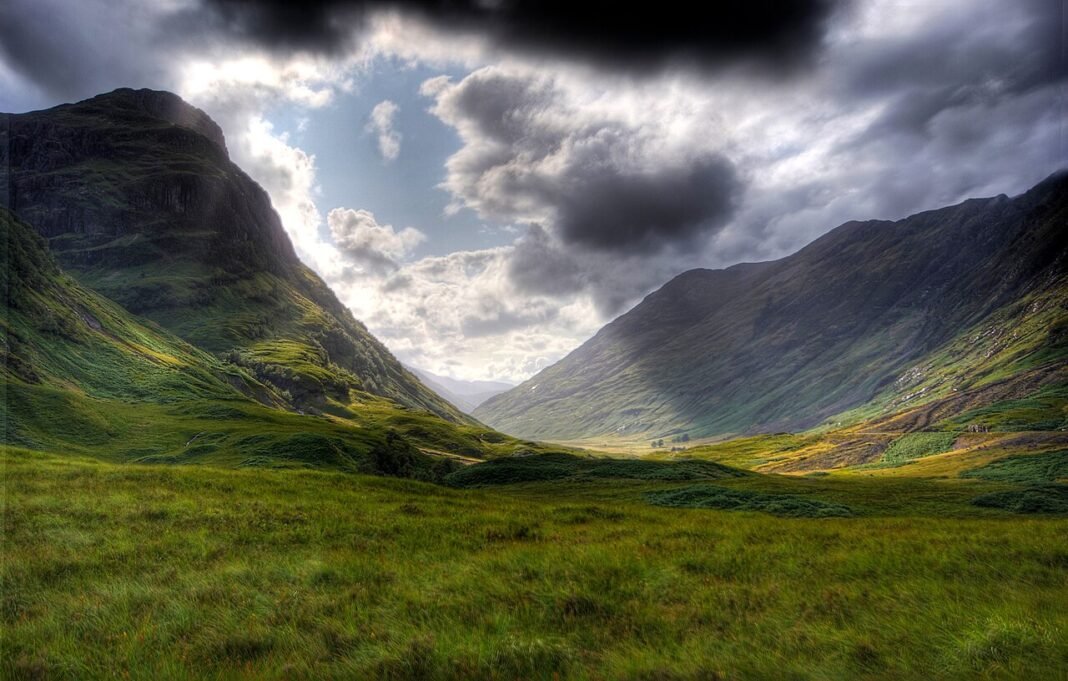
- Glencoe Munros: The Buachaille Etive Mòr (the “Great Shepherd of Etive,” the pyramid-shaped peak at the eastern entrance of Glencoe), the Bidean nam Bian (Glencoe’s highest Munro, accessed via the Three Sisters ridges), and the Aonach Eagach (the narrowest ridge traverse in Scotland’s mainland, requiring exposed scrambling along the north side of Glencoe) offer some of Scotland’s most dramatic mountain experiences within 90 minutes of Glasgow

The Islands: Skye, the Outer Hebrides, and the Northern Isles
Scotland’s island landscape is one of the finest in Europe — 790 inhabited and uninhabited islands ranging from Skye (1,656km²) to tiny skerries of storm-washed rock, each with its own geology, culture, and relationship with the surrounding sea.
- Isle of Skye: The most visited Scottish island — the Cuillin mountains (the finest mountain ridge in Britain), the Trotternish basalt cliffs (the Old Man of Storr, the Quiraing), the Neist Point lighthouse (westernmost point of Skye, above Atlantic cliffs), and the Fairy Pools (clear turquoise pools in the Cuillin foothills, the most photographed natural feature in Scotland) — is connected to the mainland by bridge and accessible by year-round ferry from Mallaig. The island’s infrastructure has strained under tourism pressure; arriving in shoulder season (May or September) provides better experiences than the peak summer crowds
- Outer Hebrides (Western Isles): Lewis and Harris (one island, two regions), North Uist, Benbecula, South Uist, and Barra — 130 miles of island chain off Scotland’s Atlantic coast, connected by causeways and ferry. The landscape (white sand beaches — the Luskentyre and Scarista beaches of Harris are the finest in Britain; the Callanish Standing Stones of Lewis; the Harris Tweed weaving sheds; the Gaelic-speaking communities) and the quality of the Atlantic light create one of Europe’s most extraordinary island experiences. Access from Inverness or Glasgow by ferry (from Ullapool to Stornoway) or air
- Orkney: The archipelago 10km north of Caithness — 70 islands, 20,000 residents, and the greatest concentration of Neolithic monuments in Europe (the Ring of Brodgar, the Standing Stones of Stenness, Skara Brae, and Maeshowe — collectively a UNESCO World Heritage Site). Orkney’s landscape is treeless and windswept (green farmland and dramatic sea cliffs rather than Highland mountains) but the archaeology and the island identity are extraordinary
- Shetland: The northernmost part of the UK (closer to Bergen than to Edinburgh), with a Norse cultural identity (the Up Helly Aa fire festival is the most spectacular midwinter event in Scotland), dramatic cliff scenery, and significant puffin and seabird populations on the sea stacks of Noss and Sumburgh Head
Wild Swimming, Kayaking, and Water Sports
Scotland’s water landscape — from the lochs of the Highlands to the Atlantic-facing beaches of the Outer Hebrides — provides some of Europe’s finest wild swimming and kayaking, in water that is cold enough to require proper equipment but accessible enough for regular recreation. Loch Lomond (the largest freshwater loch in Britain by surface area, 40 minutes from Glasgow) provides accessible swimming; the highland lochs (Loch Morlich in the Cairngorms, Loch an Eilein with its island castle ruin) provide the most scenically remarkable; Luskentyre Beach in Harris and the machairs (coastal grassland habitats) of the Outer Hebrides provide the finest Atlantic beach swimming in Britain. Sea kayaking on the west coast sea lochs and the Sound of Sleat (between Skye and Knoydart) is one of Europe’s great coastal paddling experiences; the Knoydart Peninsula (the “last wilderness” of mainland Scotland, accessible only by boat or a long walk) provides the most remote kayaking in Britain.