Oklahoma’s residential landscape is anchored by the Oklahoma City and Tulsa metros, which together account for the majority of the state’s 4 million residents and supply the employment depth, cultural infrastructure, and amenities that draw most newcomers. Between the two metros sit Norman, home to the University of Oklahoma, and Stillwater, home to Oklahoma State University, two college towns that pair real character with deep affordability. The state’s leading suburbs — Edmond, Broken Arrow, Owasso — deliver suburban quality at price points that quietly disprove the idea that affordable living requires a tradeoff. For households that prioritize value and are willing to look past Oklahoma’s modest national profile, the payoff is consistent.

1. Midtown Oklahoma City — The Urban Renaissance
Oklahoma City’s Midtown district stretches north from Bricktown along Broadway and Western Avenue, and it has emerged as the liveliest in-town quarter in the metro. Restaurants, bars, independent retailers, and new housing have drawn young professionals and empty nesters who want downtown-adjacent living at prices no coastal city could match. The Plaza District, a stretch of NW 16th Street lined with independent restaurants and boutiques in renovated mid-century commercial buildings, anchors the area’s creative streak. Just east of downtown, Bricktown supplies the entertainment, its canal district serving both the residential core and the wider metro.
Much of this momentum traces back to MAPS, the program of voter-approved sales tax measures that funded Scissortail Park, the Oklahoma City streetcar, the Paycom Center (home of the NBA’s Oklahoma City Thunder), and the RIVERSPORT Rapids whitewater center on the Oklahoma River. Together those projects have made Midtown one of the most genuinely livable downtown settings anywhere in the country’s interior. Housing across Midtown and the Plaza District runs $250,000 to $450,000 for renovated historic homes and new infill, while well-located one-bedroom rentals land between $1,000 and $1,500.
2. Tulsa’s Midtown — Art Deco and Arts Districts
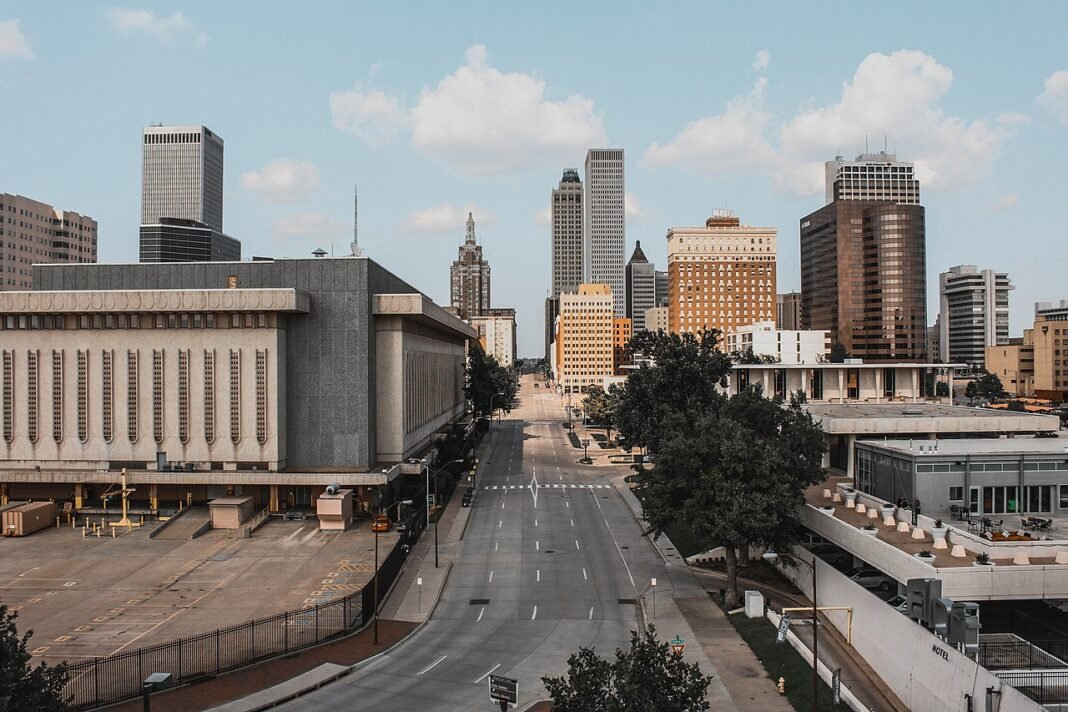
Tulsa’s Midtown is the city’s longest-established residential area, a grid of tree-lined streets where bungalows and colonial revival homes survive from the 1920s-to-1940s oil boom. Residents can walk to the Cherry Street restaurant and retail strip, to Utica Square (one of the country’s oldest outdoor shopping centers), and to the University of Tulsa. To the north, the Tulsa Arts District (formerly the Brady Arts District) and the adjacent Greenwood District carry the cultural life of a downtown shaped by decades of arts investment. The Philbrook Museum of Art, the Gilcrease Museum, the Woody Guthrie Center, and the Bob Dylan Center give the city a cultural depth few cities its size can claim.
The Tulsa Remote program, which pays $10,000 grants to remote workers who relocate, has brought in hundreds of tech-sector arrivals and seeded a startup scene clustered around the Tulsa Arts District. Within Midtown, prices run $200,000 to $350,000 for the historic homes that define the neighborhood, exceptional value given the quality and walkability on offer. Farther out, South Tulsa’s suburban communities extend the metro’s family-oriented options to $220,000 to $350,000 for newer builds with strong school access.
3. Norman — The University City
Norman, home to the University of Oklahoma and its 30,000 students, carries a college-town atmosphere uncommon in the state. The walkable campus drives an active food and arts scene, sports culture runs deep (OU Sooners football remains a central community institution), and the housing market stays affordable even against Oklahoma’s already low baseline. The pedestrian commercial district known as Campus Corner serves the university crowd, while the Sam Noble Oklahoma Museum of Natural History, on the OU campus, ranks among the finest natural history museums in the region and broadens Norman’s profile beyond its academic identity.
Sitting roughly 30 minutes from Oklahoma City along I-35, Norman works as a commuter base for OKC jobs without surrendering its own personality. OU’s research programs and the technology commercialization that follows have nurtured a small but growing tech sector. Median home prices fall between $200,000 and $250,000, with campus proximity commanding a modest premium and south Norman’s newer construction offering family options at $220,000 to $300,000.
4. Edmond — OKC’s Premier Suburb
North of Oklahoma City, Edmond is the state’s most consistently sought-after suburb. The draw is a combination of top-rated school districts, large homes on generous lots in established neighborhoods, and quick access to OKC’s employment centers via the Kilpatrick Turnpike. Growth here has held steady for three decades, sustained by the strength of the schools and the appeal of new construction priced to compete with comparable suburbs across the Sun Belt. The Edmond district’s graduation rates and college acceptance figures rank among the state’s best.
Edmond’s commercial spine has grown along the Broadway Extension corridor, giving the city the retail and dining base of a self-contained community rather than a bedroom suburb tethered to OKC. Median home prices here sit between $280,000 and $380,000, with premium neighborhoods and new construction reaching $500,000 and up. Strong schools, full suburban infrastructure, and relative affordability together make Edmond the standard other Oklahoma suburbs are measured against.
5. Broken Arrow — Tulsa’s Family Suburb
Southeast of Tulsa, Broken Arrow ranks as Oklahoma’s fourth-largest city and serves as the metro’s leading family suburb. Master-planned neighborhoods and excellent schools sit alongside the Rose District, a redeveloped downtown of independent restaurants, boutiques, and event spaces. Years of investment in facilities and programs have lifted Broken Arrow’s schools into competition with Edmond’s for state leadership. Highway 51 and the Creek Turnpike put Tulsa’s employment centers within an easy commute, and they do so without the pricing of the city’s most coveted inner neighborhoods. Median home prices in Broken Arrow run $230,000 to $320,000, with new construction in the latest subdivisions reaching $280,000 to $400,000.
6. Stillwater — The Other University Town
An hour northeast of OKC, Stillwater builds its identity around Oklahoma State University and its 27,000 students, and it offers a clear alternative to Norman’s OU-centered culture. The town runs on the Oklahoma State Cowboys athletic tradition and the campus’s substantial research programs in agriculture, engineering, and veterinary medicine. Its housing market is exceptionally affordable, with median prices of $170,000 to $220,000 placing it among the most affordable college towns in the country. The catch is employment depth: the local economy leans heavily on the university, and households without a job at OSU or in its supply chain find limited options outside education and services.
Frequently Asked Questions
What has the MAPS program done to transform Oklahoma City’s urban livability?
Oklahoma City’s MAPS (Metropolitan Area Projects) program, a series of voter-approved sales tax measures, has funded the most comprehensive downtown transformation of any interior American city in the past three decades. MAPS investments include Scissortail Park (70 acres connecting downtown to the Oklahoma River), the Oklahoma City streetcar system, the Paycom Center (home of the NBA’s Oklahoma City Thunder), and the RIVERSPORT Rapids whitewater center on the Oklahoma River. Midtown and the Plaza District (NW 16th Street, lined with independent restaurants and boutiques in renovated mid-century buildings) have grown into walkable in-town neighborhoods where housing runs $250,000 to $450,000 for renovated historic homes and new infill, prices no equivalent urban neighborhood on either coast could match. Well-located one-bedroom rentals fall between $1,000 and $1,500.
What makes Tulsa one of the most culturally significant small cities in the American interior?
Tulsa’s concentration of cultural institutions is remarkable for a city of its size. The Philbrook Museum of Art (an Italian Renaissance villa set in formal gardens), the Gilcrease Museum (the world’s largest collection of art and artifacts of the American West), the Woody Guthrie Center, and the Bob Dylan Center together give the city rare cultural depth for the interior United States. Downtown Tulsa ranks among the premier Art Deco cities in the world, its commercial buildings accumulated during the 1920s-to-1930s oil boom rivaling Miami and New York in architectural ambition. The Tulsa Remote program, which pays $10,000 grants to relocating remote workers, has drawn tech-sector arrivals and built a startup scene in the Tulsa Arts District. Midtown housing runs $200,000 to $350,000 for historic homes that deliver exceptional value for the walkability and cultural access they provide.
What does Norman offer as a university city and OKC commuter community?
Norman, home to the University of Oklahoma and its 30,000 students, has a college-town character uncommon in the state: a walkable campus, an active food and arts scene fueled by student and faculty demand, deep sports culture (OU Sooners football is a central community institution), and a housing market that stays affordable even against Oklahoma’s low baseline. The Sam Noble Oklahoma Museum of Natural History, on the OU campus, ranks among the finest natural history museums in the country’s interior and broadens Norman’s profile beyond its academic identity. Sitting roughly 30 minutes from Oklahoma City along I-35, the town works as an OKC commuter base while keeping its own personality. Median home prices run $200,000 to $250,000, with south Norman’s newer construction offering family options at $220,000 to $300,000.
What makes Edmond Oklahoma’s most consistently sought-after suburban community?
North of Oklahoma City, Edmond is the state’s most consistently desirable suburb, drawing on top-rated school districts, large homes on generous lots in established neighborhoods, and quick access to OKC employment centers via the Kilpatrick Turnpike. The Edmond district’s graduation rates and college acceptance figures rank among the state’s best, sustaining housing demand across three decades of steady growth. Its commercial spine along the Broadway Extension corridor gives the city the retail and dining base of a self-contained community rather than a bedroom suburb tethered to OKC. Median home prices run $280,000 to $380,000, with premium neighborhoods and new construction reaching $500,000 and above. Strong schools, full suburban infrastructure, and relative affordability together make Edmond the standard other Oklahoma suburbs are measured against.
What does Stillwater offer as Oklahoma’s most affordable university town?
Stillwater, home to Oklahoma State University and its 27,000 students, offers an alternative to Norman’s OU-centered culture, a college town built around the OSU Cowboys athletic tradition and the university’s substantial research programs in agriculture, engineering, and veterinary medicine. Its housing market is exceptionally affordable, with median prices of $170,000 to $220,000 making it one of the most affordable college towns in the country. The catch is employment depth: the local economy leans heavily on the university, and households without a job at OSU or in its supply chain find limited options outside education and services. The surrounding Cimarron Hills communities and nearby Cushing add rural and small-town alternatives across the north-central Oklahoma corridor for households that value land and space over urban amenities.