Quebec is Canada’s most culturally distinct province — a French-speaking society of roughly 9 million within a predominantly English-speaking continent, where the joie de vivre of Québécois culture — festivals staged in January blizzards, terrasse dining that runs from April to October, a near-religious devotion to hockey — coexists with a history that stretches from the First Nations of the St Lawrence valley through the French colonial era to the British conquest, Confederation, and the Quiet Revolution of the 1960s. The province holds Canada’s most beautiful city in Quebec City, whose walled old town is the only fortified city north of Mexico; its most dynamic metropolis in Montreal, where French and English have forged a bilingual urban energy unlike anywhere else in North America; and landscapes that range from the Laurentian highlands north of Montreal to the Gaspésie Peninsula, where mountain and sea meet at the end of the St Lawrence River’s long run to the Gulf.

Montreal: The Bilingual Metropolis
Montreal, Canada’s second-largest city (about 2 million on the island, some 4.4 million across the metropolitan area), occupies an island in the St Lawrence River and draws its character from the creative friction between its French and English communities. French is the official vehicle of public life, yet the English-speaking community of the West Island and the university precincts around McGill and Concordia carries enough cultural weight to make the city genuinely bilingual in its daily reality. A handful of neighbourhoods define it. Mile End trades in bagels from St-Viateur or Fairmount, smoked meat from Schwartz’s Deli, and the Portuguese coffee shops and Jewish delis of a quarter that absorbed wave after wave of immigrants through the 20th century. The Plateau-Mont-Royal, all exterior staircases and row houses, wraps its summer life around Parc Lafontaine. Vieux-Montréal layers cobblestone streets, the Basilique Notre-Dame-de-Montréal, and the revitalized Old Port waterfront. Below it all runs the RÉSO, 33km of climate-controlled tunnels threading the downtown core.

Montreal Must-Experiences
- Basilique Notre-Dame-de-Montréal: The 1829 Gothic Revival basilica in Old Montreal; the most ornate interior of any church in North America; the AURA light show (evenings) transforms the interior into an immersive arts experience
- Schwartz’s Deli: The original Montreal smoked meat on St-Laurent Boulevard since 1928; a cultural institution of the first order; the queue is part of the experience
- Mont Royal Park: Frederick Law Olmsted’s 1876 park design on the 233m hill above the city; the Kondiaronk Belvedere lookout provides the most complete view of Montreal and the St Lawrence; cross-country skiing in winter
- Jean-Talon Market: The finest year-round farmers’ market in Canada; the fruit and vegetable abundance of Quebec’s summer produce is something to behold; the attached artisan food producers complete the experience
- Jazz Festival: Festival International de Jazz de Montréal (late June–early July); the largest jazz festival in the world by attendance; more than 350 concerts and some 3,000 musicians, most of them free and outdoors

Quebec City: The Walled City
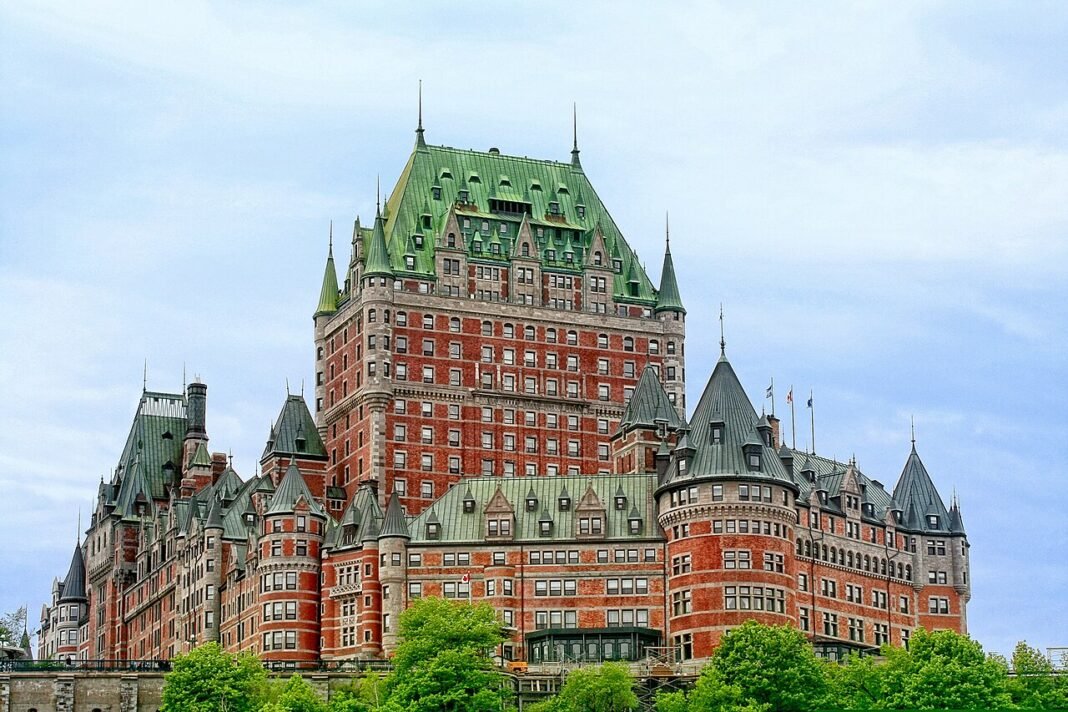
Quebec City (around 550,000 in the city proper and some 840,000 across the metropolitan area), the provincial capital on the cliffs above the St Lawrence River, is Canada’s most historically complete city — a UNESCO World Heritage Site whose old town contains the continent’s only surviving fortified city walls north of Mexico, the 17th-century streets of the Lower Town (Basse-Ville) around Place Royale, and the iconic Château Frontenac (the most photographed hotel in the world) on the promontory above. The Dufferin Terrace boardwalk alongside the Château looks out over the St Lawrence; a funicular connects Upper and Lower Towns; the St-Jean-Baptiste neighbourhood’s Grande-Allée restaurant strip is the city’s social artery. The Carnaval de Québec (February, the largest winter carnival in the world) and the Festival d’été de Québec (July, more than 150 shows across 11 days) define the city’s festival calendar.
The Laurentians and the Eastern Townships
The Laurentian Mountains, beginning just 80km north of Montreal, provide Quebec’s year-round outdoor recreation landscape — ski resorts (Mont-Tremblant, the premier ski destination east of the Rockies; Mont Saint-Sauveur; Grey Rocks), summer lake communities (the chalets of the lac du Nord country), the P’tit Train du Nord cycling trail (234km of converted railway corridor), and the summer music festivals of the Laurentian villages add up to a four-season destination within two hours of Montreal’s roughly 2 million island residents. The Eastern Townships (Estrie), south of Montreal toward the Vermont border, strike a different note — rolling dairy country of 19th-century anglophone settlement converted to a wine country landscape (Coaticook, Dunham, and the Brome-Missisquoi wine route), apple orchards, maple syrup producers, and the recreational lakes of the Memphrémagog lakeshore.
The Gaspésie: Where the St Lawrence Meets the Sea
The Gaspésie Peninsula sits 900km east of Montreal, where the St Lawrence River broadens into the Gulf. It brings together the Chic-Chocs Mountains (the highest peaks in the Canadian Appalachians), the mountain-and-sea cliffs of Forillon National Park at the peninsula’s tip, Percé Rock (a pierced limestone monolith rising from the Gaspé Bay, one of Quebec’s most recognizable natural symbols), and the Île Bonaventure seabird colony (one of the world’s largest northern gannet colonies, reached by boat from Percé). The long drive pays off in landscapes of genuine grandeur and a Gaspesian fishing-community culture all its own.
Getting the Most Out of Your Visit
A few practical points that will improve any trip to Quebec. Book accommodation and major attractions — particularly national parks, popular hiking trails, and well-known restaurants — as far in advance as possible; the best options can fill weeks or months ahead, especially in peak season. A car gives you the most flexibility for exploring beyond the main centres, and many of Quebec’s richest experiences sit in places not easily reached by public transport. Local knowledge is often found in regional visitor centres, independent bookshops, and conversations with residents — the discoveries that stay with you are rarely the ones in the guidebooks. Allocate more time than you think you need: Quebec consistently rewards travellers who slow down and explore in depth rather than trying to cover maximum ground in minimum time.
Frequently Asked Questions
What makes Montreal one of the most distinctive cities in North America?
Montreal (about 4.4 million across the metropolitan area, 2 million on the island) occupies an island in the St Lawrence River and is defined by the creative tension between its French and English communities — a bilingual city where French is the official vehicle of public life but where English-speaking communities at McGill, Concordia, and the West Island create a genuinely bilingual daily reality. The Mile End neighbourhood (bagels from St-Viateur and Fairmount Bagel, the two great rivals of the Montreal wood-fired bagel; galleries; the Schwartz’s smoked meat deli; Café Olimpico; and a music scene that produced Arcade Fire) is the most culturally concentrated neighbourhood in Canada. Plateau-Mont-Royal (the neighbourhood of staircases, balconies, and duplexes that defines Montreal’s visual identity) is the city’s signature urban residential quarter. Mount Royal Park (Frederick Law Olmsted’s design, 1876, the mountain park at the island’s centre) opens sweeping views over the entire city and the St Lawrence Valley. Montreal’s festival calendar — Jazz Festival (the world’s largest, 10 days in late June/early July, more than 350 concerts and roughly 3,000 performers, most of them free and outdoors), Just for Laughs, and the Osheaga music festival — packs more cultural events into the summer than any other Canadian city. Beneath the downtown core runs the RÉSO, the 33km Underground City — the world’s largest underground pedestrian network.
What makes Quebec City unique as a North American destination?
Quebec City (around 840,000 metropolitan), whose fortified Old Town is the only fortified city north of Mexico, is Canada’s most historically coherent city — a European cityscape of narrow streets, stone buildings, and the Château Frontenac (the most photographed hotel in the world) on a dramatic cliff above the St Lawrence River. The Old City divides into Haute-Ville (Upper Town, within the fortification walls, with the Citadelle — an active military installation and National Historic Site — and the Dufferin Terrace promenade overlooking the river) and Basse-Ville (Lower Town, with the Place Royale — the cradle of French civilization in North America, where the first permanent French settlement was established in 1608 — and the Quartier Petit-Champlain, the most intact 17th-century streetscape in North America). The Quebec Winter Carnival (early February) — the world’s largest winter carnival, with ice sculptures, the Bonhomme Carnaval mascot, and the night parade — transforms Quebec City into the winter celebration capital of North America for 10 days.
What does the Laurentians region offer north of Montreal?
The Laurentians — the ancient Precambrian shield highlands beginning 80km north of Montreal — provide Montreal residents with the most accessible ski and wilderness recreation of any major Canadian city. Mont-Tremblant (about 145km north) is the premier Quebec ski resort: roughly 760 acres of skiable terrain across four mountain faces, and a pedestrian resort village of Tyrolean character that ranks among the most complete four-season resort destinations in eastern Canada. The Laurentians’ Route des Sommets cycling and cross-country ski network, the P’tit Train du Nord linear trail (234km from Bois-des-Filion to Mont-Laurier, converted from a historic railway), and the lake cabin culture (chalets on the Laurentian lakes are a multi-generational Montreal family tradition) make the region essential to understanding Montreal’s quality of life. Smaller ski areas (Saint-Sauveur, Sainte-Adèle) sit within a 90-minute drive of Montreal for day trips.
What does the Gaspésie Peninsula offer as a Quebec wilderness destination?
The Gaspésie Peninsula — the land mass extending into the Gulf of St Lawrence east of Quebec City, where the Appalachian Mountains meet the St Lawrence estuary and the open Atlantic — is Quebec’s most spectacular wilderness destination: a landscape where sea cliffs, boreal forest, and mountain tundra combine in terrain of extraordinary visual drama. The Chic-Choc Mountains (the Gaspésie portion of the Appalachians, with Mont Jacques-Cartier at 1,268m the highest peak in the Canadian Appalachians) hold the finest alpine walking in eastern Canada. The Gaspésie National Park’s mountain herd of woodland caribou (reintroduced; one of the southernmost woodland caribou herds in North America) is the region’s most distinctive wildlife. Percé Rock (a massive detached limestone rock with a natural arch, one of the most photographed geological features in eastern Canada) and Bonaventure Island (offshore, accessible by boat, with the world’s largest accessible northern gannet colony — 100,000+ gannets nesting on the cliff faces) define the Gaspésie’s coastline. The Forillon National Park at the tip of the peninsula provides whale watching (multiple species, accessible from boat or from the cap cliffs) and the terminus of the Trans Canada Trail.
What is Quebec’s food and festival culture and why does it define the province’s identity?
Quebec’s food and festival culture is the expression of the Québécois joie de vivre — a cultural philosophy that insists on enjoying life regardless of external conditions, demonstrated most vividly by the willingness to celebrate in January blizzards, to eat on terrasses until October, and to treat food as a cultural rather than merely nutritional act. The sugar shack (cabane à sucre) tradition — February and March gatherings in the maple forests for maple syrup harvest celebrations, with traditional foods (pea soup, baked beans, oreilles de crisse, tourtière, maple-drenched everything) — is the most widely shared seasonal ritual in Quebec society. Poutine (french fries, cheese curds, and gravy) has been adopted nationally and internationally, but its Quebec variants — from the basic snack counter version to the sophisticated restaurant interpretations at Au Pied de Cochon — represent a genuinely complex food tradition. The Montreal food scene has achieved international recognition through Au Pied de Cochon (Martin Picard’s hyperlocal Quebec ingredient cuisine), Joe Beef (one of the most celebrated restaurants in Canada), and a bistro culture that rivals Paris in density if not fame. The Quebec City Carnaval, Montreal’s Jazz Festival, and the Festival d’été de Québec constitute the most significant Canadian cultural festival concentration.