Stepping into Old Quebec City feels like being transported to 18th-century France — except cleaner, safer, and with better food. Cobblestone streets, fortified stone walls, centuries-old stone buildings, bakeries selling fresh croissants, and a population that lives, breathes, and argues almost exclusively in French. It’s unlike anywhere else in North America: a UNESCO World Heritage Site that has managed to preserve its historic character while remaining a vibrant, functioning city rather than a museum piece. As the only walled city north of Mexico, Quebec City occupies a unique position in the continent’s cultural geography — and understanding it means understanding how profoundly different this corner of Canada is from the English-speaking world that surrounds it.
Old Quebec: Upper Town and Lower Town
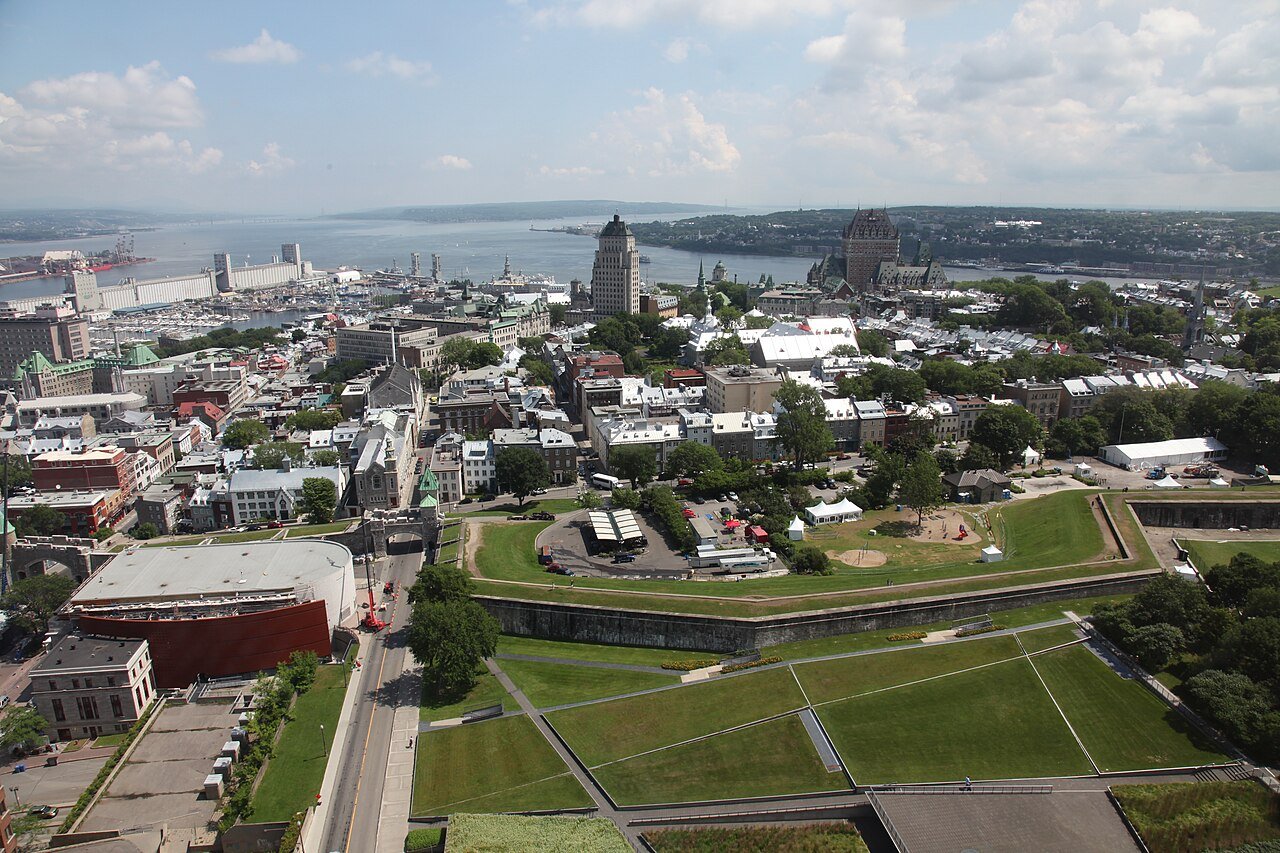
Old Quebec is divided into Upper Town (Haute-Ville) and Lower Town (Basse-Ville), separated by a cliff and connected by the famous funicular (a cable railway, just a few minutes’ ride) and the steep Breakneck Stairs (Escalier Casse-Cou) — the oldest staircase in North America, dating from 1635. The Château Frontenac, the most photographed hotel in the world according to Guinness, dominates the Upper Town skyline from its perch on Cap Diamant — a château-style railway hotel built by the Canadian Pacific Railway in 1893 and still one of the finest hotels in Canada. Even if you’re not staying there, afternoon tea in the lobby, a drink in the bar, or simply walking through the grand public spaces is worthwhile. The Dufferin Terrace boardwalk in front of the hotel — 671 meters of elevated wooden promenade — has spectacular views of the St Lawrence River, the Île d’Orléans, and the Laurentian Mountains and is one of the great free walks in Canada, particularly in winter when it hosts a toboggan slide that has been operating since 1884.
Lower Town: Place Royale and Petit-Champlain
Place Royale, at the foot of the cliff in the Lower Town, is the site of Samuel de Champlain’s original settlement of 1608 — the oldest commercial district in North America, now beautifully restored. The Notre-Dame-des-Victoires church (built 1688) is the oldest stone church in North America still in use. The Musée de la Civilisation, a few steps away, is one of the finest museums in Canada — its permanent collection explores Quebecois history, First Nations cultures, and world civilizations with extraordinary depth and excellent bilingual signage. The Rue du Petit-Champlain, a pedestrianized street of boutiques, cafés, and restaurants carved into the base of the cliff, is irresistibly charming despite its popularity — at Christmas, with lights strung between the buildings and snow on the cobblestones, it’s genuinely magical. The funicular or the Breakneck Stairs provide the most dramatic ascent back to the Upper Town.
The Plains of Abraham and the Fortifications
The Plains of Abraham — formally Battlefields Park — is the large plateau above the Lower Town where the Battle of the Plains of Abraham was fought on September 13, 1759, lasting all of 15 minutes but deciding the fate of North America. The British forces under General Wolfe defeated the French under Montcalm; both commanders died in the battle. The result transferred Quebec from French to British control and ultimately produced the bicultural Canada that exists today. The park itself is a beautiful green space popular with joggers and picnickers, and the Musée des Plaines d’Abraham tells the battle’s story with excellent multimedia presentations. The star-shaped fortifications of the city — the only remaining fortified city walls in North America north of Mexico — are free to walk, stretching 4.6 kilometers around the Upper Town perimeter.
The Authentic Quebec Table: What to Eat
Quebec cuisine is rooted in the traditions of rural French Canada — hearty, warming, deeply flavored, and entirely distinct from Parisian French cooking. Essential experiences:
- Poutine: French fries with fresh cheese curds (which must squeak when you eat them — if they don’t squeak, they’re not fresh) and rich brown gravy. A proper poutine at a Quebec casse-croûte (snack bar) is a different animal from the versions served elsewhere. Chez Ashton in Quebec City is the local institution.
- Tourtière: A double-crust meat pie filled with ground pork (and sometimes beef, veal, or game) spiced with cloves, cinnamon, and allspice. Traditional at Christmas, but available year-round. A Saguenay tourtière (from the Saguenay–Lac-Saint-Jean region, thicker and more substantial) is the definitive version.
- Maple everything: Quebec produces 75% of the world’s maple syrup — the sugar shacks (cabanes à sucre) in the countryside around Quebec City open in March and April when the sap runs, serving maple taffy poured over snow (tire d’érable), maple ham, maple beans, and maple desserts. This is a genuinely wonderful seasonal experience. Sucrerie de la Montagne near Montreal and several operations near Quebec City run excellent sugar shack experiences.
- Cipaille (sea pie): A multi-layered meat pie made with alternating layers of pastry and seasoned game or beef — a rustic Quebec winter dish of extraordinary depth of flavor.
- Local cheese: Quebec has a thriving artisan cheese culture, with over 250 varieties of local cheese including the famous Oka (a semi-soft monastery cheese) and Baluchon (a washed-rind cheese from the Lanaudière region).
Winter in Quebec City: The Most Enchanting Season
Quebec City in winter is one of the most genuinely magical experiences in North America. The stone buildings covered in snow, the illuminated Château Frontenac against the winter sky, the frozen St Lawrence viewed from the Dufferin Terrace, and the city’s extraordinary capacity for winter festivity combine to create an atmosphere that is entirely unlike anywhere else. The Winter Carnival (Carnaval de Québec), held each February, is the world’s largest winter carnival — with monumental ice sculptures on the Grande-Allée, the Night Parade (a spectacular night procession through the city), ice canoe races across the St Lawrence (genuinely terrifying — participants sometimes break through the ice), snow baths (exactly what it sounds like), and the nighttime Bonhomme palaces made from ice blocks cut from the river. Ice skating on outdoor rinks (including one on the Plains of Abraham), cross-country skiing on the Plains, and sliding on the Dufferin Terrace toboggan run are all free. Dress for temperatures between -10°C and -25°C — and then add another layer.
Day Trips and Getting There
The Île d’Orléans (accessible by bridge 10km from the city center) is a farming island in the St Lawrence where time seems to have moved more slowly — wine producers, cider orchards, strawberry farms, and artisan food shops line the island’s perimeter road. The Montmorency Falls (8km from the city) are 83 meters high — taller than Niagara Falls — with a cable car, footbridges, and a zipline. The Sainte-Anne-de-Beaupré Basilica (40km east) is one of the major Catholic pilgrimage sites in North America. Getting to Quebec City: VIA Rail trains connect Montreal to Quebec City in about 3 hours (from $50 one-way). Direct flights connect Quebec City Jean Lesage Airport to Toronto, Montreal, Ottawa, New York, and select European cities. The city is 3 hours’ drive from Montreal on Autoroute 20 along the south shore or Autoroute 40 along the north shore.