
Moving to Michigan in 2026: Complete Relocation Guide
Moving to Michigan requires preparation in areas specific to the state’s administrative requirements, its extreme weather variability (Michigan’s climate spans from the milder southern Lower Peninsula to the genuinely harsh winters of the Upper Peninsula), its automotive-economy employment landscape, and the practical differences between the Detroit metropolitan area, the western Michigan communities, and the northern resort corridor. Michigan is generally straightforward for administrative tasks, but several aspects of life in the state — particularly weather preparation and the property tax system’s uncapping provision — are important to understand before arrival.
Driver’s License and Vehicle Registration
Driver’s license: New Michigan residents must obtain a Michigan driver’s license within 30 days of establishing residency. The Michigan Secretary of State (SOS) offices handle licensing — a single agency that also handles vehicle registration, voter registration, and other administrative functions. Required: proof of legal presence (US passport or birth certificate), proof of Social Security number (Social Security card, W-2, or pay stub showing full SSN), and proof of Michigan residency (two documents showing your Michigan address — utility bill, bank statement, lease, or government mail). Vision screening is required; a knowledge test may be required if transferring from certain states. Michigan has an online appointment system for SOS visits — walk-in service is possible but appointment users are consistently served faster. Michigan’s REAL ID-compliant Enhanced Driver’s License (EDL) allows entry to Canada by land or sea without a passport — useful for households near the border.
Vehicle registration: Michigan requires vehicle registration within 30 days of establishing residency. The Michigan SOS handles registration. Michigan calculates registration fees based on the vehicle’s value and age — new vehicles carry higher fees than older ones. Michigan does not require a vehicle safety inspection for registration (unlike Massachusetts or New York), simplifying the registration process. The state’s vehicle registration fees include a portion dedicated to road maintenance — Michigan’s roads have been a persistent political and infrastructure issue, with the state’s harsh freeze-thaw cycle producing road damage that requires continuous maintenance. Michigan drivers routinely encounter construction and road repair more than drivers in milder-climate states.
Understanding Michigan’s Property Tax System
Michigan’s property tax system has an important feature that new homeowners must understand: the taxable value “uncapping” provision. Under Michigan’s Proposal A (1994), existing homeowners have their property’s taxable value capped at the rate of inflation annually — meaning that longtime homeowners may pay property taxes on a taxable value significantly below their home’s actual market value. When a property is sold, the taxable value resets to 50% of the purchase price (the “state equalized value” or SEV).
The practical implication: the previous owner of a Detroit-area home purchased 20 years ago may pay property taxes on a taxable value of $120,000 while the home sells for $350,000. You, as the new buyer, will be assessed at $175,000 (50% of purchase price) — potentially paying substantially higher property taxes than the seller paid in their final year. Before purchasing, buyers should calculate the post-purchase tax liability based on the purchase price, not the current tax bill. Real estate agents who work regularly with buyers are familiar with this calculation; lenders will include the estimated post-sale tax obligation in their underwriting, so there will be no surprise at closing, but understanding the system in advance helps inform neighborhood and price-point decisions.
Winter Preparation: Michigan’s Most Critical Topic
Michigan winters are the most important practical reality that newcomers from warmer climates need to prepare for — not because they are extreme by northern standards (they are not compared to Minnesota or the Upper Peninsula itself), but because unprepared households are caught off-guard by the duration, frequency, and severity of winter weather events in the Lower Peninsula, and by the snow totals in the lake-effect snow belt east of Lake Michigan.
Winter tires are not legally required in Michigan but are strongly recommended for the December–March period and essential for communities in the lake-effect snow zone (Grand Rapids, Kalamazoo, and the western Lower Peninsula regularly receive 100+ inches of snow annually). All-season tires are inadequate for the ice conditions that follow winter precipitation, particularly on Michigan’s secondary roads. Four-wheel or all-wheel drive assists with traction in deep snow but does not substitute for winter tires on ice. Michigan road crews are well-equipped and maintain major highways during storms, but secondary and residential streets may remain snow-covered for hours or days after a storm.
Home heating is a material budget item in Michigan — natural gas is the dominant fuel for most of the state, with bills averaging $900–$1,800 annually for a typical home in the southern Lower Peninsula and significantly higher for larger homes and the colder U.P. Homes with older insulation, drafty windows, or inefficient furnaces can carry heating costs of $2,000–$4,000 annually. Before purchasing a Michigan home, request the previous year’s utility bills and note the furnace age and insulation quality. Michigan’s energy efficiency programs (through Consumers Energy and DTE Energy, the two dominant utilities) offer weatherization incentives that can meaningfully reduce ongoing heating costs.

Employment: The Automotive Economy and Beyond
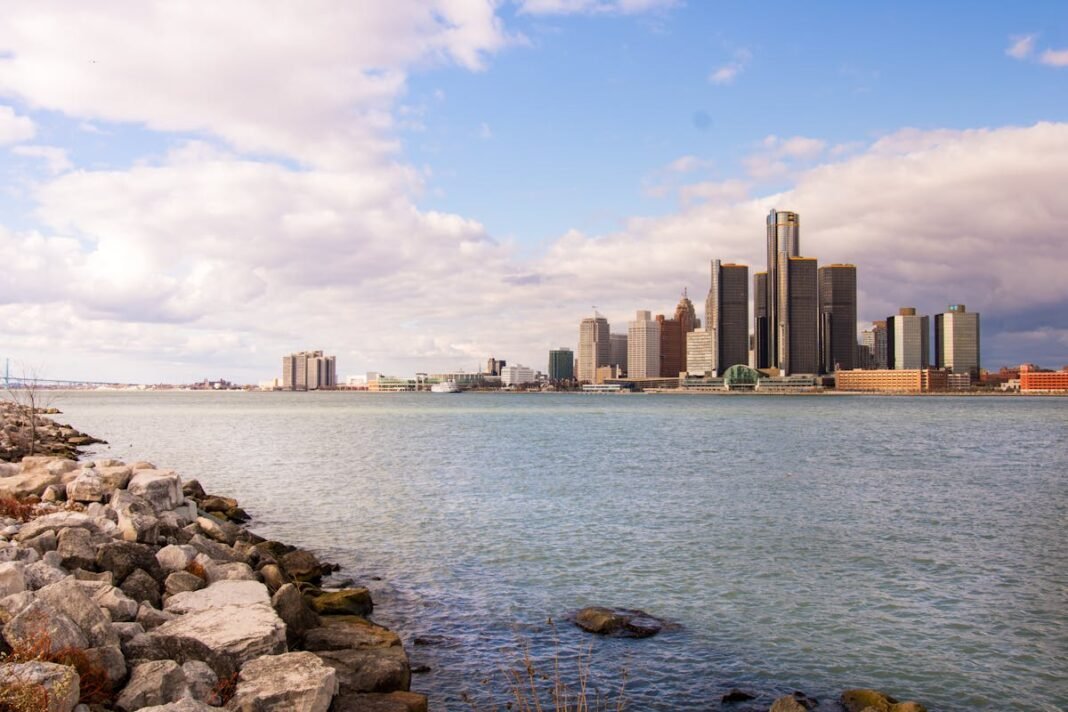
Michigan’s economy is more diversified than the “automotive state” stereotype suggests, but the automotive sector remains its largest employer and its most distinctive economic feature. General Motors (headquartered in Detroit’s Renaissance Center), Ford Motor Company (headquartered in Dearborn), and Stellantis (with major operations in Auburn Hills and Detroit) together with their supply chain — the Tier 1 and Tier 2 suppliers concentrated in Oakland, Wayne, and Macomb Counties — employ hundreds of thousands of Michigan workers directly and support hundreds of thousands more in indirect employment. The transition of the automotive industry to electric vehicles is the dominant economic story in Michigan for the next decade — GM and Ford are investing tens of billions in EV production facilities in Michigan, creating engineering, manufacturing, and supply chain employment at a scale that will reshape the state’s economy.
Healthcare is Michigan’s second-largest employer sector: the University of Michigan Health System, Henry Ford Health, Beaumont Health (now Corewell Health), and Spectrum Health (Grand Rapids) are each major regional employers with thousands of clinical and administrative positions. The life sciences cluster in Ann Arbor and the Detroit suburbs includes Pfizer’s Ann Arbor research operations, Stryker (based in Kalamazoo), and numerous smaller biotech and medical device companies. Michigan’s technology sector — concentrated in Ann Arbor, Detroit’s Midtown, and the Grand Rapids area — has grown significantly as automotive technology companies have relocated engineering operations to be close to the OEM headquarters.
The Michigan “Brain Drain” and Its Reversal
Michigan has historically lost college graduates to other states — a “brain drain” that reflected the perception that Michigan’s economy offered fewer opportunities than coastal markets. This pattern has been shifting meaningfully as Detroit’s urban revival has made the city attractive to young professionals who value urban density and authenticity over coastal prestige, as the EV transition has created high-paying engineering employment in Michigan, and as remote work has allowed Michigan natives to maintain non-Michigan employment while living in the state they grew up in.
New residents from coastal markets typically experience Michigan’s affordability as one of its primary draws — the ability to own a substantial home with a yard in a walkable community at a fraction of what comparable housing would cost in Chicago, New York, or the Bay Area is genuinely available in Michigan in ways that are not available in most other states. The cultural trade-offs (Michigan’s professional sports, performing arts, and dining scene are excellent but not at the scale of the largest coastal markets) are real but often less significant in practice than newcomers anticipate. Michigan’s outdoor recreation access — 11,000 inland lakes, 3,200 miles of Great Lakes shoreline, excellent skiing and hiking in the north — provides a quality-of-life dimension that coastal markets with similar employment profiles cannot offer.