


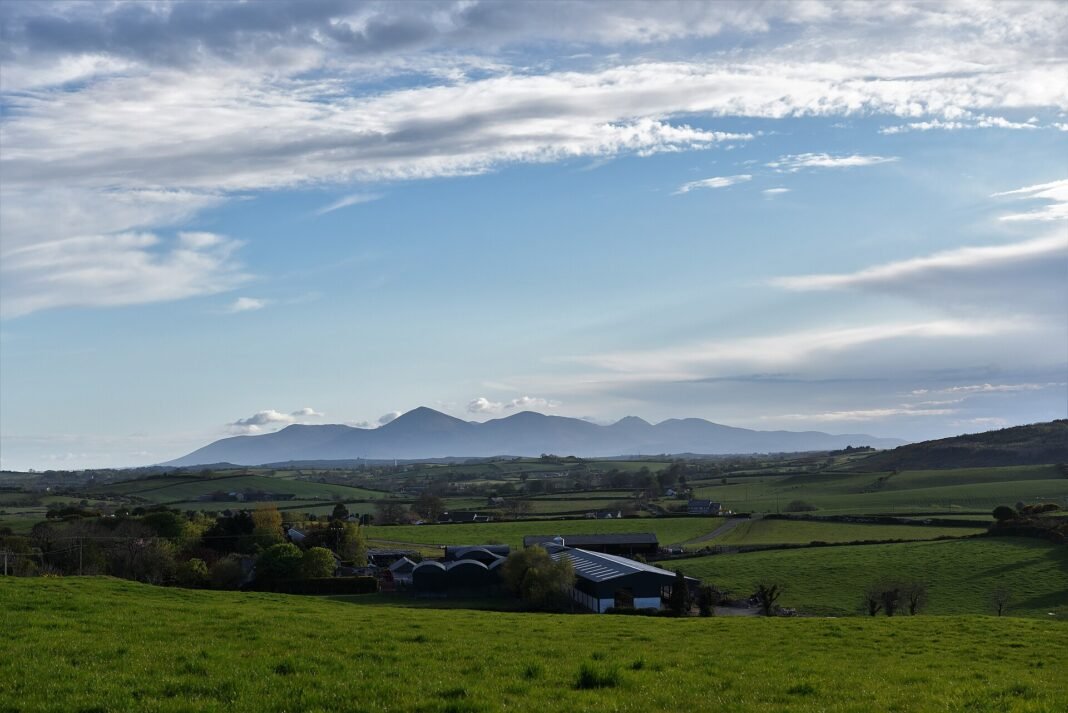
Northern Ireland packs an unusual amount of outdoor variety into a small space. Across roughly 14,130km² sit the United Kingdom’s largest freshwater lake (Lough Neagh), the basalt geology of the Giant’s Causeway, the sea cliffs of the Antrim coast, and the Mourne Mountains — a granite range that climbs straight from the Irish Sea to form one of Britain’s more arresting coastal uplands. Because the country is compact, the Antrim coast, the Mournes, the Fermanagh lakelands, and the Sperrin Mountains all sit within two hours of Belfast, so the range of terrain per mile travelled is hard to match. For years UK and international visitors looked instead to England’s Lake District or Scotland’s Highlands; that lighter footfall (the Giant’s Causeway and the Carrick-a-Rede Bridge aside) means the best walks, beaches, and wild areas can still be had in comparative solitude.
The Causeway Coast Way: Northern Ireland’s Signature Walk
The Causeway Coast Way (53km, from Ballycastle to Portstewart, in County Antrim) is Northern Ireland’s best-known long-distance walk — a coastal path along the cliff-top above the Irish Sea, passing the Giant’s Causeway, the Carrick-a-Rede Rope Bridge, Kinbane Castle, Ballintoy Harbour (a Game of Thrones filming location), and the whitewashed villages of the Antrim coast over a two-to-three-day route of near-continuous scenery.
- Giant’s Causeway section: The central stretch above the Giant’s Causeway — taking the cliff-top route rather than the visitor centre path — gives the finest views of the basalt columns from above and shows how the formation sits within the wider coast
- Kinbane Castle: A 16th-century MacDonnell clan ruin on a chalk headland above the sea, reached by steps from the cliff top, with views across the North Channel to the Scottish islands on clear days
- Rathlin Island: Northern Ireland’s only inhabited offshore island (about 150 residents), reached by ferry from Ballycastle (25 minutes), hosts the RSPB Rathlin West Light Seabird Centre, where puffins, razorbills, and guillemots nest on the sea stacks beneath the inverted lighthouse. The island’s cliffs hold one of the largest seabird colonies in Ireland (June–July peak for puffin viewing)

The Mourne Mountains: Northern Ireland’s High Ground
The Mourne Mountains in County Down — a compact granite range 50km south of Belfast — hold Northern Ireland’s highest ground. Slieve Donard (850m, the country’s highest peak), Slieve Commedagh (767m), Slieve Bearnagh (739m, crowned by its twin granite tors), and the high ground around them, threaded by the Mourne Wall, add up to serious hill country in a place not usually associated with it.
- Slieve Donard ascent: The highest summit is usually reached from Newcastle (County Down) via the Glen River Path — a five-to-six-hour return hike climbing roughly 840m through forest to the granite top, with views on clear days of Scotland’s Galloway Hills, the Isle of Man, the Wicklow Mountains in the Republic, and Snowdonia in Wales. The summit cairn and the Mourne Wall’s crossing at the top cap off the classic Donard route
- Mourne Wall walk: The roughly 31km circuit following the Mourne Wall (which crosses fifteen summits and was built 1904–1922 to protect the Silent Valley reservoir catchment) ranks among Northern Ireland’s hardest mountain challenges — usually tackled over one to two days by experienced hill walkers, taking in every enclosed peak and giving the fullest overview of the range
- Silent Valley: The reservoirs at the heart of the Mournes (reached from the Silent Valley car park) offer the gentlest valley walking in the range — an easy, flat-bottomed route past the Ben Crom and Silent Valley reservoirs, with the surrounding summits in view from the valley floor
The Fermanagh Lakelands: Water Wilderness
County Fermanagh’s lakelands — Upper and Lower Lough Erne, with 154 islands, set among a drumlin landscape of lakes, rivers, and bogland — rank among the better inland waterway and kayaking environments in the British Isles. The Erne system runs roughly 84km from Belleek in the north to Belturbet in County Cavan, taking in Lower and Upper Lough Erne, and is navigable by hire boat from Enniskillen — some of Ireland’s most peaceful cruising. Several islands of Lower Lough Erne add a cultural layer to the water: the monastic ruins of Devenish Island, the White Island Christian figurines, and the Boa Island Janus figure, one of Ireland’s strangest pagan sculptures.
- Marble Arch Caves Global Geopark: The UNESCO Geopark in south Fermanagh (straddling the border with the Republic’s County Cavan) holds the Marble Arch Caves — the best show cave system in Ireland, where boat tours follow underground rivers through caverns of stalactite and stalagmite formations beneath the Cuilcagh plateau
- Cuilcagh Mountain Boardwalk: The “Stairway to Heaven” boardwalk on Cuilcagh Mountain (666m, on the border with County Cavan) opens up one of the country’s grandest high-level views — the wooden walkway rises through blanket bog to the summit plateau, with the Fermanagh lakes spread out to the north and the Republic’s Leitrim and Cavan hills to the south
Wild Swimming, Surfing, and Coastal Adventures
Northern Ireland’s coast offers wild swimming that ranges from the cold North Channel (the Antrim shore, where the sea rarely tops 15°C) to the more sheltered bays of County Down. Portrush and Portstewart on the north coast are the country’s main surf beaches (North Atlantic swells, reliable year-round surf with offshore winds), while White Rocks Beach (between Portrush and the Giant’s Causeway) sets clean sand against the basalt cliffs. Murlough National Nature Reserve (County Down) and the Strangford Lough area suit gentler coastal walking and wildlife watching — Strangford Lough, the UK’s largest sea lough, draws huge numbers of wildfowl in winter (light-bellied Brent geese, duck and wader species) and basking sharks in summer.
Frequently Asked Questions
What does the Causeway Coast offer as Northern Ireland’s premier outdoor experience?
The Causeway Coast — followed end to end by the 53km Causeway Coast Way from Ballycastle to Portstewart, in County Antrim — is Northern Ireland’s signature landscape: sea cliffs of Carboniferous basalt and chalk, the Giant’s Causeway, and a run of headlands, castles, and beaches that make this one of the finest coastal walks in Europe. The Giant’s Causeway (roughly 40,000 interlocking hexagonal basalt columns formed 60 million years ago during a volcanic event, reached from the National Trust visitor centre at Bushmills) is Northern Ireland’s only UNESCO World Heritage Site and the most visited natural attraction in Ireland. The Carrick-a-Rede Rope Bridge (a 20m crossing linking the mainland to a small island, once used by salmon fishermen) is the coast’s most exhilarating short walk. Dunluce Castle (the clifftop medieval fortress 3km east of Portrush, part of it long since fallen into the sea) and the Dark Hedges (the avenue of intertwined beech trees on the Bregagh Road, the Kingsroad in Game of Thrones) add the cultural and cinematic angles. The nearby Old Bushmills Distillery (licensed in 1608 — the world’s oldest licensed whiskey distillery) rounds out the day.
What do the Mourne Mountains offer?
The Mourne Mountains — a compact range of granite peaks in County Down, rising straight from the Irish Sea to Slieve Donard (850m, the highest mountain in Northern Ireland, on the edge of Newcastle town) and visible from both the Belfast hills and across Dundrum Bay — are the country’s standout coastal mountain landscape. The Mourne Wall (a roughly 31km dry-stone wall, built 1904–1922 by the Belfast Water Commissioners to enclose the catchment, crossing fifteen summits) is the defining feature of hillwalking here and a historic walking route in its own right. Slieve Donard (4km return from Newcastle, 850m, the most climbed mountain in Northern Ireland) opens up views to Scotland, the Isle of Man, and on clear days to Wales and Snowdonia. The Doan–Slieve Meelmore–Slieve Bearnagh circuit makes the fullest single-day Mourne outing, with the granite tors of Slieve Bearnagh offering the range’s most photogenic and technically interesting ground. The Mourne Mountains AONB (Area of Outstanding Natural Beauty) protects the landscape from development, and the Mourne Coastal Route links Newcastle to Rostrevor along the Irish Sea.
What does the Antrim Coast and Glens offer for outdoor recreation?
The Antrim Coast — the A2 Coastal Route from Belfast north to Ballycastle, 100km of some of the most scenic coastal road in the British Isles — runs along the edge of the Antrim Plateau, where nine glacially carved glens (the Glens of Antrim: Glenarm, Glencloy, Glenariff, Glenballyeamon, Glenaan, Glencorp, Glendun, Glenshesk, and Glentaisie) drop from the plateau to the sea. Glenariff Forest Park (the “Queen of the Glens”, with a 10km waymarked trail past three waterfalls — Ess-na-Larach, Ess-na-Crub, and the Tears of the Mountain — through a wooded gorge) is the most visited forest park in Northern Ireland. Cushendall (the “Capital of the Glens”) and Cushendun (the whitewashed village with National Trust-protected buildings, the Qarth of Game of Thrones) are the best-kept Glens of Antrim villages. Fair Head (200m columnar dolerite cliffs at the northeastern tip of the country, with views to Rathlin Island and the Mull of Kintyre) is the boldest viewpoint on the coast. The Rathlin Island RSPB seabird colony (ferry from Ballycastle, 25 minutes) is Northern Ireland’s largest, with tens of thousands of breeding seabirds — puffins, razorbills, guillemots, kittiwakes, and fulmars among them, peaking from late April to July.
What does the Fermanagh Lakelands offer as an outdoor destination?
The Fermanagh Lakelands — the waterway country of Lower and Upper Lough Erne in County Fermanagh, covering roughly a third of the county — hold Northern Ireland’s most developed water-recreation network and some of its most peaceful, undervisited scenery. The Erne Waterway (roughly 84km of navigable water from Belleek to Belturbet in County Cavan, Republic of Ireland) ranks among the finest inland boating routes in the British Isles, with hire boats (from Enniskillen and Bellanaleck) reaching the lough’s 154 islands. Devenish Island (the largest and busiest island on Lough Erne, reached by ferry from Trory Point, with a complete Early Christian monastic site including a 25m round tower, the best-preserved of its type in Ireland) is the lough’s key historical site. The Marble Arch Caves UNESCO Global Geopark (the cave system at Marble Arch, near Florence Court, with 6km of underground passages, an underground lake, and a boat tour through the caverns — one of Europe’s best accessible cave systems) and the adjacent Florence Court House (National Trust, 18th-century Palladian, home to the original Florence Court yew from which all such trees descend) round out a Fermanagh day beyond the water.
What does Belfast offer as Northern Ireland’s capital for outdoor access?
Belfast — around 345,000 residents, Northern Ireland’s capital and largest city — makes the jump from streets to hills unusually easy: Cave Hill (the volcanic basalt escarpment above the city, with the profile of Napoleon’s nose as seen from the docks) sits 20 minutes from the city centre, with views across Belfast Lough to Scotland. The Belfast Hills (the upland ridge above the western suburbs) carry 20km of open moorland walking from Cave Hill to Black Mountain and Divis (the high point of the Belfast Hills at 478m, managed by the National Trust), giving residents moorland inside the metropolitan area that few British cities of comparable size can offer. Stormont Estate (the grounds of the Northern Ireland Assembly, east Belfast, with around 91 hectares of parkland and the mile-long avenue of limes leading to the parliament building) is the most formal green space in the city. The Lagan Valley Regional Park (the 11km riverside greenway along the River Lagan from Belfast to Lisburn) and the Titanic Quarter’s regenerated waterfront (Titanic Belfast, the world’s largest Titanic visitor attraction, opened 2012) are the city’s most distinctive outdoor settings. The Harland and Wolff cranes (Samson and Goliath, the two giant yellow cranes of the former shipyard) frame the waterfront skyline.
 in the Mournes, and explore Fermanagh's lakelands in our 2026 Northern Ireland outdoor guide.)