Kentucky‘s outdoor recreation draws on some of the most varied natural country in the eastern United States: the world’s longest cave system beneath the Highland Rim, the sandstone arch country of the Red River Gorge in Daniel Boone National Forest, the broad currents of the Cumberland, Kentucky, and Green Rivers, and the pastoral Bluegrass of horse farms and rolling limestone pasture. Add Land Between the Lakes, a 170,000-acre national recreation area on the peninsula between Lake Barkley and Kentucky Lake, and you have one of the largest stretches of public land for freshwater fishing, wildlife, and camping anywhere in the eastern US.

Red River Gorge: Rock Climbing Capital of the East
The Red River Gorge, in the Daniel Boone National Forest south of Natural Bridge State Resort Park, has become the leading rock climbing destination in the eastern United States. Two things earned it that reputation: the sandstone itself, steep and featured with excellent friction at moderate heights, and the sheer volume of developed lines, over 3,000 documented routes and still growing as the climbing community bolts new walls. Miguel’s Pizza, the legendary climber hangout near the main Gorge access road, ranks among the best-known gathering places in American climbing.
Beyond the cliffs, the Gorge’s trail network reaches natural arches, creek swimming holes, and forest-canyon hiking that feels closer to the Ozarks or the southern Appalachians than to the surrounding pasture. Rough Trail to Courthouse Rock opens onto one of the finest panoramas in Kentucky; Chimney Rock and Auxier Ridge reward a summer approach on foot. When the fall color arrives from mid-October into early November, the mixed hardwood forest of oaks, maples, and tulip poplars lights up the canyon walls, and the Gorge becomes one of the most striking landscapes in the state.
_3_(19866850155).jpg?width=1200)
Mammoth Cave: Surface and Underground
Outdoor recreation at Mammoth Cave National Park extends well past the cave tours that most visitors book first. Roughly 80 miles of surface trails wind through the oak-hickory forest above the cave, far quieter than the passages below. The Green River, which carved the karst drainage that formed the cave system, is among the most biodiverse rivers in the country: more than 150 fish species and around 70 freshwater mussel species have been recorded in its watershed, a richness unmatched by comparable rivers across the Midwest or South. Canoe camping on the Green, with two designated river campgrounds reachable only by water, is the most immersive way to take in the park’s ecology.
On the Styx area trails, the Echo River springs surface from the cave system, and in the shallow pools you can sometimes spot cave-adapted life, including the blind, pigmentless cavefish that spend their whole lives in total darkness. Above ground, the park’s cedar glades, a rare limestone-bedrock grassland, hold plants usually tied to far drier climates; walk those surface trails in spring and the wildflower communities are worth slowing down for.
Land Between the Lakes: Freshwater Recreation
Land Between the Lakes National Recreation Area sits on the Kentucky-Tennessee border between Kentucky Lake (160,309 acres, formed by Kentucky Dam on the Tennessee River) and Lake Barkley (57,920 acres, formed by Barkley Dam on the Cumberland River). One of the largest inland peninsulas in the United States, this 170,000-acre finger of public land carries 300 miles of undeveloped shoreline and 200 miles of forest roads open to mountain biking and horseback riding. At its heart, the Elk and Bison Prairie restores native grassland where free-ranging bison and elk graze within view of the Prairie Road. The Homeplace, a living-history farm recreating 1850s frontier life, adds historical depth to the recreation area.
Together, Kentucky Lake and Lake Barkley deliver some of the finest crappie, bass, and catfish fishing in the Midwest. Their combined surface area and their link to the Tennessee and Cumberland river systems make for an unusually productive fishery, which is why the Bassmaster and crappie tournaments staged here draw professional anglers who rank the lakes among the country’s top competitive venues.
Cumberland Gap and Appalachian Hiking
Cumberland Gap National Historical Park, where Kentucky, Virginia, and Tennessee meet, preserves the mountain pass that funneled roughly 300,000 settlers across the Appalachians into the Kentucky frontier between 1775 and 1810. A highway tunnel now carries traffic beneath the Gap, a project that pulled the road out of the historic pass and restored the view Daniel Boone and the Wilderness Road travelers knew. From the parking area, the Pinnacle Overlook Trail (4 miles round trip) climbs to panoramas sweeping into three states. For something longer, the 21-mile Ridge Trail follows the Cumberland Mountain crest and makes for multi-day backpacking through ground central to the nation’s westward expansion.
Kentucky Cycling
The Country Music Highway (US 23) corridor in eastern Kentucky and the Bourbon Trail roads of the Bluegrass thread through some of the state’s most characteristic scenery. The Louisville Loop, a developing 100-mile trail and greenway system designed to ring Jefferson County, is the most ambitious urban cycling project in Kentucky, with roughly half of the planned route already built and open. In central Kentucky, the Muldraugh Hill area offers gravel riding through the farmland of Lincoln County. And every spring the Horsey Hundred, a non-competitive century ride through the horse-farm country near Lexington, brings together Kentucky’s two signature identities, horses and cycling, on roads that pass farm gates opened just for the event.
Kentucky’s outdoors rewards anyone who meets it on its own terms: the cool darkness of Mammoth, the cliff-edge exposure of the Red River Gorge, the Bluegrass softening under a fall morning, the bison drifting across the Land Between the Lakes prairie at dusk. These are Kentucky’s own, and you will not find them quite this way anywhere else in the eastern United States.
Frequently Asked Questions
What is the Red River Gorge and why is it the rock climbing capital of the eastern US?
The Red River Gorge, in Daniel Boone National Forest south of Natural Bridge State Resort Park, is the leading rock climbing destination in the eastern United States. Its reputation rests on the sandstone (steep, featured surfaces with excellent friction at moderate heights) and on the volume of developed lines (over 3,000 documented routes). Miguel’s Pizza, near the main access road, is one of the best-known climber gathering places in American climbing. The trail system reaches well beyond the crags: Rough Trail to Courthouse Rock offers some of Kentucky’s finest panoramas, while natural arches, the swimming holes at Chimney Rock and Auxier Ridge, and forest-canyon hiking round out the experience. Fall color from mid-October into early November makes the Gorge one of Kentucky’s most striking landscapes.
What outdoor activities does Mammoth Cave National Park offer beyond the cave tours?
Mammoth Cave National Park’s surface trails (about 80 miles through oak-hickory forest above the cave) see far fewer visitors than the famous passages below. The Green River, flowing through the park’s core, is among the most biodiverse rivers in the United States, with more than 150 fish species and around 70 freshwater mussel species recorded in its watershed. Canoe camping on the Green, with two designated river campgrounds reachable only by water, is the most immersive way to experience the park’s ecology. On the Styx area trails, the Echo River springs surface from the cave system, and the shallow pools sometimes reveal the blind, pigmentless cavefish adapted to total darkness. Above the cave, cedar glades hold rare limestone-bedrock wildflower communities best seen in spring.
What is Land Between the Lakes and what does it offer?
Land Between the Lakes National Recreation Area, on the Kentucky-Tennessee border between Kentucky Lake and Lake Barkley, is one of the largest inland peninsulas in the United States, a 170,000-acre stretch of public land with 300 miles of undeveloped shoreline and 200 miles of forest roads for mountain biking and horseback riding. The Elk and Bison Prairie restores native grassland where free-ranging bison and elk are visible from the Prairie Road. Together, Kentucky Lake (160,309 acres) and Lake Barkley (57,920 acres) form a fishery prized for crappie, bass, and catfish, drawing professional anglers to the Bassmaster and crappie tournaments held here.
What is Cumberland Gap and what hiking does it offer?
Cumberland Gap National Historical Park, at the Kentucky-Virginia-Tennessee tri-state junction, preserves the mountain pass that carried roughly 300,000 settlers across the Appalachians into the Kentucky frontier between 1775 and 1810 along Daniel Boone’s Wilderness Road. The Pinnacle Overlook Trail (4 miles round trip) climbs to panoramas reaching into three states. A highway tunnel now routes traffic beneath the Gap, restoring the historic pass to its natural state. The 21-mile Ridge Trail along the Cumberland Mountain crest offers multi-day backpacking through ground central to the nation’s westward expansion.
What cycling and paddling does Kentucky offer?
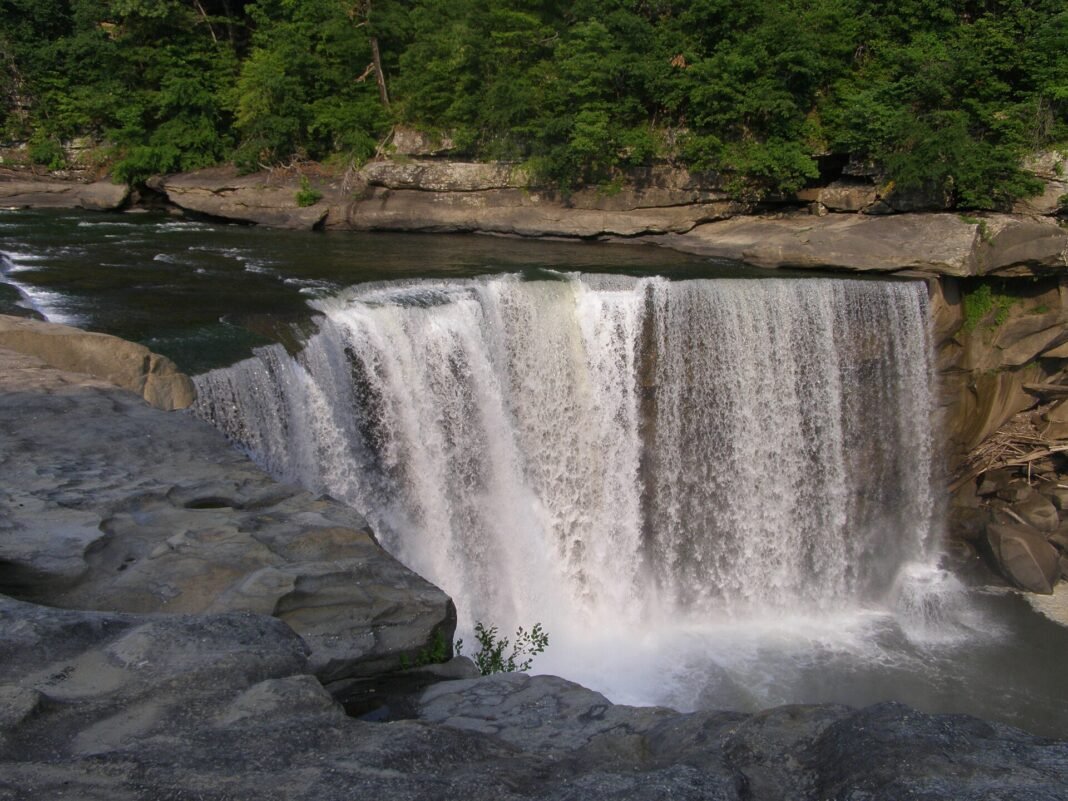
The Louisville Loop, a developing 100-mile trail and greenway system planned to ring Jefferson County, is Kentucky’s most ambitious urban cycling project, connecting the city’s parks, waterfront, and neighborhoods, with roughly half the planned route already open. Near Lexington, the annual Horsey Hundred is a non-competitive century ride through Bluegrass horse-farm country, on roads passing farm gates opened just for the event. For paddling, the Green River through Mammoth Cave National Park, the Red River through the Gorge (floating beneath the sandstone arches), and the Cumberland River below Cumberland Falls all stand out. Cumberland Falls, the “Niagara of the South,” is one of the few places in the Western Hemisphere where a moonbow, a rainbow produced by moonlight, appears on clear nights around the full moon.