
Cost of Living in New Jersey 2026: Property Taxes, New York Proximity, and the Shore Premium
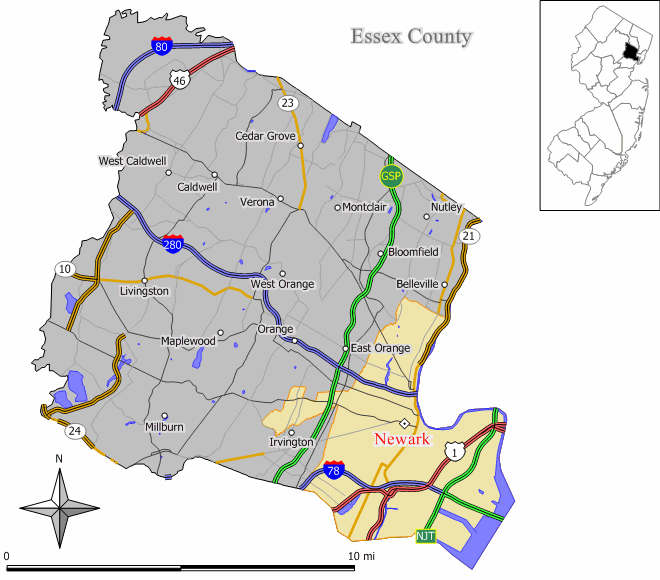
New Jersey’s cost-of-living profile is shaped by its position as the most densely populated state and the residential hinterland for both New York City and Philadelphia — a dual-metro dependence that drives housing costs, property taxes, and overall living expenses to levels that make New Jersey one of the most expensive states in the country by most aggregate measures. The honest assessment requires geographic specificity: northern New Jersey (Hudson, Bergen, Essex, and Union Counties) operates within the New York City economic gravitational field, with housing costs and commute considerations that reflect Manhattan proximity; central New Jersey (Middlesex, Monmouth, and Somerset Counties) represents a middle ground of Princeton-corridor professionals and suburbanites at moderate commute distances from both New York and Philadelphia; southern New Jersey (Burlington, Camden, Atlantic, Ocean, and Cape May Counties) is the state’s most affordable region, with housing markets more aligned with Philadelphia than New York and the Pine Barrens corridor providing additional downward price pressure. Property taxes — New Jersey consistently has the highest effective property tax rates in the country — are the constant across all regions.
Housing: The Three New Jerseys
Northern New Jersey’s housing market in Hudson County (Jersey City, Hoboken, Bayonne) has been transformed by direct proximity to Manhattan via PATH train — Hoboken and Jersey City waterfront properties command $600,000–$1.2 million for condominiums and $800,000–$1.5 million for single-family homes in desirable neighborhoods, reflecting the premium for New York City access without Manhattan’s actual price levels. The Bergen County communities (Ridgewood, Glen Rock, Ho-Ho-Kus, Ramsey) — the classic commuter suburbs with excellent public schools and New York City rail access — show medians of $600,000–$900,000 for single-family homes in the most desirable school districts. Essex County’s Montclair (an arts-forward suburb with a diverse population, excellent schools, and direct Midtown Direct rail service) runs $550,000–$850,000; the closer-in communities of Maplewood and South Orange provide similar character at slightly lower prices.
Central New Jersey’s Princeton corridor — the communities surrounding Princeton University (Princeton, Montgomery, Plainsboro, West Windsor) — provides the state’s most educationally oriented suburban communities at median prices of $500,000–$800,000 for single-family homes. The Middlesex County communities of Metuchen, Highland Park, and New Brunswick (home of Rutgers University) offer more accessible entry points at $350,000–$550,000. The Monmouth County shore communities — particularly the Victorian resort towns of Spring Lake and Sea Girt — combine shore access with New York commuter train service at prices of $700,000–$1.2 million for the most desirable homes. Southern New Jersey’s communities — Cherry Hill, Moorestown, and Haddonfield across from Philadelphia — provide the state’s best value for household size: median single-family home prices of $300,000–$500,000 in communities with excellent schools and Philadelphia transit access.

Property Taxes: The New Jersey Burden
New Jersey’s property taxes are the highest effective rates in the United States — a distinction the state has held consistently for decades and that represents the most significant financial burden for New Jersey homeowners relative to peer states. Average property tax bills in New Jersey exceed $9,000 annually — the national average is approximately $2,800. The effective rates (taxes as a percentage of home value) average approximately 2.1–2.5% statewide, with significant variation by municipality: some Hudson County urban communities (Newark, Camden) have relatively lower effective rates due to commercial tax bases, while some suburban communities in Morris, Somerset, and Bergen Counties exceed 2.5% effective rates due to school district spending.
The property tax system’s impact on housing affordability is significant and often underappreciated by buyers focused on purchase prices. A $500,000 home in Bergen County carrying a 2.2% effective tax rate costs $11,000 annually in property taxes — nearly $920 monthly added to the mortgage payment. The same $500,000 home in Connecticut, New York, or Pennsylvania would typically carry lower property tax rates, making the true housing cost comparison between New Jersey and neighboring states less favorable than purchase prices alone suggest. The New Jersey Senior Freeze (Property Tax Reimbursement) program provides some relief for seniors with frozen assessed values, and the Homestead Benefit program provides modest property tax credits for owner-occupants — but neither program addresses the fundamental structural issue of a state government model that relies heavily on local property taxation.
State Income Tax
New Jersey’s state income tax is graduated, with rates ranging from 1.4% on income up to $20,000 to 10.75% on income above $1 million. The rate structure for most middle-income households — the 5.525% rate applies to income from $75,000–$500,000 — is comparable to neighboring states. New Jersey provides property tax deductions for homeowners that partially offset the property tax burden in the income tax calculation. The state’s earned income tax credit (equal to 40% of the federal EITC) provides meaningful relief for lower-income households. The most significant income tax consideration for New Jersey residents is the interaction between New Jersey income taxes and New York City income taxes for commuters — New York City levies a nonresident city income tax on employees who work in the city, which is separate from the New York State income tax, creating a multi-state tax situation that requires careful planning for New Jersey residents who work in Manhattan.
Everyday Costs
New Jersey’s everyday costs are consistently above national averages in most categories. Grocery costs run approximately 5–8% above national averages, reflecting the state’s real estate costs (which affect food retail through store rents), the premium pricing of the New York metropolitan market, and the cost of doing business in a high-labor-cost state. New Jersey’s gasoline prices have historically been below the national average (the state has one of the lowest gas taxes in the northeast, and New Jersey remains one of the last states where attendants pump gas — full-service only, which maintains a local employment category that most states eliminated in the 1970s). Utility costs (electricity, natural gas for heating) are above national averages, reflecting the state’s energy distribution infrastructure costs and the climate’s genuine four-season demands. Automobile insurance in New Jersey is among the most expensive in the country — the state’s high population density, heavy traffic, and historical problems with auto insurance fraud have produced a market where minimum coverage is expensive and comprehensive coverage is significantly above national averages.
The New Jersey Calculation
New Jersey is not a state where people move for financial advantage — it is a state where people live because of New York City or Philadelphia proximity, family connections, or established community roots that make moving elsewhere less attractive than staying despite the cost. The financial trade-offs are clear: property taxes among the highest in the country, income taxes at above-average rates, and the general cost-of-living premium of the northeastern corridor — offset by world-class schools in the best districts, proximity to two of the largest and most culturally rich metropolitan areas in the world, beaches of genuine quality, and a state government that (despite its costs) provides public services of relatively high quality. For households who can work remotely and are not tethered to New York or Philadelphia employment, New Jersey is rarely the rational cost-optimization choice. For households with deep roots in the state and employment in the New York or Philadelphia metros, the combination of suburban quality and metropolitan access remains compelling despite the financial burden.