Why Alabama Belongs on Your Travel Bucket List
Alabama might not be the first state that crosses your mind when planning an American road trip, but seasoned travelers know better. The Heart of Dixie delivers a remarkable range of experiences — from Gulf Coast beaches with sand so white it looks like powdered sugar, to dramatic Appalachian ridgelines, world-class space museums, nationally recognized civil rights landmarks, and a food culture that has earned serious national attention. All of this, and still without the crushing crowds and inflated prices that characterize more obvious destinations.

The state rewards the people who actually show up. What follows is a region-by-region guide to the places worth building a trip around — coast, mountains, and the cities in between.


Gulf Shores and Orange Beach: The Gulf Coast’s Most Underrated Beaches
Start here, because most first-time visitors do, and for good reason. The beaches along Alabama’s 60-mile Gulf Coast stretch rank among the finest in the southeastern United States. The sand is quartz-white — almost blinding in afternoon light — and the water runs every shade of blue-green depending on depth and weather. The combination is hard to beat, and the beaches remain markedly less crowded than the Florida Panhandle just east of the state line.
Gulf State Park is the anchor of the region, spanning 6,150 acres of protected shoreline, freshwater lakes, and maritime pine forest. The park’s two-mile swimming beach is kept in exceptional condition, and the trail system offers cycling paths, birdwatching hides, and kayaking access to quiet interior lakes. The Lodge at Gulf State Park — a full-service Hilton property built to LEED certification standards — represents a significant upgrade from the condominium-heavy lodging that once defined the area.
Orange Beach, a short drive east, has a distinct personality centered on fishing and boating culture. Deep-sea fishing charters depart daily from the Wharf Marina targeting red snapper, grouper, king mackerel, and amberjack. West along the coast on Dauphin Island, the Alabama Deep Sea Fishing Rodeo — running every July since 1929 — draws thousands of anglers in what is recognized as the world’s largest fishing tournament, a regional institution as much as a sport.
The culinary scene on the coast has grown considerably over the past decade. Seafood houses that once relied entirely on fried platters have been joined by chef-driven restaurants serving fresh oysters on the half shell, raw bar selections sourced directly from regional aquaculture operations, and Gulf fish prepared with real technique. The Hangout Gulf Music and Arts Festival each May brings major national acts to the beach and transforms the area into a music destination for a long weekend.
When to go: Late April through May offers warm water (around 75°F), minimal crowds, and accommodation rates 25–35% below summer peaks. October is equally pleasant, with slightly cooler air temperatures and excellent water visibility for snorkeling.
Huntsville: Rocket City and the Space Race Legacy
No American city has a more singular identity than Huntsville, and no identity is quite as improbable: a mid-size Southern city that played a decisive role in getting humanity to the moon. Huntsville is home to NASA’s Marshall Space Flight Center, which was responsible for developing the Saturn V rocket — the most powerful launch vehicle ever built — under the leadership of German-born aerospace engineer Wernher von Braun, who was brought to Huntsville after World War II as part of Operation Paperclip.
_(cropped).jpg?width=1280)
The U.S. Space & Rocket Center, the museum built around this heritage, is one of the best science museums in the United States — not just one of the best space museums, but one of the best museums of any kind, period. The Saturn V pavilion alone justifies the drive to Huntsville. Lying on its side in a climate-controlled hall, the rocket’s 363-foot length becomes viscerally comprehensible in a way that photographs never convey. Standing next to the five F-1 engines at the base — each one producing 1.5 million pounds of thrust — produces a kind of physical awe that is rare in any museum context.
Space Camp has operated here since 1982 and has now trained more than one million participants from over 150 countries. Multi-day programs combine classroom instruction, flight simulation, zero-gravity training, and team-building exercises modeled on actual NASA mission protocols. For children between 9 and 18 with any interest in science, technology, engineering, or aviation, the camp programs can be life-changing.
Contemporary Huntsville extends well beyond the space theme. The city has become one of the fastest-growing tech corridors in the Southeast, driven by federal defense contracts and a pipeline of engineering talent from nearby University of Alabama in Huntsville. This influx of educated professionals has transformed the downtown food and nightlife scene dramatically. The Mars Manufacturing Excellence Center and Lowe Mill Arts & Entertainment — the largest privately owned arts center in the United States — add creative depth to a city that might otherwise seem narrowly technical. Monte Sano State Park, directly above the city, provides mountain biking trails and panoramic views that have helped Huntsville develop a surprisingly active outdoor culture.
Birmingham: The Civil Rights Movement and a City Reborn
Birmingham’s history is uncomfortable, essential, and worth every moment of engagement. In April 1963, this industrial city became the focal point of the Civil Rights Movement. Public Safety Commissioner Bull Connor’s decision to deploy fire hoses and police dogs against peaceful marchers — including hundreds of children — produced photographs that were broadcast around the world and created an international crisis that accelerated the passage of the Civil Rights Act of 1964.

The Birmingham Civil Rights District preserves this history with extraordinary seriousness. The Birmingham Civil Rights Institute anchors the district and is one of the finest social history museums in the country. Its permanent exhibition walks visitors from the realities of Jim Crow through the Birmingham campaign and its aftermath with unflinching honesty and impressive depth of scholarship. Across Kelly Ingram Park — where the 1963 demonstrations took place — bronze sculptures by artist Raymond Kaskey depict scenes from the campaign with an emotional directness that stops visitors in their tracks.
The 16th Street Baptist Church, a National Historic Landmark, still serves an active congregation and holds its most solemn place in American history as the site of the September 15, 1963 bombing that killed four young girls: Addie Mae Collins, Cynthia Wesley, Carole Robertson, and Carol Denise McNair. The church’s basement museum, small but deeply affecting, ensures that their names are not forgotten.
Beyond the civil rights heritage, Birmingham in 2026 is a city experiencing one of the more convincing urban renaissances in the South. The food scene has been nationally recognized for over two decades, anchored by chef Frank Stitt’s Highlands Bar and Grill, which helped establish Birmingham as a serious culinary destination in the 1980s. A newer generation of chefs has continued this tradition, particularly in the Pepper Place and Avondale neighborhoods. The Saturday Pepper Place Farmers Market runs from March through December and serves as the social center of Birmingham’s food culture — arriving at 8am on a Saturday and spending two hours working through the vendors is as good an introduction to local food culture as you’ll find anywhere in the South.
Montgomery: America’s Civil Rights Capital
If Birmingham represents the crucible of the Civil Rights Movement, Montgomery is its historical foundation. It was here that Rosa Parks refused to give up her bus seat on December 1, 1955, sparking the Montgomery Bus Boycott — a 381-day economic campaign that ended with the Supreme Court ruling bus segregation unconstitutional. It was here that Dr. Martin Luther King Jr. launched his public career as pastor of Dexter Avenue Baptist Church. And it was to Montgomery that 25,000 marchers arrived on March 25, 1965, after the 54-mile march from Selma along U.S. Highway 80.
The Rosa Parks Museum, built on the corner of Montgomery and Court Streets where she was arrested, is a carefully curated tribute that uses original documents, photographs, and oral histories to put her act of courage in its full context. The Dexter Avenue King Memorial Baptist Church, where King served from 1954 to 1960, offers guided tours of the sanctuary and a basement mural depicting key events in King’s life.
The National Memorial for Peace and Justice, founded by Bryan Stevenson’s Equal Justice Initiative and opened in 2018, has been widely described as one of the most significant memorials built in the United States in a generation. Dedicated to the more than 4,000 African Americans killed in racial terror lynchings between 1877 and 1950, the memorial’s more than 800 hanging steel columns — one for each county where a documented lynching occurred — create an atmosphere of accumulated grief that is unlike anything else in American public life. The adjacent Legacy Museum, housed in a former warehouse where enslaved people were warehoused during the domestic slave trade, extends this history into a deeply researched examination of the connections between slavery, lynching, Jim Crow, and mass incarceration.
Mobile: Creole Culture and America’s First Mardi Gras
Here is the fact that surprises nearly everyone: Mobile, Alabama — not New Orleans, Louisiana — holds America’s oldest Mardi Gras celebration. The port city has been celebrating the pre-Lenten festival since 1703 — predating New Orleans’s founding by 15 years. Every February, Mobile transforms with multiple parades, masquerade balls dating to the 19th century, and street celebrations that draw hundreds of thousands of visitors from across the region.
The rest of the year, Mobile earns its keep as one of Alabama’s most historically layered cities. Founded by the French in 1702, transferred to the Spanish and then the British before becoming American territory after the War of 1812, Mobile’s architecture reflects this complex colonial history in ways that feel distinctly unlike anywhere else in Alabama. The Old Dauphin Way Historic District is lined with antebellum Greek Revival and Italianate homes of unusual quality, many of which survived the Civil War intact.
Battleship Memorial Park, on the Mobile Bay waterfront, is one of Alabama’s most-visited attractions. The USS Alabama — a World War II-era South Dakota-class battleship — is preserved in extraordinary condition and can be toured extensively, from main deck gun turrets to engine rooms. The park also houses a submarine (USS Drum), a B-52 bomber, and an A-12 Blackbird spy plane among other military artifacts.
Mobile’s culinary identity is distinctly Creole, shaped by its French, Spanish, and African heritage in ways that differ markedly from the rest of Alabama. Gulf seafood is everywhere, prepared with more herb complexity and spice than in the state’s interior. The Eastern Shore of Mobile Bay is home to some of Alabama’s most celebrated restaurants, including several that have earned national recognition for their treatment of local oysters and Gulf fish.
Cheaha State Park and Little River Canyon
Northeastern Alabama’s Appalachian foothills contain the state’s best outdoor secrets. Cheaha State Park sits atop Mount Cheaha at 2,407 feet — Alabama’s highest point — and the views from the summit extend across a panorama of forested ridges that seem to stretch to the horizon in every direction. The clarity of the air on cool mornings in September and October, when fall color begins appearing in the hardwood canopy below, produces conditions for landscape photography that rival anything in the more famous Southern Appalachians.
The Civilian Conservation Corps built the park’s lodge and cabins in the 1930s using native stone, and the structures have aged into their surroundings with an authenticity that modern park construction rarely achieves. Rock climbing on Cheaha’s granite faces draws dedicated climbers from across the Southeast, and the Pinhoti Trail — which runs nearly 170 miles through the Talladega National Forest — offers multi-day backpacking opportunities of serious quality.
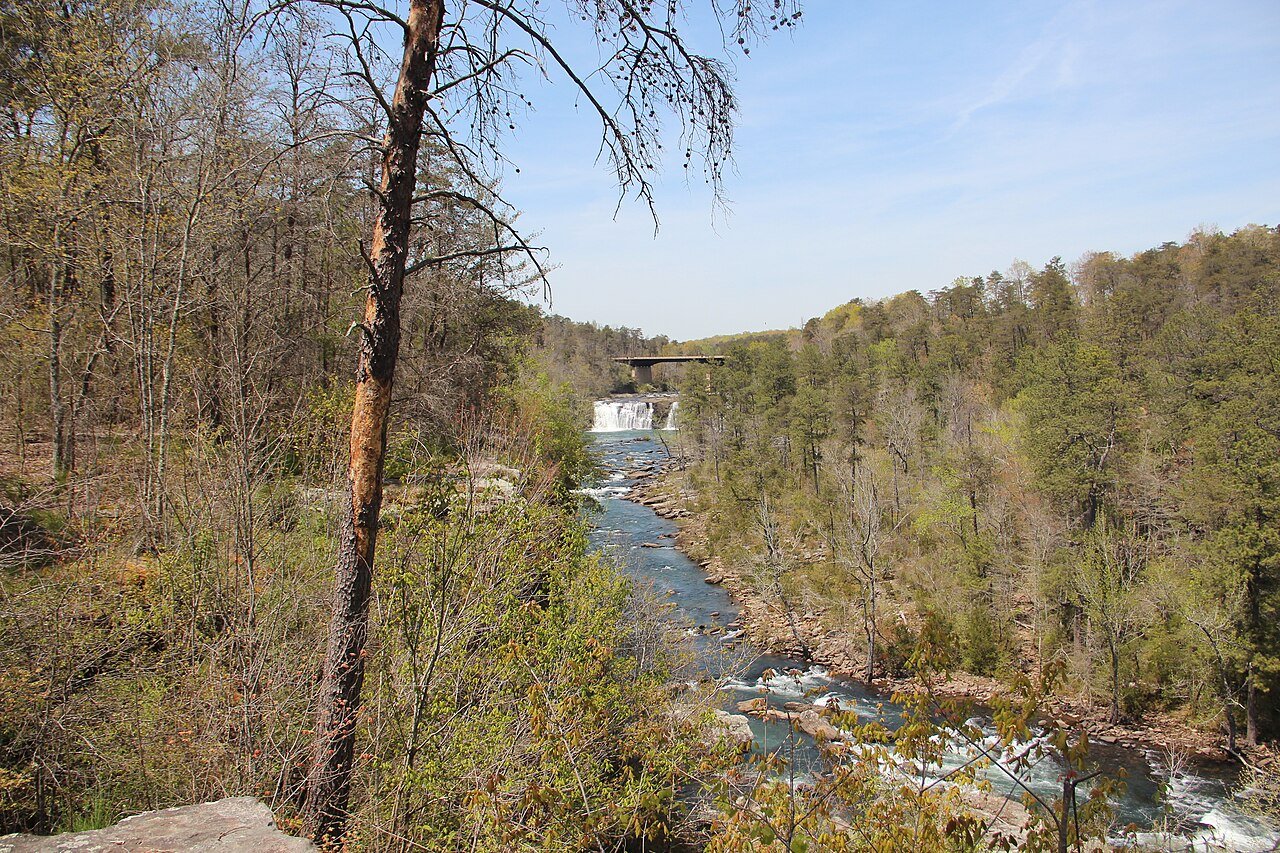
Thirty miles north of Cheaha, Little River Canyon National Preserve protects one of the longest mountaintop rivers in North America. Little River runs along the top of Lookout Mountain for over 20 miles before dropping into a canyon with walls over 600 feet high in places. The 14-mile Canyon Rim Drive offers a series of dramatic overlooks, while the canyon floor — accessible by trail — is a world of swimming holes, waterfalls, and crystalline water over sandstone. Few Alabama visitors know this place exists. Fewer still, after visiting, can resist coming back.
Essential Alabama Travel Tips
- Best seasons: March through May and September through November. Summers run hot and humid throughout the state, though the Gulf Coast remains popular for beach vacations from Memorial Day through Labor Day.
- Transportation: A rental car is essential. Alabama has no intercity rail service and minimal regional bus connections. Driving between major cities is straightforward; interstate highways connect Birmingham, Huntsville, Montgomery, and Mobile efficiently.
- Budget expectations: Alabama is excellent value. Hotel rates, restaurant prices, and attraction costs average 20–35% below national figures. A comfortable multi-day road trip can be managed very economically.
- Must-eat foods: Alabama white barbecue sauce (a mayonnaise and vinegar-based preparation unique to the northern part of the state), Conecuh sausage smoked over local hardwoods, fried green tomatoes, Gulf oysters, boiled peanuts from roadside stands, and banana pudding made with vanilla wafers. These are non-negotiable.
- Day trip from Birmingham: Cheaha (1.5 hours east), Huntsville (1.5 hours north), and Talladega Superspeedway (1 hour east) make excellent single-day excursions.
- Safety note: Alabama is generally safe for tourists, but as with anywhere, exercise normal awareness in urban areas after dark. The state’s weather can be severe in spring, particularly tornadoes in April and May. Download a weather alert app before you go.
Final Verdict
Alabama consistently outperforms its reputation. Visitors who arrive with modest expectations leave talking about space museums that rivaled Kennedy Space Center, about civil rights landmarks that made them cry, about beaches they want to return to every year, about mountain parks they never knew existed, and about meals they’re still thinking about weeks later.
The Heart of Dixie earns its nickname not through sentimentality but through genuine character — a state where history sits close to the surface, where the landscape surprises at every turn, and where Southern hospitality remains a real and present quality rather than a marketing claim.
Plan at least five days. You’ll wish you had planned for ten.
Frequently Asked Questions
What makes Alabama’s Gulf Coast beaches worth visiting?
Alabama’s Gulf Coast — 60 miles of quartz-white sand along Gulf Shores and Orange Beach — is one of the most underrated beach destinations in the southeastern United States. The sand is almost blinding in afternoon light, and the water runs every shade of blue-green. The beaches remain far less crowded than the adjacent Florida Panhandle. Gulf State Park (6,150 acres of protected shoreline, freshwater lakes, and maritime pine forest) anchors the region. Orange Beach is known for deep-sea fishing culture; the Alabama Deep Sea Fishing Rodeo each July is officially the world’s largest fishing tournament. The best time to visit is late April through May or October — warm water, minimal crowds, and accommodation rates 25–35% below summer peaks.
What is the U.S. Space & Rocket Center in Huntsville and why is it worth visiting?
The U.S. Space & Rocket Center in Huntsville is one of the finest science museums in the United States — not just among space museums, but among the best museums of any kind. The Saturn V pavilion is the centerpiece: lying on its side in a climate-controlled hall, the 363-foot rocket’s scale becomes viscerally comprehensible in a way photographs never convey. The museum is built around NASA’s Marshall Space Flight Center heritage, which developed the Saturn V under Wernher von Braun after WWII’s Operation Paperclip. Space Camp has trained more than one million participants from over 150 countries since 1982. Huntsville is also home to Lowe Mill Arts & Entertainment, the largest privately owned arts center in the United States.
What civil rights history sites should you visit in Alabama?
Alabama has three essential civil rights sites. In Birmingham: the Birmingham Civil Rights Institute (one of the finest social history museums in the country) and the 16th Street Baptist Church, where four young girls — Addie Mae Collins, Cynthia Wesley, Carole Robertson, and Carol Denise McNair — were killed in the September 15, 1963 bombing. Kelly Ingram Park has bronze sculptures depicting the 1963 campaign. In Montgomery: the Rosa Parks Museum (on the corner where she was arrested, December 1, 1955), the Dexter Avenue King Memorial Baptist Church (where Dr. King served 1954–1960), the National Memorial for Peace and Justice (dedicated to 4,000+ victims of racial terror lynchings), and the Legacy Museum — opened 2018, widely regarded as one of the most significant new memorials built in the US in a generation.
What outdoor destinations in Alabama are most underrated?
Two parks define Alabama’s best outdoor experiences. Cheaha State Park sits atop Mount Cheaha at 2,407 feet — Alabama’s highest point — with panoramic views over forested Appalachian ridges; the Civilian Conservation Corps-built lodge and cabins (1930s, native stone) give the park real character; the Pinhoti Trail runs nearly 170 miles through the Talladega National Forest for multi-day backpacking. Little River Canyon National Preserve, 30 miles north of Cheaha, protects one of the longest mountaintop rivers in North America: Little River runs along Lookout Mountain for over 20 miles before dropping into a 600-foot-deep canyon, with swimming holes, waterfalls, and crystalline sandstone water below.
What is Mobile’s Mardi Gras and why is it historically significant?
Mobile, Alabama — not New Orleans, Louisiana — holds America’s oldest Mardi Gras celebration. The port city has been celebrating the pre-Lenten festival since 1703 — predating New Orleans’s founding by 15 years. Every February, Mobile hosts multiple parades, masquerade balls dating to the 19th century, and street celebrations drawing hundreds of thousands of visitors. Mobile was founded by the French in 1702 and passed through Spanish and British hands before becoming American territory after the War of 1812 — the city’s architecture reflects this complex colonial history. The USS Alabama at Battleship Memorial Park (a WWII South Dakota-class battleship preserved in extraordinary condition) is one of the state’s most visited attractions.