Wales’s urban geography is concentrated in the south — Cardiff, Swansea, and Newport form the three vertices of a triangle that contains most of the country’s urban population, linked by the M4 corridor and the South Wales railway. North Wales has no large city in population terms; Wrexham — granted city status in September 2022 as part of the Queen’s Platinum Jubilee honours — is the seventh city of Wales, with a town population of about 61,000 and a wider county borough of roughly 135,000, while Bangor and Caernarfon serve as service centres for the Eryri (Snowdonia) region. The rural middle of the country (Mid Wales) has no significant urban centres at all — a vast agricultural landscape of hills and river valleys between the coastal towns and the border with England. This geography shapes the character of Welsh cities: Cardiff is a young, ambitious capital trying to establish its metropolitan credentials; Swansea is a maritime city of distinct cultural character living in the shadow of its more glamorous neighbour; Newport is the post-industrial city working to define a contemporary identity; and the smaller towns of north and west Wales hold on to a Welsh-language (Cymraeg) and cultural identity more concentrated, and more authentic, than the anglicised cities of the south.
Cardiff: Capital in Progress
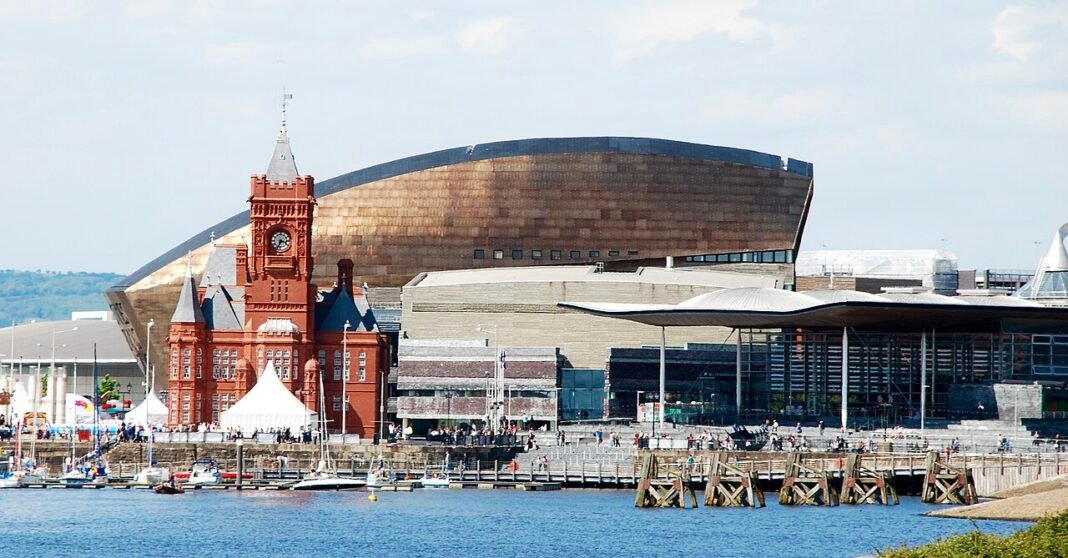
Cardiff (about 370,000 residents) is Wales’s capital and its only large city — a place transformed since the 1980s, from a declining port and industrial town into a modern European capital with genuine cultural ambition. The regeneration of Cardiff Bay (the former docks district, now home to the Senedd — the seat of Senedd Cymru / Welsh Parliament — the Wales Millennium Centre, and the boldest public architecture in the country), the rebuilding of the city centre retail and leisure district, and the growth of the university sector (Cardiff University, Cardiff Metropolitan, the University of South Wales city campus and the Royal Welsh College of Music and Drama, with 60,000-plus students combined) have given the city real energy and a rising reputation for liveability.
- Best neighbourhoods: Pontcanna and Canton (west Cardiff’s most sought-after residential areas — independent cafés, restaurants, and shops; Victorian and Edwardian terraced housing; a short walk from Bute Park and the river Taff; Cardiff Arms Park and the Principality Stadium nearby); Roath (east of the city centre — the Roath Park lake and botanical gardens; a dense independent food and drink scene along City Road and Albany Road; the student population of Cardiff University nearby); Cathays (student-dominated, cheap, lively — the Victorian terraces of the country’s most student-dense neighbourhood)
- Cultural infrastructure: Wales Millennium Centre; the National Museum Cardiff (free entry, with a remarkable Impressionist collection and a substantial holding of Charles Rennie Mackintosh furniture); Cardiff Castle; Principality Stadium; the Sherman Theatre; Chapter Arts Centre in Canton (Cardiff’s most adventurous arts venue); the Depot (street food and arts space)
- Why Cardiff: The cheapest capital-city lifestyle in the UK; a real arts and music scene (Welsh music’s renaissance — Manic Street Preachers, Stereophonics, Catatonia — gave the city a credible musical identity); direct London Paddington trains in roughly two hours; close to Bannau Brycheiniog (the Brecon Beacons) and the Vale of Glamorgan countryside
Swansea: The Second City’s Character
Swansea (about 251,000 residents, on Swansea Bay at the western end of the M4 corridor) is Wales‘s second city and its most characterful — the home of Dylan Thomas (who called Swansea “an ugly, lovely town”), the gateway to the Gower Peninsula (the UK’s first AONB, designated in 1956, with Rhossili Bay and Three Cliffs Bay regularly ranked among Britain’s finest beaches), and a city whose maritime and industrial identity has survived Cardiff’s capital aspirations intact. Swansea University (about 25,000 students, with a Bay Campus directly on the water) keeps a permanent youth population in town; the SA1 Swansea Waterfront development and the Swansea Arena (opened 2022) mark the city’s ongoing regeneration.

- Cultural highlights: The Dylan Thomas Centre (the national literature centre for Wales, in a former guild hall); the Swansea Museum (the oldest public museum in the country); the National Waterfront Museum (free entry, covering Welsh industrial history); the Grand Theatre; the Brangwyn Hall (with its remarkable series of murals by Frank Brangwyn)
- Gower Peninsula: 30 minutes from Swansea’s city centre — the limestone headlands, Three Cliffs Bay (the loveliest bay in South Wales), the Rhossili Bay surf beach (three miles of west-facing Atlantic sand, regularly voted Britain’s best), and the Gower Heritage Centre put open countryside and wild coast within reach of the city in a way no other Welsh or English city can match
Newport: The Gateway City
Newport (Casnewydd, about 165,000 residents and the fastest-growing local authority in Wales according to the latest ONS mid-year estimates) sits between Cardiff and the English border — the third city of Wales, often overlooked in the Cardiff–Swansea binary, but a city with a distinct post-industrial identity (the Transporter Bridge, one of only a handful still standing worldwide; the Roman fortress of Caerleon 3km from the city centre; the Newport Wetlands RSPB reserve on the Severn Estuary) and the lowest urban property prices of any UK city its size. Newport’s position on the M4 (15 minutes to Cardiff, 45 minutes to Bristol) makes it an increasingly popular base for commuters to both cities.
Wrexham (Wrecsam): The Newest Welsh City
Wrexham (Wrecsam, town population about 61,000, county borough about 135,000) in northeast Wales — near the English border, 30 minutes from Chester — was granted city status in September 2022 as part of the Queen’s Platinum Jubilee honours, becoming the seventh city of Wales. The purchase of Wrexham AFC by Hollywood actors Ryan Reynolds and Rob McElhenney in 2020, and the club’s subsequent climb through the English football pyramid (documented in the Welcome to Wrexham series), has handed the city a global profile out of all proportion to its size. Wrexham’s industrial heritage (coal, steel, and the famous Wrexham Lager brewery), the Erddig estate (National Trust, one of the finest country houses in the country), and its nearness to the Clwydian Range and Dee Valley AONB supply the cultural and natural context that the football fame has amplified rather than created.
_and_the_St_Giles_Angels_027_(51659307227).jpg?width=1200)
Market Towns and Rural Wales
Wales’s small market towns — Brecon (gateway to Bannau Brycheiniog / the Brecon Beacons), Abergavenny (“the food capital of Wales,” home of the Abergavenny Food Festival), Hay-on-Wye (the world’s used-book capital, with more than twenty second-hand bookshops in a town of about 1,600), Aberystwyth (the Welsh university and National Library town on Cardigan Bay, population about 14,000), and Machynlleth (the Centre for Alternative Technology) — offer the most characteristically Welsh urban life: small, Welsh-language-present, community-minded, and rooted in the rural landscape in a way that the urban scale of Cardiff and Swansea cannot replicate.
Frequently Asked Questions
What makes Cardiff Wales’s most ambitious city?
Cardiff — about 370,000 residents, the Welsh capital — has been transformed since the 1980s, from a declining port and industrial town into a modern European capital with genuine cultural ambition and a rising reputation for liveability. Cardiff Bay (the regenerated former docks district, now home to the Senedd — the seat of Senedd Cymru / Welsh Parliament, Richard Rogers’ transparent timber, slate and glass debating chamber opened on St David’s Day 2006 — and the Wales Millennium Centre, designed by Jonathan Adams of Percy Thomas Architects with its bronze-coloured stainless steel dome and slate-clad façade pierced by Gwyneth Lewis’s bilingual inscription “In these stones, horizons sing / Creu gwir fel gwydr o ffwrnais awen”) has become the symbol of the city’s modern ambition. Cardiff Castle (a Roman fort reworked through Norman, Victorian, and Edwardian periods, with the 3rd Marquess of Bute’s fantastical Gothic Revival interiors created from 1865 by William Burges) and Castell Coch (the Victorian fairy-tale castle in the Taff Gorge north of the city, also by Burges for the Marquess of Bute) are its most extraordinary heritage experiences. The Principality Stadium (capacity 73,931, the largest in Wales, with a retractable roof and a central location that makes match-day Cardiff one of Britain’s great sporting occasions) and Cardiff Arms Park (next door, historic home of Cardiff Rugby) define the city’s rugby culture. Pontcanna and Canton (west Cardiff, Victorian and Edwardian terraces with independent café and restaurant culture) are its most desirable residential neighbourhoods.
What does Swansea offer as Wales’s second city?
Swansea — about 251,000 residents, on the Gower Peninsula and Swansea Bay — is Wales’s second city and a maritime place of distinct character that lives in Cardiff’s shadow but holds a strong separate identity, rooted in its industrial heritage, its Dylan Thomas connections (Thomas was born in Swansea in 1914; the Dylan Thomas Centre in the Maritime Quarter and his birthplace at 5 Cwmdonkin Drive are the leading literary heritage sites in Wales), and the Gower Peninsula’s landscape. Gower (the UK’s first Area of Outstanding Natural Beauty, designated in 1956 and now branded as Gower National Landscape, immediately west of the city) — limestone cliffs, sand dunes, and the finest beaches in South Wales (Rhossili Bay, consistently rated one of the UK’s top beaches; Three Cliffs Bay, probably the most photographed bay in Wales) — gives Swansea the easiest reach to wild coast of any Welsh city. Swansea Market (the largest indoor market in Wales, with cockles, laverbread — the seaweed preparation unique to Welsh food culture — and Gower produce) is the most authentic Welsh food experience in a city setting. Mumbles (the Victorian seaside resort at the western end of Swansea Bay, reached by the Swansea Bay cycle path) rounds out the city’s waterfront leisure.
What does North Wales offer beyond Eryri/Snowdonia?
North Wales — the region of Gwynedd, Conwy, and Denbighshire north of the Cambrian Mountains — holds both the highest mountain landscape in Wales (Eryri, the Welsh name now used in preference to Snowdonia by the national park authority since 2022) and a string of Edwardian castle towns and coastal resorts that form one of Britain’s densest heritage landscapes. The Llŷn Peninsula (the finger of land west of Yr Wyddfa, reaching into Cardigan Bay) keeps one of the country’s strongest Welsh-speaking communities — Welsh is the first language for over 70% of residents in many Llŷn communities according to the 2021 Census — alongside the Llŷn Coastal Path (91 miles) and the pilgrimage destination of Bardsey Island (Ynys Enlli, the ‘Island of 20,000 Saints’, reached by boat from Aberdaron, one of the most significant early medieval religious sites in Wales). Caernarfon Castle (a UNESCO World Heritage Site, begun by Edward I in 1283 to consolidate English control of Gwynedd — among Britain’s most formidable medieval castles, where Charles III was invested as Prince of Wales in 1969) anchors the North Wales castle route. Conwy (another UNESCO castle town, with the most complete medieval town walls in Britain), Harlech (a coastal castle with a clifftop position of extraordinary drama), and Beaumaris (the most technically perfect concentric castle in Britain, begun in 1295 to a design by Master James of St George for Edward I) complete what is widely held to be the finest concentration of medieval castles in the world.
What does Mid Wales offer for outdoor recreation and living?
Mid Wales — the vast agricultural hinterland between the North Wales coast and Bannau Brycheiniog (the Brecon Beacons), stretching from Machynlleth in the west to Welshpool on the English border — is the least-visited and most rurally characterful part of the country: a landscape of rounded hills, river valleys, and market towns that keeps a Welsh cultural and linguistic character (Cymraeg remains the first language across much of Ceredigion and parts of Powys) without the tourist infrastructure of Eryri or Gower. Aberystwyth (about 14,000 residents on Cardigan Bay, home of Aberystwyth University and the National Library of Wales) is the region’s cultural anchor — the clifftop Victorian promenade, the National Library’s extraordinary collection (legal deposit library, Welsh manuscripts), and a lively student culture. The Elan Valley (the Victorian reservoir system above Rhayader, supplying water to Birmingham, with a road and cycling route through dramatic reservoir country) and the Cambrian Mountains walking routes cover the outdoor side. The Centre for Alternative Technology (near Machynlleth, founded in 1974 as a pioneering demonstration site for sustainable living) and Hay-on-Wye (the book town on the Welsh–English border, with more than twenty second-hand bookshops in a town of about 1,600 and the Hay Festival — among the most celebrated literary festivals in the English-speaking world) carry Mid Wales’s alternative cultural identity.
What does Bannau Brycheiniog (the Brecon Beacons) offer as South Wales’s premier outdoor destination?
Bannau Brycheiniog National Park (officially rebranded from the Brecon Beacons in 2023; 1,344 square kilometres, the southern mountain wall of Wales, about 45 minutes from Cardiff) is South Wales’s go-to mountain landscape. Pen y Fan (886m, the highest peak in southern Britain south of Cadair Idris, reached from the Pont ar Daf car park in about 3km — the most walked mountain in Wales and one of the busiest in the UK) dominates the central Beacons. The park became the fifth International Dark Sky Reserve in the world — and the first in Wales — when it was accredited in February 2013, giving it stargazing infrastructure of international standing. The Taff Trail (55 miles of cycling and walking from Cardiff to Brecon) is the most complete active-travel link between a major Welsh city and a national park. The Black Mountains (the eastern section, with Pen y Gadair Fawr and the Waun Fach ridge) and the Black Mountain (the western section, with the glacial cwm of Llyn y Fan Fach and the iconic Fan Brycheiniog ridge) hold the remotest walking in the park. The Sgwd yr Eira waterfall (in the Waterfall Country of the Neath–Afan valleys on the park’s southern edge, where four major waterfalls cluster above the Vale of Neath) offers its most dramatic short walks.