
Kansas Travel Guide 2026: Beyond the Flat Stereotype
Kansas carries the weight of America’s most dismissive geographic reputation — flat, featureless, something to drive through rather than stop in. This reputation is wrong in the specific and interesting ways that the best misunderstood destinations always are. Kansas contains the last significant tracts of tallgrass prairie on the continent, some of the most dramatic river bluff country in the Great Plains, a space and aviation heritage that is uniquely concentrated in Wichita, remarkable chalk formations in the Smoky Hills that rival better-known geological destinations in other states, and a historical depth along the old Chisholm Trail and Civil War battlegrounds that shaped American history in ways that few other states can match. The visitor who comes to Kansas prepared to look closely finds more than the interstate reveals.
Tallgrass Prairie National Preserve: America’s Last Prairie
The Tallgrass Prairie National Preserve, in the Flint Hills of east-central Kansas near Strong City, protects approximately 11,000 acres of the original tallgrass prairie ecosystem — one of the most diminished ecosystems in North America, with less than 4% of the original 170 million acres remaining unplowed. The Flint Hills are the largest remaining expanse of tallgrass prairie in the world, and their chert-rich limestone soil resisted the breaking plow that converted the rest of the Great Plains to agriculture. Walking through the Preserve’s grasses — big bluestem, Indian grass, and switchgrass reaching shoulder height in the late summer — provides a direct physical experience of the landscape that Lewis and Clark crossed, that generations of bison in numbers exceeding 30 million once grazed, and that the nation’s agricultural transformation essentially erased everywhere else.
The Preserve’s trail system includes the Bottomland Nature Trail (1.75 miles through the spring-fed Lower Fox Creek), the Southwind Nature Trail (2 miles across the prairie uplands), and the lengthy backcountry trail to Upper Fox Creek that provides multi-hour prairie immersion. Seasonal cattle grazing is used as a land management tool within the preserve — visitors may encounter longhorn cattle on some trails, part of the historically accurate management practice that keeps woody shrubs from invading the prairie grassland.
Monument Rocks and Castle Rock: Chalk Badlands
Monument Rocks, in Gove County in western Kansas, is one of the most visually remarkable geological formations in the Great Plains — a collection of chalk buttes and natural arches rising 70 feet above the flat shortgrass prairie of the High Plains. The chalk, deposited in the shallow Cretaceous Western Interior Seaway that covered much of Kansas 80 million years ago, was protected by harder caprock while the surrounding chalk eroded away, leaving isolated towers, fins, and arches that in aerial view and on the ground resemble a miniature Arches National Park on the prairie floor. The site has no fee, no facilities, and receives limited visitors — which means that those who know about it typically have it to themselves.
_6.jpg?width=1200)
Castle Rock, 15 miles south of Monument Rocks, provides a similar chalk formation experience — a single dramatic butte that rises above the Smoky Valley in a formation more compact and vertical than Monument Rocks. Both sites are most easily reached via gravel roads from US-40 and are best visited in the cooler months; summer heat on the open prairie can be severe.
Wichita: Aviation Capital
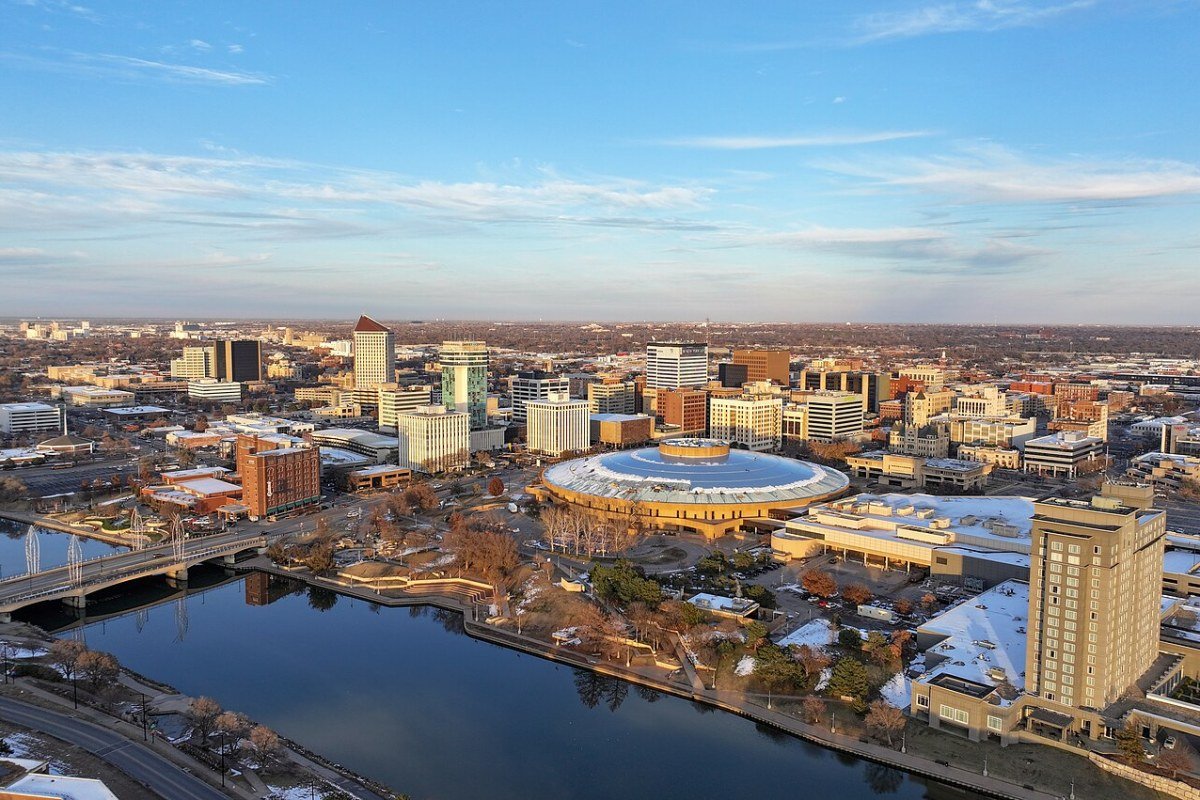
Wichita has a claim to being the air capital of the world that is not marketing hyperbole: more general aviation aircraft have been built in Wichita than in any other city on Earth, and the aerospace manufacturing tradition established by Cessna, Beechcraft, and Lear Jet (all headquartered or founded in Wichita) continues through the current operations of Bombardier Learjet, Cessna/Textron Aviation, and Beechcraft/Textron. The Kansas Aviation Museum, housed in the original Art Deco Wichita Municipal Airport terminal building (now a National Historic Landmark), provides one of the country’s finest collections of aircraft from the Kansas manufacturing heritage.
Wichita’s Old Town entertainment district, the Keeper of the Plains statue at the confluence of the Arkansas and Little Arkansas Rivers (a 44-foot welded steel figure created by Kiowa-Comanche artist Blackbear Bosin that has become the city’s defining landmark), and the growing River District development along the Arkansas River through downtown provide urban amenities that are more developed than Wichita’s secondary-city profile suggests to visitors who haven’t been there recently.
The Chisholm Trail and Dodge City
Dodge City, in southwestern Kansas on the Arkansas River, was the most famous cattle town of the post-Civil War era — the endpoint of the Chisholm Trail’s western extension and the site of the lawless cattle drives and peace-keeping mythology (Wyatt Earp, Bat Masterson) that shaped American Western mythology. The Boot Hill Museum, built on the historic site of Dodge City’s original cemetery, re-creates the Front Street of the 1870s cattle town era with period buildings, live performances, and artifact collections that provide a substantive historical interpretation rather than a superficial theme park. The Long Branch Saloon of legend is reconstructed within the museum grounds.
Kansas’s historical sites along the Chisholm Trail corridor — from Wichita north through Newton, Abilene, and Ellsworth — trace the cattle drives that drove the post-Civil War Texas cattle economy and created the mythology of the American cowboy. The Eisenhower Presidential Library and Museum in Abilene, Kansas, provides a contrasting historical anchor: the birthplace and boyhood home of the Supreme Allied Commander and 34th President, whose connection to the small Kansas town he grew up in remained a defining element of his public identity throughout his career.
Kansas rewards the traveler who approaches it with genuine curiosity about the American interior. The prairie ecosystem, the chalk formations, the aviation heritage, the cattle town history, and the Civil War battlegrounds (the Battle of Mine Creek in 1864 was the second-largest cavalry engagement of the Civil War and is commemorated at a state historic site near Pleasanton) together compose a state of considerable historical and natural depth that its flat reputation entirely fails to convey.