

Kansas Outdoor Activities 2026: Prairie, Reservoirs, and Big-Sky Adventure
Kansas outdoor recreation operates at the scale of the Great Plains — vast open spaces, big skies, the specific beauty of grassland ecosystems that require a different kind of attention than mountain or coastal landscapes. The state’s outdoor activities are less well-known than those of its neighbors but are significant: the Flint Hills tallgrass prairie provides one of the most important and evocative hiking environments in the Midwest, the state’s reservoirs provide extensive flatwater recreation, the chalk formation country of western Kansas has no equivalent anywhere in the Great Plains, and the birding along the Cimarron and Arkansas River corridors provides access to species and concentrations that rival any location in the central United States.
Tallgrass Prairie: Walking the Last Prairie
The Tallgrass Prairie National Preserve and the Konza Prairie Biological Research Station together protect the most accessible and most significant tracts of original tallgrass prairie in existence. At the National Preserve, the 10-mile backcountry trail (open only to day hikers with a permit, no camping) provides the most immersive prairie walking experience — hours of travel through grasses that can reach 8 feet in late summer, past limestone outcrops, across spring-fed creek drainages, and through the subtle topographic variation of the Flint Hills that belies the prairie’s reputation for flatness. The seasonal burning program (ranchers and the preserve staff conduct prescribed burns in spring) creates the fire-grass cycle that has maintained the tallgrass ecosystem for thousands of years.
The Konza Prairie, south of Manhattan near Kansas State University, is a 8,600-acre research preserve where long-term ecological studies have been ongoing since 1981 — one of the longest-running ecological research programs in the world. Public hiking is available on two trail loops: the Kings Creek Loop (2.6 miles) and the Nature Trail (1.8 miles) through the wooded upland. Bison (a herd managed for ecological research) graze the Konza, and encounters with the herd on the trail loops are possible and memorable.
Monument Rocks and the Chalk Formations
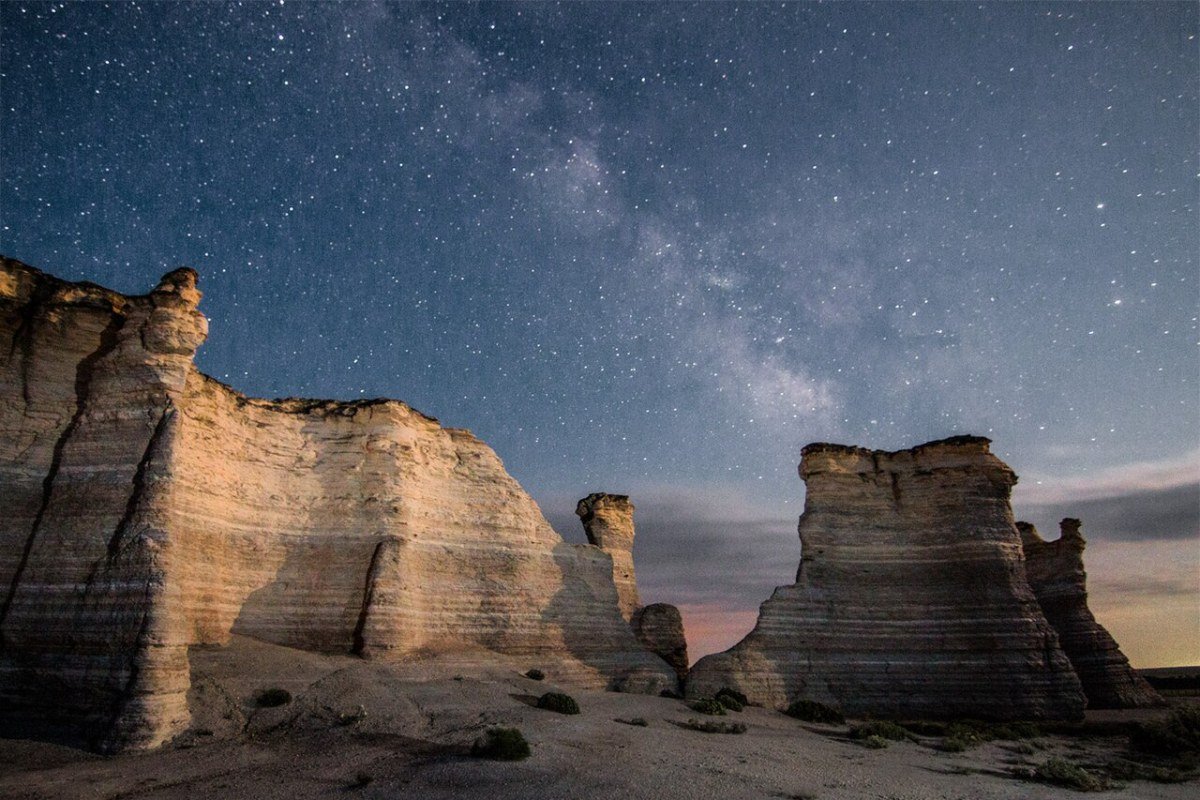
Monument Rocks (also called the Chalk Pyramids) in Gove County and Castle Rock in Trego County are the most spectacular geological features accessible to visitors in Kansas — 70-foot chalk buttes and natural arches rising from the flat High Plains shortgrass prairie of western Kansas. The chalk, deposited in the Cretaceous Western Interior Seaway that divided North America 80 million years ago, weathers into dramatic vertical formations when exposed. Both sites are open to the public with no fee, no paved roads, and no facilities — drive to within a mile on gravel roads, then walk across the prairie to reach the formations. In the absence of crowds, the experience is one of the most genuinely surprising in the Great Plains.

Reservoir Recreation: Milford, Cheney, and Tuttle Creek
Kansas has over 20 major reservoirs managed by the Army Corps of Engineers and the Kansas Department of Wildlife and Parks, providing flatwater recreation across all regions of the state. Milford Lake, near Junction City, is the largest reservoir in Kansas at 16,000 acres and provides sailing, power boating, fishing (white bass, walleye, and channel catfish are the primary species), and camping on its 163 miles of shoreline. Cheney Reservoir, west of Wichita, is the state’s premier sailing lake and the primary water source for Wichita — a combination that requires careful boat maintenance and no-wake zones near the intake structures but provides consistent sailing wind from the southwest that makes it one of the best inland sailing venues in the Midwest.
Tuttle Creek Reservoir, north of Manhattan in the Flint Hills, provides the most scenically distinctive reservoir environment in Kansas — surrounded by the rolling limestone hills and tallgrass prairie of the Flint Hills, it offers fishing, camping, and the Fancy Creek Wildlife Area on its northern shore where shorebird and waterfowl habitat supports excellent birding. The Big Blue River arm of Tuttle Creek provides flatwater kayaking through wooded bottomland that feels remote despite its proximity to Manhattan.
Birding: The Central Flyway
Kansas sits along the Central Flyway — the main migration route for birds moving between the Great Plains and the central breeding grounds of Canada and the Arctic. The Quivira National Wildlife Refuge, in Stafford County in central Kansas, is one of the most important shorebird staging areas in the interior of North America — in spring and fall, tens of thousands of shorebirds (including Wilson’s Phalaropes in numbers that can exceed 100,000 at peak migration) stop at Quivira’s shallow salt marsh lakes. American Avocets, Black-necked Stilts, White-faced Ibis, and in winter, Whooping Cranes (the critically endangered species uses Quivira as a migration stopover, making it one of the few locations in the country where Whooping Cranes can be reliably observed) use the refuge throughout the year.
The Cimarron National Grassland in southwest Kansas provides the only public land in the state with true shortgrass prairie and semi-arid canyon habitat — the nesting range of Lesser Prairie-Chickens (a threatened species), Scaled Quail, and the suite of desert grassland birds that require conditions found nowhere else in the state.
Cycling and Trails
The Katy Trail in Missouri connects at the Kansas border for multi-state cycling, but Kansas has developed its own trail network centered on the Lawrence Riverfront Trail and the Wichita cycling infrastructure. The Wichita bike trail network, expanding through the Arkansas River corridor and into the neighborhood trail system, has become one of the more ambitious urban cycling projects in the Plains states. The Sunflower Rail-Trail Conservancy manages several rail-trail conversion projects across the state, and the Prairie Spirit Trail (51 miles from Ottawa to Iola in eastern Kansas) provides one of the longest paved rail-trails in the state through small-town prairie landscapes.
Kansas outdoors rewards the visitor or resident who approaches it as a practitioner — who hikes the prairie with an eye for the specific grasses and wildflowers rather than looking for dramatic peaks; who paddles the reservoir calm waters for the shorebird concentrations rather than whitewater excitement; who drives the chalk formation roads of the High Plains with genuine curiosity about the sea that deposited them. That orientation — patient, attentive, curious about the specific rather than the spectacular — is what Kansas requires, and what it rewards.