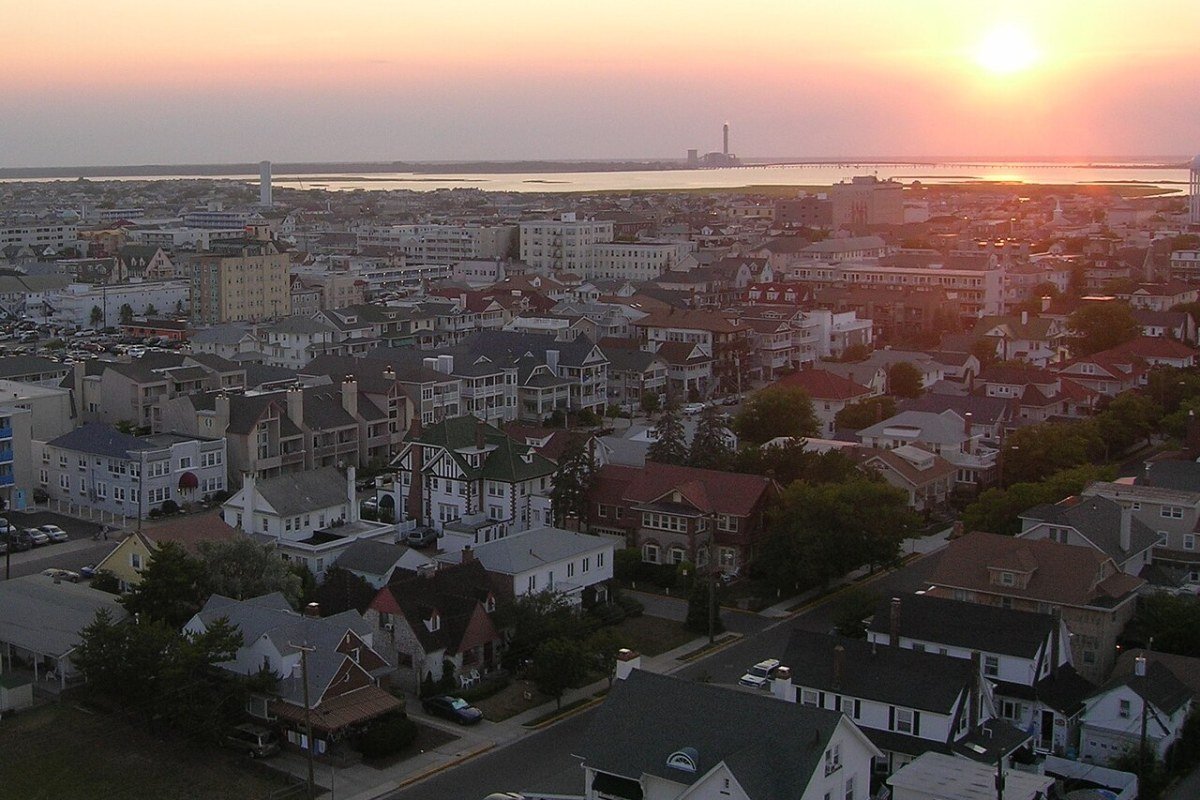
New Jersey‘s most desirable places to live cluster around two axes: the New York City commuter belt of the northeast (where rail and PATH access to Manhattan sets the value of an address, and school-district quality reflects the premium incomes of commuter households) and the Philadelphia suburban ring of the southwest (where Burlington, Camden, and Gloucester Counties offer quieter, more affordable towns with Philly access). Between those metropolitan pulls, the Shore towns deliver seasonal and year-round living of a different character entirely — places whose identity comes from the ocean rather than from commute efficiency. The state’s most sought-after addresses run the full range, from the Victorian streets of Montclair to the quiet affluence of Princeton to the resort grandeur of Cape May.

1. Montclair — The Arts Suburb
Montclair, 12 miles from Manhattan in Essex County, rates consistently among the finest suburbs in the New York metropolitan area — a township of roughly 41,000 residents that pulls off an unusual mix: genuine urban character (a walkable downtown, independent restaurants and theaters, an art museum of regional significance, a population diverse across income levels), strong public schools (the Montclair magnet program offers school choice within the district and sustains integration), and direct Midtown Direct rail service to Penn Station in about 45 minutes. The Montclair Art Museum (opened 1914, with a deep permanent collection of American art and Native American art), the Wellmont Theater (a 2,500-seat concert venue), and the run of independent restaurants, coffee shops, and boutiques along Bloomfield Avenue and Church Street form a walkable commercial district that few New Jersey suburbs can match.
Montclair’s housing costs track its desirability — median single-family prices of $550,000–$850,000 in the historic neighborhoods next to downtown (Upper Montclair, the North End, and the Bradford Street corridor), with the most coveted Victorian and Craftsman homes clearing $1 million. Property taxes here run above the Essex County average, reflecting school-district spending; the effective rate of roughly 2.3–2.6% adds $12,000–$20,000 a year to ownership costs in the median range. Neighboring Glen Ridge (a borough fully surrounded by Montclair, with its own small-town New Jersey feel) and Bloomfield offer modestly lower prices while keeping access to the Montclair shopping district and Midtown Direct rail.
2. Princeton — The University Town
Princeton, home of Princeton University in Mercer County, gives New Jersey its most intellectually charged place to live — a small city of about 30,000 residents (including roughly 9,000 university students) where the campus generates cultural infrastructure (the Princeton University Art Museum, the McCarter Theatre Center, the university’s concert and lecture series) that a town of this size would not otherwise support. Nassau Street, the commercial spine of downtown Princeton, carries the independent bookshops, restaurants, and cafes you would expect beside a university of global academic stature. Palmer Square, the planned district next to Nassau Hall, anchors the town center with shops and dining in a Colonial Revival setting designed in 1937.
Princeton’s housing costs sit among the highest in central New Jersey — median single-family prices of $700,000–$1.1 million in the walkable streets adjacent to campus (Riverside, Western, the historic Borough), with the faculty-heavy western side commanding the steepest prices. The Princeton Public Schools rank consistently among the highest-performing in the state, which drives a steep premium from families chasing both the academic setting and the school quality. Somerset County towns just to the north — Montgomery, Hillsborough, and Bound Brook — open more affordable access (medians of $400,000–$600,000) to the Princeton employment corridor without the full Princeton markup.

3. Jersey City — The Urban Alternative
Jersey City, New Jersey’s second-largest city with about 305,000 residents directly across the Hudson River from Lower Manhattan, has worked through a long shift from industrial port to urban residential destination — propelled by PATH access to Lower Manhattan (Exchange Place, 10 minutes to the World Trade Center station), Midtown (Journal Square to 33rd Street), and Brooklyn, paired with prices that still sit below comparable New York City neighborhoods despite a decade of sharp appreciation. The downtown waterfront (the Exchange Place financial district) and the rising neighborhoods of the Heights, Paulus Hook, and Van Vorst Park deliver real urban density — brownstone housing stock, independent restaurants, and the energy of a diverse city that has drawn working professionals and creative households out of Brooklyn and Manhattan in search of more space per dollar.
Jersey City’s market has appreciated steeply — median condominium prices on the downtown waterfront run $550,000–$900,000, and brownstone single-family homes in Paulus Hook and Hamilton Park run $700,000–$1.2 million. The more affordable Heights, Bergen-Lafayette, and western sections of the city open entry-level access at $350,000–$550,000, in a market that keeps gentrifying westward from the river. Property taxes here come in below those of the Essex and Bergen County commuter suburbs — the city’s large commercial tax base (the downtown financial district in particular) eases the residential tax burden relative to bedroom towns without that commercial development.
4. Asbury Park — The Shore Comeback
Asbury Park, the Monmouth County shore city that endured decades of economic decline after the 1970 riots and the collapse of its resort trade, has pulled off one of the most striking turnarounds in New Jersey — a swing from near-abandonment to one of the most creative and culturally alive small cities on the Jersey Shore, powered by arts investment, LGBTQ+ community development, and the draw of its music heritage (the Stone Pony, where Bruce Springsteen’s career took off, remains an active venue and a pilgrimage stop). Convention Hall on the boardwalk — a 1930 Art Deco landmark that slid into disrepair before its restoration — now anchors a boardwalk of independent restaurants, bars, and music venues that stays open year-round rather than only through the summer.
Asbury Park’s market has climbed sharply as the revival has drawn buyers from New York City and the suburban New Jersey market — brownstone and Victorian homes on the west side, severely blighted a decade ago, now command $350,000–$600,000, and the oceanfront condominium project on the Convention Hall block marks significant investment in the city’s continued turnaround. The surrounding towns of Ocean Grove (a Methodist camp-meeting enclave of Victorian architecture that bars alcohol sales and keeps a distinctly quiet character), Bradley Beach, and Belmar offer alternatives within the Asbury Park coastal cluster across a range of price points.
5. Haddonfield — Philadelphia’s Finest Suburb
Haddonfield, a borough of about 12,800 residents in Camden County directly across the Delaware River from Philadelphia, is the most complete small-town suburb on the Philadelphia metro’s New Jersey side — a National Register Historic District of Federal and Victorian architecture along a Kings Highway dating to 1686, with a walkable downtown of independent shops and restaurants, strong Camden County schools (the Haddonfield public schools rank consistently among the top performers in southern New Jersey), and PATCO Speedline access to Center City Philadelphia in about 15 minutes. The borough’s historic fabric — Haddonfield was settled by Elizabeth Haddon, whose story inspired Longfellow’s “Evangeline,” and it has kept its colonial street pattern and building stock — gives it a sense of place that New Jersey’s broader suburban landscape rarely manages.
Haddonfield housing costs sit among the highest in southern New Jersey — median single-family prices of $450,000–$700,000 for the Victorian and Colonial Revival homes in the historic blocks, with premium properties on the Haddonfield-Barrington Road corridor approaching $1 million. The property tax rate runs above the Camden County average, reflecting school-district quality; the effective rate of roughly 2.0–2.4% adds $9,000–$16,800 a year to ownership costs in the median range. Neighboring Haddon Township and Haddon Heights deliver similar character (and the same PATCO transit corridor) at modestly lower prices.
Frequently Asked Questions
What makes Montclair one of the finest suburbs in the New York metropolitan area?
Montclair, 12 miles from Manhattan in Essex County, rates consistently among the finest suburbs in the New York metropolitan area — combining genuine urban character (a walkable downtown, independent restaurants and theaters, a population diverse across income levels), strong public schools (the magnet program offers school choice within the district and sustains integration), and direct Midtown Direct rail service to Penn Station in about 45 minutes. The Montclair Art Museum (opened 1914, with a deep permanent collection of American and Native American art), the Wellmont Theater (a 2,500-seat concert venue), and the run of independent restaurants, coffee shops, and boutiques along Bloomfield Avenue and Church Street form a walkable commercial district that few New Jersey suburbs can match. Median single-family prices of $550,000–$850,000 reflect the demand, with the most coveted Victorian and Craftsman homes clearing $1 million. Property taxes at a roughly 2.3–2.6% effective rate add $12,000–$20,000 a year to ownership costs.
What makes Princeton the most intellectually oriented city in New Jersey?
Princeton, home of Princeton University in Mercer County, gives New Jersey its most intellectually charged place to live — a small city of about 30,000 residents where the campus generates cultural infrastructure (the Princeton University Art Museum, the McCarter Theatre Center, a university concert and lecture series) that a town of this size would not otherwise support. Nassau Street, the commercial spine of downtown Princeton, carries the independent bookshops, restaurants, and cafes you would expect beside a university of global academic stature. Palmer Square, the planned district designed in 1937, anchors the town center in a Colonial Revival setting. Median single-family prices of $700,000–$1.1 million reflect both Princeton University proximity and the consistently top-performing Princeton Public Schools. Somerset County towns just to the north — Montgomery and Hillsborough — open more affordable access ($400,000–$600,000) to the Princeton employment corridor.
What does Jersey City offer as an urban alternative to New York City neighborhoods?
Jersey City, New Jersey’s second-largest city with about 305,000 residents directly across the Hudson River from Lower Manhattan, has worked through a long shift from industrial port to urban residential destination. PATH access reaches Lower Manhattan in 10 minutes (Exchange Place to the World Trade Center station), with connections to Midtown and Brooklyn. Prices still sit below comparable New York City neighborhoods despite sharp appreciation: downtown waterfront condominiums run $550,000–$900,000; brownstone single-family homes in Paulus Hook and Hamilton Park run $700,000–$1.2 million. The more affordable Heights and Bergen-Lafayette open entry at $350,000–$550,000. Property taxes come in below those of the Essex and Bergen County commuter suburbs — the city’s large commercial tax base (the downtown financial district in particular) eases the residential burden relative to bedroom towns without that commercial development.
What has driven Asbury Park’s transformation into a cultural destination?
Asbury Park, the Monmouth County shore city that endured decades of decline after the 1970 riots and the collapse of its resort trade, has pulled off one of the most striking turnarounds in New Jersey — powered by arts investment, LGBTQ+ community development, and the draw of its music heritage. The Stone Pony on Ocean Avenue, where Bruce Springsteen’s career took off, remains an active venue and a pilgrimage stop. Convention Hall — a 1930 Art Deco landmark restored after years of disrepair — now anchors a boardwalk of independent restaurants, bars, and music venues that stays open year-round rather than only through summer. Victorian and brownstone homes on the west side, severely blighted a decade ago, now command $350,000–$600,000, and oceanfront condominium development marks significant ongoing investment. The surrounding towns of Ocean Grove (Victorian architecture, Methodist alcohol prohibition) and Bradley Beach offer alternatives across a range of price points.
What makes Haddonfield the finest suburb in the Philadelphia metro’s New Jersey side?
Haddonfield, a borough of about 12,800 residents in Camden County directly across the Delaware River from Philadelphia, is the most complete small-town suburb on the Philadelphia metro’s New Jersey side — a National Register Historic District of Federal and Victorian architecture along a Kings Highway dating to 1686, with a walkable downtown of independent shops and restaurants, strong public schools (consistently among the top performers in southern New Jersey), and PATCO Speedline access to Center City Philadelphia in about 15 minutes. The borough’s historic fabric — settled by Elizabeth Haddon and keeping its colonial street pattern and building stock — gives it a sense of place that New Jersey’s broader suburban landscape rarely manages. Haddonfield is also notable for the 1858 discovery of a hadrosaur skeleton in the town — the first nearly complete dinosaur skeleton found in North America (Hadrosaurus foulkii), which established the scientific case for bipedal dinosaurs. Median home prices of $450,000–$700,000 reflect the school quality and the walkable historic core.