Virginia’s cost of living is defined by a stark geographic divide – the Northern Virginia suburbs of Washington D.C. (Fairfax County, Arlington, Alexandria) rank among the most expensive residential markets on the East Coast, propped up by federal government employment, defense contracting, and the Amazon HQ2 buildout in National Landing. Drive 100 miles south or west and the numbers collapse: Richmond, Charlottesville, and the Shenandoah Valley deliver a comfortable standard of living at prices well below the national average for comparable housing. The state income tax tops out at 5.75% (the top bracket starts at just $17,000 of taxable income, so it functions as a flat rate for most households), which is middling for the East Coast; with no estate tax and a below-average effective property tax rate, Virginia holds its own against neighboring states on overall household tax burden. The short version: Virginia is two housing markets sharing one state government.
.jpg?width=1200)
Virginia Cost at a Glance 2026
- State income tax: 2%-5.75% (top rate on income above $17,000 – effectively flat for most households)
- Northern Virginia median home price: $650,000-$850,000 overall; single-family detached well over $1 million in Arlington (Fairfax, Arlington, Alexandria)
- Richmond metro median: $380,000-$435,000
- Charlottesville median: $460,000-$520,000
- Roanoke/Shenandoah Valley median: $260,000-$340,000
- Sales tax: 5.3% state + local (most areas 6%-7%)
- Property tax effective rate: ~0.80% – below the national average
Northern Virginia: The Federal Premium
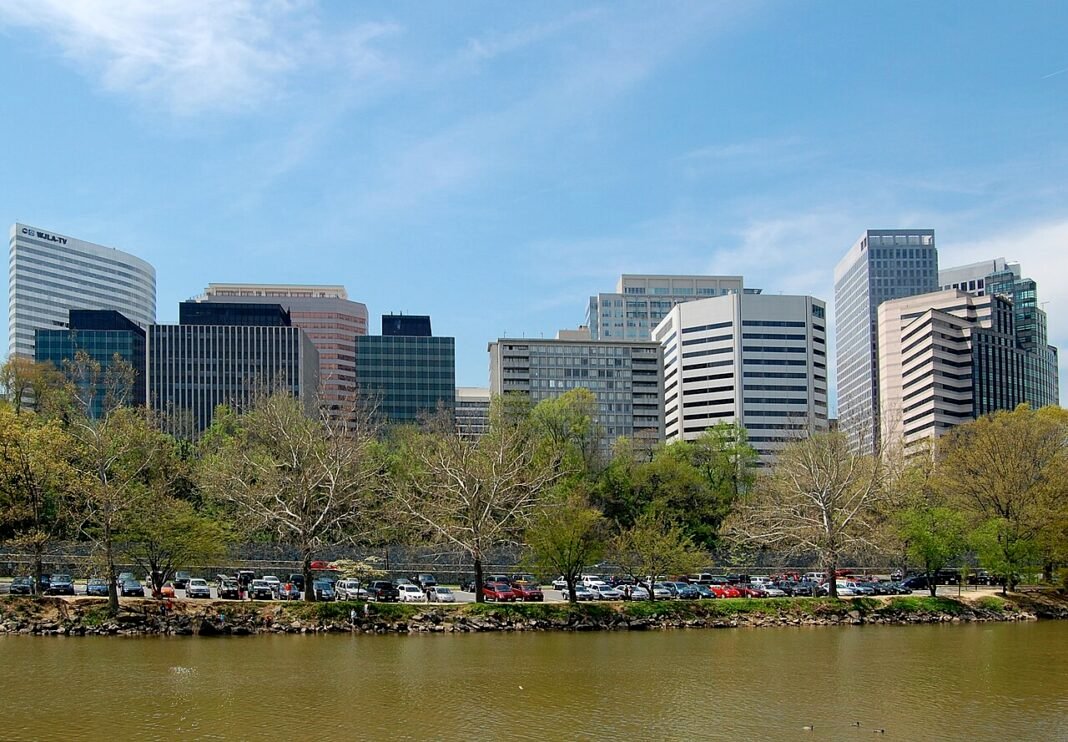
Northern Virginia sits atop the largest concentration of federal employment and defense contracting in the country. The Pentagon (around 26,000 employees), the Defense Intelligence Agency, the National Geospatial-Intelligence Agency, and a dense layer of defense and intelligence contractors along the I-66, I-95, and Route 7 corridors create a demand floor that has held up through multiple national downturns. Amazon’s HQ2 in National Landing added a tech wage layer on top – though the buildout has cooled, with roughly 8,000 workers in place after Phase 1 and the second phase (PenPlace) paused as of 2026, so the price pressure from it has leveled rather than surged. The result still reads like a coastal tech city: Arlington’s overall median sale price runs around $815,000, but a single-family detached home now clears $1.3 million, while condos hover near $475,000 – a spread that reflects how much of the demand comes from dual-income federal and tech households competing for limited detached inventory.
Richmond: The Value Proposition

For anyone not chained to a Northern Virginia paycheck, Richmond is the clearest bargain in the state. The city pairs a celebrated food and beer scene and a fast-growing creative and tech economy with Class III/IV whitewater inside the city limits, and the metro median sits around $380,000-$435,000 – affordable by East Coast standards. The Fan District, with its Victorian rowhouses near Virginia Commonwealth University, and Church Hill, the oldest neighborhood and the one with the panoramic James River views, carry the steepest premiums in town. The value plays sit just behind them: Manchester, gentrifying fast on the south bank, and Scott’s Addition, where the brewery district is converting warehouses into apartments. Trade a D.C. suburb for Richmond and you cut your housing cost by roughly 40% while keeping most of the cultural payoff.
Charlottesville: University Town Premium
Charlottesville carries a premium its interior peers do not. Home to the University of Virginia – Thomas Jefferson’s “academical village” – the city draws demand from three directions at once: steady university employment, a restaurant and wine scene that pulls weekenders to the dozens of vineyards along the Monticello Wine Trail in the surrounding Piedmont hills, and the Jefferson-designed UNESCO World Heritage Site on the hill above town. Together they have pushed the median to roughly $460,000-$520,000. The Downtown Mall, a pedestrianized strip of independent restaurants and shops, and the Belmont neighborhood are the most walkable places to land. Among Virginia’s interior options, Charlottesville offers the richest cultural draw while still undercutting Northern Virginia on price.
Shenandoah Valley: Affordable Mountain Living
For the best ratio of affordability to scenery, the Shenandoah Valley wins outright – Winchester in the north, Harrisonburg (James Madison University) in the center, and Staunton and Waynesboro in the south. Winchester’s 90-minute reach to Northern Virginia jobs has nudged prices up; Harrisonburg leans on its university economy and the nearby Massanutten ski resort for a four-season base. Staunton anchors a small but serious arts scene around the American Shakespeare Center’s Blackfriars Playhouse, a faithful recreation of Shakespeare’s indoor theater, and Waynesboro serves as the gateway to Shenandoah National Park and the Blue Ridge Parkway. Sale medians across these towns land near $260,000-$340,000 – the most Virginia character your dollar buys anywhere in the state.
The Personal Property Tax and Vehicle Costs
Virginia’s annual personal property tax on vehicles is a recurring cost that surprises most new residents. Unlike most states that charge only a one-time sales tax at vehicle purchase, Virginia counties levy an annual tax on vehicle assessed value – typically $3.70-$5.00 per $100 of value depending on locality. A household with a $35,000 vehicle in Arlington County (the highest rate at $5.00/$100) pays $1,750 per year in personal property tax on that vehicle alone. Most localities participate in the Car Tax Relief Act that partially subsidizes the tax on vehicles assessed below $20,000, but two-vehicle households in Northern Virginia regularly budget $2,000-$3,500 annually in personal property taxes. This ongoing expense is a genuine component of Virginia’s total cost structure that comparison shopping against other states should account for explicitly.
Utilities and Energy Costs
By East Coast standards, Virginia’s utility costs sit in the middle of the pack. Electricity from Dominion Energy, the dominant provider, runs roughly 16-18 cents per kilowatt-hour after the rate increases that took effect through 2025 and into 2026 – below New England but above the national average. Natural gas is widely available across the state’s urban and suburban areas at competitive rates. Heating demand is modest in most of Virginia, though the Shenandoah Valley and the Southwest Virginia highlands get genuinely cold winters. The bigger seasonal hit is summer air conditioning in the state’s humidity – a $150-$250 monthly bill in July and August is typical for an average-sized home. Water and sewer run higher than the national average in Richmond, Alexandria, and other older cities still paying down aging-infrastructure replacement; the newer suburban subdivisions in Fairfax and Loudoun Counties tend to bill less for the same service.
Budgeting Practically for Virginia
Knowing the headline numbers is only the start; the real work is sorting which costs are fixed and which you can bend. Housing is the biggest lever in nearly every budget, and the neighborhood you pick within Virginia can swing your monthly outlay by hundreds of dollars while still keeping you near the things you moved for. Utilities, transport, and groceries are smaller line items, but they compound – a $50 monthly gap is $600 a year. Measured against high-cost metros like New York, San Francisco, or Boston, Virginia’s advantage outside the D.C. suburbs is real and easy to quantify, and plenty of transplants land in a stronger financial position without giving up much quality of life. Treat these figures as a working framework and pull current rent and sale prices for your specific target area, since local markets move faster than the annual cost-of-living studies can track.
Frequently Asked Questions
Is Virginia expensive to live in?
It depends entirely on location. Northern Virginia (Fairfax County, Arlington, Alexandria) is among the most expensive residential markets on the East Coast – Arlington’s overall median runs about $815,000, and a single-family detached home there clears $1.3 million. But 100 miles south or west, prices fall sharply: the Richmond metro median runs $380,000-$435,000, and Shenandoah Valley towns (Winchester, Harrisonburg, Staunton) run $260,000-$340,000.
What is Virginia’s income tax rate?
Virginia has a graduated income tax from 2% to 5.75% that is effectively flat for most households (the top 5.75% bracket kicks in above $17,000 of taxable income; a separate 7% bracket applies only to income above $600,000). There is no estate tax. The state sales tax is 5.3%, with most areas reaching 6-7% combined. Property taxes average ~0.80% effective statewide – below the national average.
What is Virginia’s annual vehicle property tax?
Virginia counties levy an annual personal property tax on vehicles – typically $3.70-$5.00 per $100 of assessed value depending on locality. A $35,000 vehicle in Arlington County (the highest rate at $5.00/$100) costs $1,750/year in property tax alone. Two-vehicle households in Northern Virginia regularly budget $2,000-$3,500/year for this. This recurring cost surprises most new residents from other states and must be factored into Virginia cost comparisons.
Is Richmond a good value compared to Northern Virginia?
Yes – Richmond runs roughly 40% lower on housing than Northern Virginia while keeping most of the cultural payoff. The metro median is $380,000-$435,000, with a celebrated food and beer scene, urban whitewater on the James River inside the city limits, a growing tech economy, and roughly 2-hour Amtrak access to Washington D.C. Scott’s Addition (the brewery district) and Manchester (south of the James) are the leading appreciation neighborhoods.
What is the most affordable part of Virginia?
The Shenandoah Valley – Winchester in the north, Harrisonburg (James Madison University) in the center, and Staunton and Waynesboro in the south – offers sale medians near $260,000-$340,000 in towns with real character. Staunton has a respected arts scene anchored by the American Shakespeare Center; Waynesboro is the gateway to Shenandoah National Park and the Blue Ridge Parkway. Winchester sits within a 90-minute commute of Northern Virginia.