.jpg?width=1200)
Best Places to Live in Minnesota 2026: Twin Cities to the North Shore
Minnesota’s residential landscape is dominated by the Twin Cities metropolitan area, which houses more than 60% of the state’s population and virtually all of its high-income employment. Within that metropolitan area, the range of neighborhoods and communities is extraordinary — from the walkable urban neighborhoods of Minneapolis and St. Paul’s historic districts to the lake-country suburbs of the western metro, the arts-district neighborhoods of Northeast Minneapolis, and the Victorian splendor of Summit Avenue. Beyond the metro, Duluth and the North Shore communities provide lifestyle alternatives for households with location-independent income who prioritize natural landscape over urban amenity.
1. Linden Hills and Kenwood — Minneapolis’s Premier Neighborhoods
Linden Hills and Kenwood, in southwest Minneapolis between Lake Harriet and Lake of the Isles, represent the Twin Cities’ most desirable urban residential environment — neighborhoods of Craftsman bungalows, Arts and Crafts homes, and Colonial Revivals on tree-lined streets with direct access to the Minneapolis Chain of Lakes park system. The Chain of Lakes — Lake of the Isles, Lake Calhoun (officially Bde Maka Ska), Lake Harriet, and Cedar Lake, connected by a 13-mile recreational trail — is the defining amenity of Minneapolis living: a system of lakes and parkway in the middle of a major city where Minneapolitans run, cycle, swim, sail, and ice skate through every season. Access to the lakes from Linden Hills and Kenwood is walking distance, not driving distance, which defines the neighborhood’s daily quality of life.
Linden Hills’ commercial district on 43rd Street provides a walkable neighborhood center with the Sebastian Joe’s ice cream parlor (a Minneapolis institution), independent restaurants, a bookstore, and a farmers market. Median home prices of $550,000–$800,000 for single-family homes reflect the premium for lakefront access and neighborhood character. For households who can afford the premium, Linden Hills and Kenwood represent the best of what Minneapolis offers as a residential city.
2. Northeast Minneapolis — The Arts District
Northeast Minneapolis has undergone the most dramatic transformation of any Minneapolis neighborhood in the past fifteen years — a former working-class neighborhood of Polish, Ukrainian, and Eastern European immigrant families that has become the most vibrant arts district in the Twin Cities, with more than 200 artists’ studios, a concentration of galleries (the Art-A-Whirl open studio event in May is the largest in the country), and a restaurant and brewery scene anchored by the Bauhaus Brew Labs, Surly Brewing, and the Dangerous Man Brewing Company. The neighborhood’s warehouse district character — redbrick industrial buildings converted to studios and creative businesses — gives it an authenticity that newer planned arts districts lack.
Residential real estate in Northeast has appreciated significantly as the neighborhood’s reputation has grown, but remains accessible relative to the southwest neighborhoods: median prices of $280,000–$420,000 for bungalows and smaller single-family homes on the residential streets behind the commercial corridors. The area attracts artists, designers, and young professionals who want urban density and creative community. The METRO Green Line extension and existing bus network provide transit access to downtown Minneapolis; the proximity to the University of Minnesota’s east bank campus adds to the neighborhood’s demographic diversity.
3. Cathedral Hill — St. Paul’s Best Neighborhood
Cathedral Hill, in St. Paul immediately west of the Cathedral of Saint Paul, is the Twin Cities’ most architecturally distinguished residential neighborhood — Victorian mansions and Queen Anne homes that reflect the wealth of St. Paul’s late 19th-century prominence as the territory’s commercial center, now maintained as a historic district with some of the most impressive residential architecture in the Midwest. The Grand Avenue commercial corridor (one of the finest independent retail and restaurant streets in the Twin Cities), the proximity to Summit Avenue’s boulevard mansions, and the neighborhood’s hilltop position with views east toward downtown St. Paul and across the river to Minneapolis create a residential environment of genuine distinction.
Median home prices of $300,000–$550,000 — consistently 15–20% below Minneapolis equivalents in comparable neighborhood types — make Cathedral Hill one of the best values in Twin Cities homeownership. The trade-off is St. Paul’s generally quieter cultural life relative to Minneapolis and the longer commute to many Minneapolis-based employers. For households who value historic architecture, walkable neighborhood character, and lower prices over proximity to Minneapolis’s cultural core, St. Paul’s neighborhoods represent the Twin Cities’ most underrated residential value.

4. Edina — The Premier Twin Cities Suburb
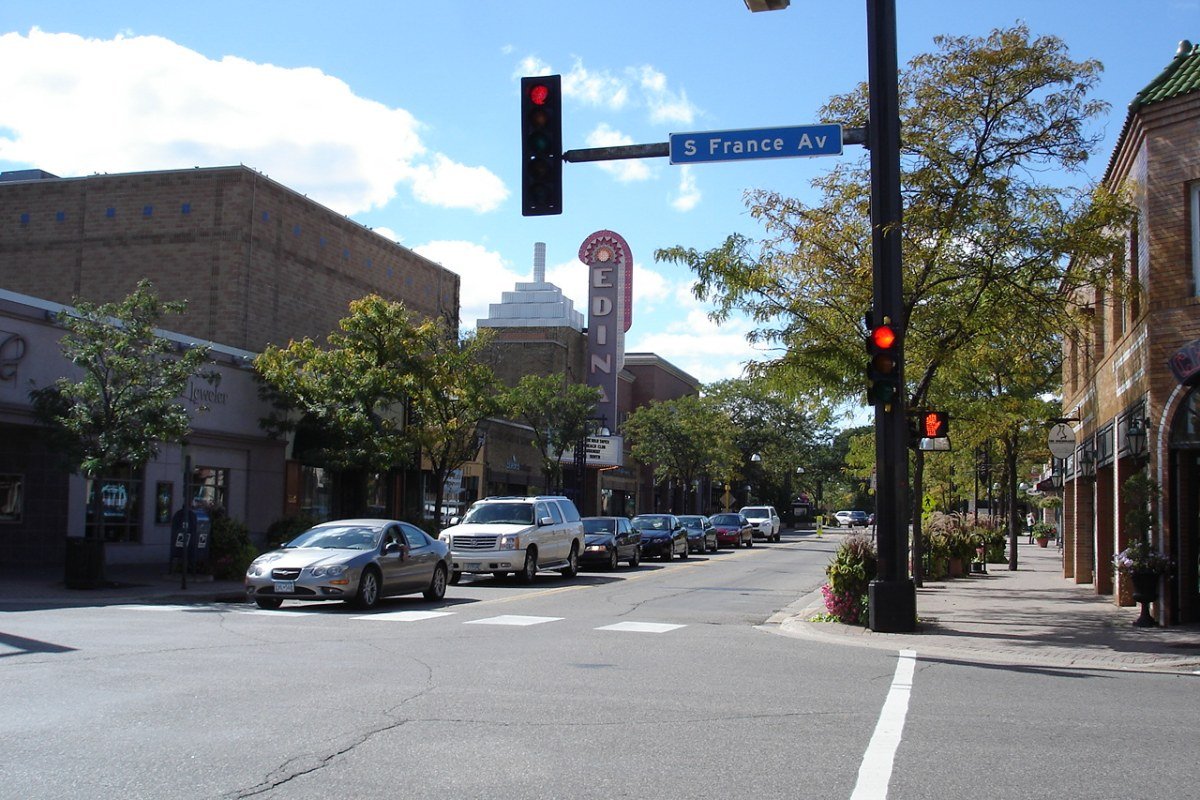
Edina, immediately south of Minneapolis in Hennepin County, is the Twin Cities’ most prestigious suburb — a community that combines exceptional public schools (Edina Public Schools consistently ranks among the top school districts in Minnesota and the Midwest), the 50th and France neighborhood commercial district (one of the most walkable suburban commercial environments in the Twin Cities, with independent restaurants, a movie theater, and specialty retail), and a housing stock of consistent quality and character at $450,000–$800,000 for single-family homes. The city’s Centennial Lakes Park — a linear park with a reflecting pond, walking trails, and summer outdoor concerts — provides community gathering space that most suburbs lack.
Edina’s demographics are affluent and family-oriented — the school district’s reputation drives a significant portion of housing demand, and the community’s character reflects this priority. For families with school-age children who are employed in south Minneapolis, the southwest suburbs, or the airport/Bloomington corridor, Edina offers the highest-confidence investment in public school quality available in the Twin Cities market.
5. Grand Marais — North Shore Living
Grand Marais, on the North Shore of Lake Superior 110 miles northeast of Duluth, is the most compelling small-city destination in Minnesota for households with location-independent income — a community of 1,200 permanent residents (swelling to many times that in summer) with an arts and cultural density that far exceeds its size. The North House Folk School offers year-round courses in traditional Nordic crafts, boat building, and wilderness skills; the Arrowhead Center for the Arts hosts performances and exhibitions; and the concentration of galleries on the harbor reflects a community of artists who have settled specifically because of the landscape and the community’s culture.
Housing in Grand Marais runs $250,000–$500,000 for single-family homes, with significant premium for Lake Superior views and walking distance to the harbor. The trade-offs are real: the nearest city-scale hospital is in Duluth (110 miles); the winter isolation of a small community in a cold climate requires genuine commitment; and the summer tourist season can feel overwhelming in a community this size. But for remote workers, artists, and retirees who are willing to make the commitment, Grand Marais offers a quality of daily life — the lake, the Boundary Waters access, the small-community culture — that no Twin Cities neighborhood can provide.
6. Rochester — The Mayo Clinic City
Rochester, 90 miles south of Minneapolis at the Iowa border, is Minnesota’s third-largest city and one of the most unusual cities in the country — a community of 120,000 whose entire economy and culture is organized around Mayo Clinic, the world’s largest integrated nonprofit medical center, which employs more than 40,000 people in Rochester. Mayo draws patients from around the world, creating a genuinely international daily life in a mid-sized Minnesota city. The Destination Medical Community initiative, a $5 billion public-private development program, is transforming downtown Rochester with hotels, restaurants, a new entertainment district, and infrastructure improvements that are accelerating the city’s quality-of-life development beyond its traditional healthcare-company-town character. Median home prices of $250,000–$380,000 represent excellent value for a city with Mayo Clinic employment, good schools, and genuine urban amenities.