Wales punches dramatically above its geographic weight as an outdoor destination — a country of 20,779km² that contains three national parks, five National Landscapes (the protected areas known as Areas of Outstanding Natural Beauty until they were renamed across England and Wales in 2023), the 870-mile Wales Coast Path, three National Trails, and some of the finest mountain, coastal, and river landscapes in the British Isles, all within a geography compact enough that Snowdon, Pembrokeshire, and the Brecon Beacons are each within 2–3 hours of each other by road. The Welsh outdoor landscape has its own specific character: the mountains are smaller than Scotland’s but more accessible and, in their rugged immediacy, often more arresting; the coastline is more intimate than Scotland’s but more varied than England’s; the valleys (the glaciated river valleys of Snowdonia and the industrial legacy valleys of the south) provide a specific Welsh landscape that has no equivalent elsewhere in Britain. Wales’s outdoor culture is deeply embedded in its national identity — the Eisteddfod celebrates the landscape in poetry and music; the red kite — which clung on in the hills of mid-Wales when it had vanished from the rest of Britain, and has since recovered from a handful of pairs to well over 1,000 — is the country’s emblematic bird; and the traditions of hill farming, droving, and landscape use that have shaped the Welsh countryside for millennia remain visible in every field boundary and drove road.
Snowdonia (Eryri): Wales’s Mountain Kingdom
Snowdonia National Park (2,132km², known as Eryri since the national park authority adopted the Welsh name in late 2022) is Wales’s highest and most rugged landscape — 15 peaks above 900m in a compact volcanic and glaciated terrain that includes Yr Wyddfa/Snowdon (1,085m, the highest mountain in England and Wales), the Glyderau (Glyder Fawr 1,001m, the strangest summit plateau in Snowdonia, strewn with shattered rock), the Carneddau (the largest high-level walking area in Snowdonia, with Carnedd Llywelyn and Carnedd Dafydd above 1,000m), and the Rhinogydd (the roughest and least visited range, above Harlech and Barmouth on the west coast).

- Snowdon routes: Six walking routes to Yr Wyddfa’s summit — the Pyg Track (most popular, 6km each way, 5–7 hours return from Pen-y-Pass); the Miners’ Track (easier gradient but longer approach, 7km); the Llanberis Path (the longest route, 9km, from Llanberis town); the Watkin Path (the most scenic, from Nant Gwynant, with the Watkin Memorial and the old quarry inclines); the Rhyd Ddu (from the west, quieter); the Snowdon Mountain Railway (from Llanberis, running to the summit or Clogwyn station depending on conditions). The summit café (Hafod Eryri, at 1,085m) provides the highest hot drinks in Wales
- Tryfan and the Glyderau: The Tryfan traverse (approaching from the A5 Ogwen Valley) is the finest day on the Glyderau — ascending the North Ridge of Tryfan (scrambling required, hands and feet needed), crossing Bwlch Tryfan to the Glyder Fach summit (with the Cantilever — the massive balanced rock that generations of hillwalkers have photographed themselves standing on), and descending via the Devil’s Kitchen (Twll Du) past Llyn Idwal (the glacial cirque lake protected as a National Nature Reserve)
- Cadair Idris: The southern Snowdonia outlier (893m, above Dolgellau) is one of the country’s great mountains — the Minffordd Path ascends through oak woodland to the glacial lake of Llyn Cau, cradled in a steep-walled cwm, before reaching the summit ridge. Welsh legend holds that anyone who spends the night on Cadair Idris will wake either a poet or a madman
Pembrokeshire: Wales’s Coastal Wonder
The Pembrokeshire Coast National Park (620km²) is the only purely coastal national park in the UK — a 186-mile coastline that ranges from the limestone arches of the south (the Green Bridge of Wales, the Elegug Stacks, the Bosherston lily ponds and Barafundle Bay) through the sheltered harbours of the Milford Haven waterway and the medieval city of St Davids to the wind-scoured headlands of the north coast (Strumble Head, Dinas Island, Fishguard Bay).

- The Pembrokeshire Coast Path: The National Trail from Amroth to St Dogmaels (186 miles, typically completed in 13–16 days) ranks among Britain’s great coastal walks — the scenery on the Castlemartin section (the limestone arches and sea stacks of the south coast) and the north coast section from St Davids to Fishguard is the pick of the route
- Skomer Island: The seabird colony of the offshore island, accessible by boat from Martin’s Haven (April–September), hosts the world’s largest colony of Manx shearwaters (around 350,000 breeding pairs, roughly half the global population), one of southern Britain’s largest puffin colonies (about 43,000 birds), razorbills, and grey seals. Day visitor numbers are strictly limited; booking weeks in advance in peak season
- Coasteering: The activity of scrambling, swimming, and jumping along and into the sea cliffs was invented in Pembrokeshire in the 1980s; it remains best practised here, with multiple operators offering guided sessions on the St Davids and south Pembrokeshire coast
Brecon Beacons (Bannau Brycheiniog): Wales’s Southern Uplands
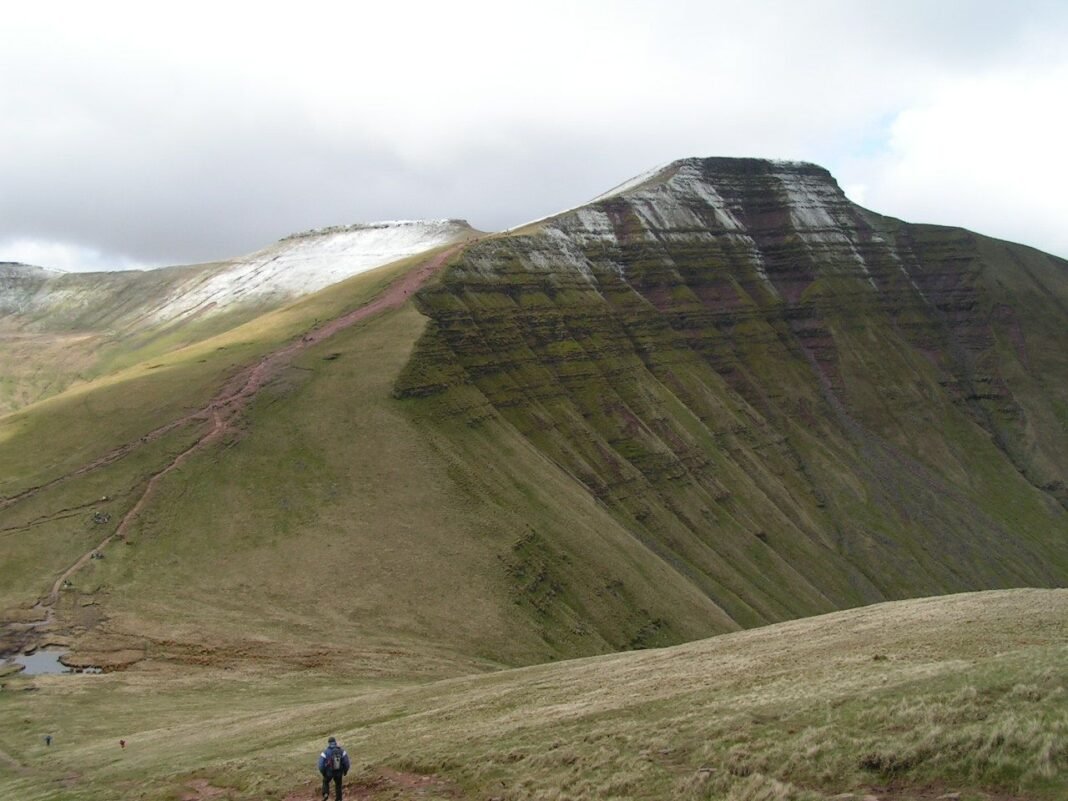
The Brecon Beacons National Park (recently renamed Bannau Brycheiniog, 1,347km²) encompasses four distinct mountain ranges: the Black Mountain (Mynydd Du) in the west, the Forest Fawr in the centre, the Brecon Beacons proper (with Pen y Fan at 886m, the highest summit in south Wales), and the Black Mountains in the east (bordering Herefordshire). The park’s designation as an International Dark Sky Reserve in 2013 — the first in Wales and only the fifth in the world — makes it one of the finest stargazing locations in England and Wales; the flat-topped sandstone ridge of Pen y Fan and Corn Du is the most walked summit in south Wales, accessible from the Storey Arms car park on the A470 in a 2–3 hour round trip.
The Wales Coast Path and Long-Distance Walking
The Wales Coast Path (870 miles, from Chepstow to Queensferry via Pembrokeshire, Cardigan Bay, the Llŷn Peninsula, and the north Wales coast) is the first path in the world to follow an entire nation’s coastline — completed in 2012, it links the country’s existing coastal trails into a single continuous route. Combined with Offa’s Dyke Path (177 miles along the England-Wales border, following the 8th-century earthwork of King Offa of Mercia) and the Cambrian Way (298 miles across the Welsh uplands from Cardiff to Conwy), Wales offers a long-distance walking network of exceptional quality and variety for its geographic size.
Frequently Asked Questions
What are the best routes up Snowdon (Yr Wyddfa) and how should visitors plan their visit?
Yr Wyddfa (Snowdon, 1,085m) — the highest mountain in Wales and England — is reached by six different walking routes and by the Snowdon Mountain Railway from Llanberis. The Pyg Track (6km each way, 5–7 hours return from Pen-y-Pass) is the most popular walking route with the most dramatic ridge approach; the Miners’ Track offers an easier gradient from the same starting point at Pen-y-Pass car park. The Llanberis Path (9km from Llanberis town) is the longest but most gradual route and most suitable for walkers with less hill experience. The Watkin Path from Nant Gwynant passes historical features including the Watkin Memorial and old quarry inclines, making it the most historically layered approach. The summit café (Hafod Eryri) provides shelter, hot food, and interpretation at 1,085m. Pen-y-Pass car park fills by 7am in summer — the Sherpa bus service from Llanberis and Nant Peris provides the most practical access. Snowdonia National Park was officially renamed Eryri National Park in 2023 to reflect the Welsh-language name.
What does Pembrokeshire Coast National Park offer for outdoor visitors?
Pembrokeshire Coast National Park — the only coastal national park in the UK — protects 620km² of the most dramatic coastline in Wales, with sea cliffs, sea stacks, offshore islands, and beaches of extraordinary variety. The Pembrokeshire Coast Path (186 miles / 299km, the most popular of Wales’s National Trails) traverses the full coastline from Amroth in the south to St Dogmaels in the north, through the most varied coastal scenery in Britain — sheltered estuary, exposed headland, Cathedral cliff faces, and remote sandy beaches. The Pembrokeshire islands are exceptional for seabird colonies: Skomer Island (accessible by boat from Martin’s Haven) hosts the world’s largest Manx shearwater colony (more than 350,000 breeding pairs) and significant Atlantic puffin, razorbill, and guillemot populations. Skokholm Island is a bird observatory with limited residential accommodation for ornithologists. Blue Lagoon at Abereiddy (a flooded slate quarry with brilliant blue water and coasteering routes) and the Green Bridge of Wales (a natural sea arch) are among the coast’s most photographed features. Coasteering — swimming, scrambling, and jumping from rocks along the clifftops above the sea — was invented in Pembrokeshire and is offered by multiple outfitters.
What makes the Brecon Beacons (Bannau Brycheiniog) distinctive as an outdoor destination?
The Brecon Beacons National Park (renamed Bannau Brycheiniog National Park in 2023) is the southernmost of Wales’s three national parks, 45 minutes north of Cardiff — a landscape of rounded sandstone peaks, dramatic waterfalls, cave systems, and the largest concentration of Dark Sky Reserve in Wales. Pen y Fan (886m, the highest point in southern Britain) is accessible via the Corn Du ridge from Pen y Fan car park (6.5km round trip) or from the longer Neuadd reservoirs approach; the ridge walk from Corn Du to Pen y Fan to Cribyn is the finest high-level ridge route in the park. The Four Falls Walk (Sgwd Chwarelau, Sgwd Isaf Clun-gwyn, Sgwd Clun-gwyn, and Sgwd yr Eira) in the Waterfall Country near Pontneddfechan traverses a wooded gorge with four significant waterfalls — Sgwd yr Eira allows walkers to pass behind the curtain of water. The Black Mountain (western Brecons) and Black Mountains (eastern Brecons, bordering England) provide the park’s most remote and least visited terrain.
What long-distance walking routes traverse Wales?
Wales has an exceptional network of long-distance walking routes. Offa’s Dyke Path (285km) follows the Welsh-English border from Chepstow in the south to Prestatyn on the north Wales coast, tracing the 8th-century earthwork constructed by King Offa of Mercia as a boundary marker between his kingdom and the Welsh kingdoms — one of the finest archaeological features accessible on foot in Britain. The Cambrian Way (298 miles / 479km) traverses the full length of Wales from Cardiff to Conwy through the highest and most remote terrain in the country — a challenging route through the Brecon Beacons, Elan Valley, Cadair Idris, and Snowdonia that requires navigation competence and multi-day wild camping experience. The Wales Coast Path (1,400km, the world’s first nation-wide coastal path when opened in 2012) circumnavigates the entire Welsh coastline from Chepstow to Queensferry, passing through all three national parks and five National Landscapes (the former Areas of Outstanding Natural Beauty).
What are Wales’s best mountain biking and adventure sports destinations?
Wales has built one of the most comprehensive mountain biking networks in the UK, much of it on Natural Resources Wales forest land. Coed y Brenin in southern Snowdonia — widely regarded as the birthplace of the purpose-built trail centre in Britain — has around eight waymarked trails, from gentle family loops to the original black-graded Tarw Du and the long, demanding Beast (around 35km). Bike Park Wales near Merthyr Tydfil is the UK’s premier gravity facility, with more than 40 graded trails and a minibus uplift to the summit, including international-standard downhill runs. Glentress in Scotland may be more famous, but Wales’s network is arguably more varied. The Llanberis area in Snowdonia offers some of the most technical riding in the country. For other adventure sports, Snowdonia’s slate quarries have been repurposed for underground adventure courses (the Via Ferrata and zip lines at Zip World’s Llechwedd slate caverns, near Blaenau Ffestiniog) and for above-ground zip lines — Velocity 2 at Penrhyn Quarry near Bethesda is the fastest zip line in the world. Adventure Parc Snowdonia at Dolgarrog opened in 2015 as the world’s first inland surf lagoon, though its wave pool closed in 2023.