North Dakota is the least-visited state in the continental United States — and for travelers who want genuine solitude and country that looks much as it did when the Great Plains defined the American frontier, that is its single greatest asset. Theodore Roosevelt National Park, the state’s signature wild destination, protects 70,446 acres of North Dakota badlands across three separate units along the Little Missouri River: eroded buttes, petrified forests, prairie dog towns, and one of the most accessible free-roaming bison herds in the American West. On the Canadian border, the International Peace Garden marks the longest undefended frontier in the world. Farther east, the wetlands of the Drift Prairie and Coteau du Missouri — the “Prairie Pothole Region” — form the continent’s most important waterfowl breeding ground. And the small cities of Bismarck and Fargo carry cultural institutions that belie their size.
Theodore Roosevelt National Park
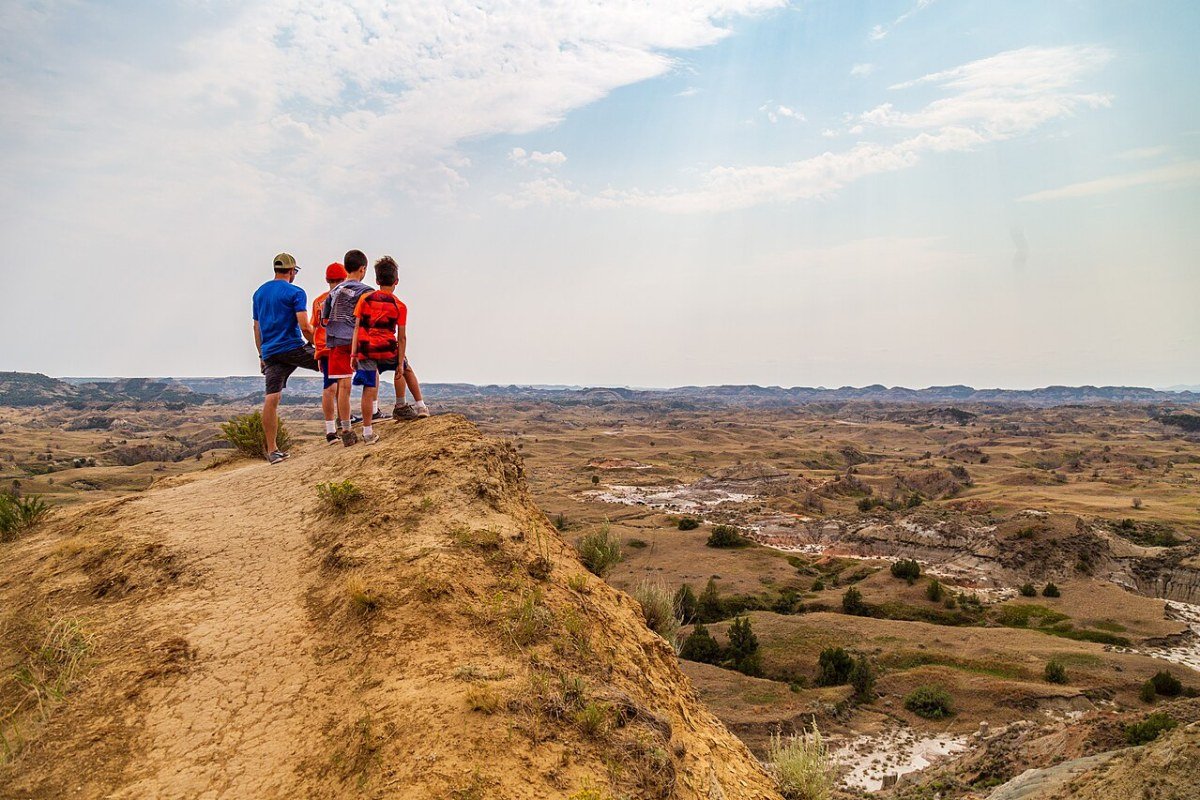
Three units make up the park. The South Unit near Medora draws the most visitors and is the easiest to reach; the North Unit, more remote and wilder, holds the finest badlands scenery in the park; and the Elkhorn Ranch Unit — the site of Roosevelt’s actual ranch — sits at the end of an unpaved road and rewards the effort with near-total solitude. A 36-mile scenic loop winds through the South Unit, where bison turn up reliably, a distinct herd of wild horses roams the southern range, and overlooks open onto the painted badlands that built the park’s reputation. Just outside the entrance, the town of Medora has turned itself into a credible gateway, with a musical and a dining scene that stretch a day trip into an overnight stay.

Medora and the Little Missouri Badlands
Few small towns in the American West are as appealing as Medora, a restored frontier settlement in the Little Missouri River valley whose comeback from near-ghost-town to cultural draw ranks among the great success stories of Great Plains tourism. Carved into a badlands hillside, the open-air amphitheater hosts the Medora Musical nightly through the summer, pulling audiences from across the region. The Chateau de Morès — the restored ranch house of the Marquis de Morès, whose beef-packing venture first brought Roosevelt to the Dakota Territory — lends historical weight. And the Theodore Roosevelt Presidential Library, now under construction in Medora, will hand a community already punching above its weight a major new institution.
Fargo and the Red River Valley
Fargo sits on the eastern edge of the Red River valley, North Dakota’s largest city and its liveliest. Home to North Dakota State University, it has grown a genuinely surprising arts and food scene over the past few decades. Downtown revitalization has filled the district with independent restaurants, live-music rooms, and gallery spaces that serve students and the wider region alike. Straddling the North Dakota–Minnesota line, the Fargo-Moorhead metro has cultural and commercial ties that make it feel more dynamic than its Great Plains setting might suggest. Housed in a renovated 1904 warehouse, the Plains Art Museum holds a notable collection of American and Plains Native work.
The Enchanted Highway
Among the Great Plains’ strangest roadside attractions is the Enchanted Highway, a 32-mile run of two-lane blacktop from Gladstone south to Regent lined with seven enormous metal sculptures by the artist Gary Greff. Geese in Flight — at 110 feet tall, the world’s largest scrap-metal sculpture — leads a cast that includes Deer Crossing and Pheasants on the Prairie. They rise from the flat country of southwestern North Dakota with no warning and no explanation, and the effect is surreal and oddly moving.
Knife River Indian Villages and Native Heritage
Near Stanton in central North Dakota, the Knife River Indian Villages National Historic Site preserves the earthlodge village sites of the Hidatsa and Mandan — farming peoples who lived in permanent towns along the Missouri River for centuries before European contact, and who welcomed the Lewis and Clark Expedition during the winter of 1804–1805. A reconstructed earthlodge on site gives the fullest picture of Plains village life anywhere in the Missouri River corridor. A short drive away, the Fort Clark State Historic Site marks the trading post where the 1837 smallpox epidemic devastated the Mandan population — one of the most catastrophic events in the history of Northern Plains Native peoples.
Practical Information
Air access comes through Hector International Airport (FAR) in Fargo and Bismarck Municipal Airport (BIS), both with connections to Minneapolis, Denver, and other hubs. A rental car is essential: the state’s attractions spread across a lot of ground, and you will lean on two arteries — interstate I-94 running east–west through Fargo and Bismarck, and US-85 running north–south from Watford City down through Medora. June through September is the prime window. Theodore Roosevelt National Park stays open year-round, but the most comfortable trips fall in May and June, when wildflowers bloom, or September and October, when the fall color comes in and the crowds thin. Winter turns the badlands into a different place entirely — dramatic, but only for travelers prepared for extreme cold.
What North Dakota gives back is proportional to the curiosity you bring. The state does not market itself hard or trade in obvious spectacle. But drive the Enchanted Highway at dusk, watch bison move through the badlands at sunrise, or stand in the silence of the Prairie Pothole Region on a spring morning, and the country that looks featureless from the interstate reveals itself as one of the most distinctive landscapes in America. Finding North Dakota is mostly a matter of slowing down enough to see it.
Getting the Most Out of Your Visit
A few practical points to sharpen any North Dakota trip. Book lodging and major attractions — national parks, popular trails, well-known restaurants — as far ahead as you can; the best options fill up weeks or months out, especially in peak season. A car buys the most flexibility, and most of the state’s rewarding experiences sit in places public transport never reaches. For local knowledge, head to regional visitor centers and independent bookshops, or simply talk to residents — the trips you remember rarely come straight from a guidebook. Above all, budget more time than you think you need. North Dakota pays off for travelers who slow down and dig in rather than racing to cover ground.
Frequently Asked Questions
What is Theodore Roosevelt National Park and what can you see there?
Theodore Roosevelt National Park protects 70,446 acres of North Dakota badlands across three separate units along the Little Missouri River. The South Unit near Medora carries a 36-mile scenic loop with reliable bison sightings, wild horses, and overlooks above the painted badlands. The North Unit runs more remote and wild, with the finest badlands scenery in the park. The Elkhorn Ranch Unit, the site of Roosevelt’s actual cattle ranch, sits at the end of an unpaved road and offers near-total solitude. Roosevelt credited this North Dakota country with shaping his conservation thinking and his identity as a naturalist — he arrived in 1883 after the deaths of his mother and first wife, and stayed to run cattle on the Dakota prairie.
What is Medora and why is it worth visiting?
Medora is one of the most appealing small towns in the American West — a restored frontier community in the Little Missouri River valley at the South Unit entrance of Theodore Roosevelt National Park. The Medora Musical runs nightly through the summer in an open-air amphitheater cut into the badlands hillside, drawing audiences from across the region. The Chateau de Morès — the restored ranch house of the Marquis de Morès, whose beef-packing venture brought Roosevelt to the Dakota Territory — adds historical depth. The Theodore Roosevelt Presidential Library is under construction in Medora and will give the town a major cultural institution. Around it, the badlands open up for hiking, wildlife viewing, and one of the most distinctive landscapes in the central United States.
What is the Enchanted Highway?
The Enchanted Highway is one of the Great Plains’ strangest roadside attractions — a 32-mile stretch of two-lane road from Gladstone south to Regent in southwestern North Dakota, lined with seven enormous metal sculptures by the artist Gary Greff. The centerpiece, Geese in Flight, stands 110 feet tall, the world’s largest scrap-metal sculpture. Other pieces include Deer Crossing, Pheasants on the Prairie, and Grasshoppers in the Field. The sculptures rise from the prairie with no context or introduction, a surreal and genuinely moving sight in the flat country. The Dickinson-to-Regent circuit makes the best route, taking in all seven in sequence at sunset.
What is the Knife River Indian Villages National Historic Site?
The Knife River Indian Villages National Historic Site, near Stanton in central North Dakota, preserves the earthlodge village sites of the Hidatsa and Mandan peoples — farming tribes who lived in permanent towns along the Missouri River for centuries before European contact, and who welcomed the Lewis and Clark Expedition during the winter of 1804–1805. A reconstructed earthlodge gives the fullest picture of Plains village life anywhere in the Missouri River corridor. Nearby, the Fort Clark State Historic Site marks the trading post where a smallpox epidemic devastated the Mandan population in 1837 — one of the most catastrophic events in the history of Northern Plains Native peoples. With the On-A-Slant Indian Village in Fort Abraham Lincoln State Park, these sites open an extraordinary window onto Plains Indian life.
What is the Prairie Pothole Region and why is it ecologically significant?
North Dakota’s Drift Prairie and Coteau du Missouri — the “Prairie Pothole Region” — make up the most important waterfowl breeding habitat in North America. Millions of shallow wetlands (potholes), gouged out by glacial action, supply nesting habitat for more than 50% of the continent’s breeding ducks each year. Sitting within the Central Flyway migration corridor, North Dakota’s wetland complex produces more ducks than any other state in the contiguous United States. In the north-central part of the state, the J. Clark Salyer National Wildlife Refuge is North Dakota’s largest NWR (58,693 acres) and one of the finest wetland birding destinations on the continent. The best viewing comes during spring migration (April–May) and fall migration (September–October).