

.jpg?width=1200)
Outdoor Activities in Nebraska 2026: Prairie, Rivers, and the Great Migration
Nebraska’s outdoor recreation is defined by the particular qualities of Great Plains ecology — landscapes that reward patience, attention, and the willingness to look past the absence of mountains to the specific richness of prairie, river, and sky. The state’s best outdoor experiences — the sandhill crane migration on the Platte, the solitude of the Sandhills by kayak or horseback, the canyon hiking of the Pine Ridge, the spring wildflower bloom in the Loess Hills, and the night sky of the Nebraska outback where light pollution is genuinely absent — are all experiences that have no equivalent in the more visually dramatic landscapes of the West, and that provide their own form of wilderness immersion once the visitor adjusts expectations to what Nebraska actually offers rather than what it lacks.
The Crane Migration: Nebraska’s Signature Event
The sandhill crane migration through the central Platte River valley is Nebraska’s most significant outdoor attraction and one of the most spectacular wildlife events accessible to any American traveler. Between mid-February and mid-April, 500,000–600,000 sandhill cranes concentrate on the Platte’s shallow, braided channels near Kearney and Grand Island — the 80% of the global population staging here before continuing to Arctic nesting grounds consumes waste corn from harvested fields to build fat reserves for the journey. The birds roost on the Platte’s sandbars at night and fly to cornfields during the day; the sunrise and sunset flights, when hundreds of thousands of cranes rise simultaneously from the river or return to roost, generate a sound and visual spectacle that regularly reduces experienced wildlife watchers to speechlessness.
The Rowe Sanctuary (managed by the National Audubon Society near Gibbon) offers the finest crane viewing experience — morning and evening guided blind visits place visitors 20 feet from the river as cranes land and rise around them, a proximity to mass wildlife movement available nowhere else in the country. The sanctuary’s blinds fill months in advance for peak viewing weekends (mid-March is typically the peak); reservations should be made in November or December for March viewing. The Crane Trust south of Grand Island provides additional viewing access with educational programming. For visitors who cannot access the guided blind experience, the many bridges over the Platte in the Kearney-Grand Island corridor provide free public viewing access — parking pullouts on the highway bridges allow dozens of observers to watch the evening return flights from March through early April.
Hiking and Cycling: Nebraska’s Trail Network
Nebraska’s trail infrastructure is more extensive than most visitors expect — the Cowboy Trail (the longest rail trail in the United States, running 321 miles from Norfolk to Chadron across the northern Nebraska Sandhills) provides a multi-day cycling and hiking experience through the heart of the Sandhills region that is unmatched for distance and prairie immersion. The trail crosses the Sandhills’ grass-covered dunes, passes through the Niobrara River canyon country near Valentine, and traverses the Pine Ridge terrain of the Nebraska Panhandle — a diverse cross-section of Nebraska landscapes accessible on a single continuous trail surface. The surface quality varies (some sections are cinder or grass that requires a gravel or hybrid bike rather than a road bike), and services along the route are sparse — planning overnight stops and water resupply points is essential for multi-day trips.
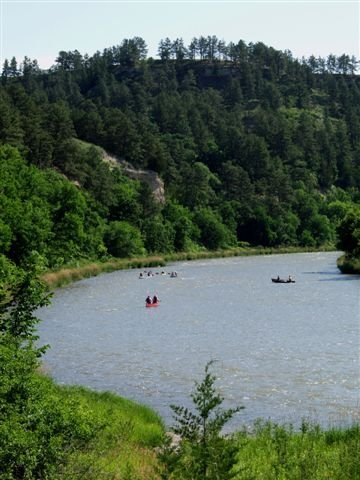
The Niobrara National Scenic River, flowing east through north-central Nebraska from Valentine to the Missouri River, is Nebraska’s most complete outdoor recreation corridor — a 76-mile designated scenic river with 230 waterfalls (concentrated in the Valentine to Norden section where the river cuts through the Sandhills-to-Pine-Ridge transition zone), excellent fishing for smallmouth bass and channel catfish, and the diverse habitat of the Niobrara’s unique position where five major ecosystem types (eastern deciduous forest, western ponderosa pine, northern boreal spruce, Sandhills prairie, and tallgrass prairie) meet at a single location due to the microclimate of the river canyon. Canoeing from Cornell Dam west of Valentine to the Smith Falls State Park (home of Nebraska’s tallest waterfall at 63 feet) — a 2-day, 22-mile trip — is the finest river float in Nebraska and one of the most ecologically interesting in the Midwest.
.jpg?width=1200)
Hunting and Fishing
Nebraska’s hunting culture is central to the state’s outdoor identity — pheasant, whitetail deer, pronghorn antelope, turkey, and waterfowl hunting are all significant traditions with deep community roots. The Nebraska Sandhills produce some of the finest pheasant hunting in North America in good years — the grass cover, the wet meadow edges, and the wildlife-management focus of the Sandhills ranching community create habitat that sustains pheasant populations that most midwestern agricultural landscapes have lost. Public hunting access on Wildlife Management Areas throughout the Sandhills provides non-resident hunters with reasonable opportunities; outfitter-guided hunting on private Sandhills ranches provides premium access for serious upland hunters.
Nebraska fishing is anchored by the large reservoir system — Lake McConaughy (Omaha Beach, as locals call the state’s largest lake at 55 miles long) near Ogallala on the South Platte River provides sailboating, powerboating, and the white sand beaches of a freshwater sea on the edge of the High Plains. The lake’s walleye, white bass, and tiger muskie fishery draws anglers from across the Great Plains. The Sandhills lakes and the Niobrara River’s smallmouth bass fishery provide additional quality fishing in environments of greater ecological richness than the reservoirs. The Missouri River along Nebraska’s eastern border has recovered from its channelization history and now supports channel catfish and flathead catfish of significant size that draw dedicated catfish anglers from across the region.
Dark Sky and Stargazing
Nebraska’s wide-open spaces and low population density create some of the finest dark sky conditions in the eastern half of the United States — a fact that is becoming increasingly recognized as urban light pollution makes genuine stargazing impossible for the majority of Americans. The central and western Nebraska Sandhills, far from any significant artificial light source, provide Milky Way visibility that approaches what is available only in designated dark sky parks in more famous western locations. The Merritt Reservoir south of Valentine and the Cherry County backcountry (the largest county east of the Rocky Mountains by area, with a population of approximately 6,000 people) provide accessible dark sky access within the state. The Nebraska Star Party (held annually near Valentine in the central Sandhills) draws hundreds of amateur astronomers who travel specifically for the exceptional viewing conditions — an event that has been operating for more than 30 years and that provides a community around Nebraska’s most underappreciated natural asset.