
Nebraska Travel Guide 2026: Sandhills, the Oregon Trail, and Omaha’s Renaissance
Nebraska is one of the most misunderstood states in America — dismissed by coastal travelers as flat, featureless fly-over country while harboring some of the continent’s most dramatic natural landscapes, the most historically significant migration corridor in American history, and a city (Omaha) whose arts and culinary scenes have earned national recognition disproportionate to the city’s size and media profile. The Sandhills — 20,000 square miles of grass-stabilized sand dunes that constitute the largest sand dune formation in the Western Hemisphere — are one of the most ecologically intact prairie landscapes remaining in North America. The Oregon, California, and Mormon Trails’ ruts, still visible in the Nebraska soil in dozens of locations, provide the most physically present connection to 19th-century westward migration available anywhere in the country. And Omaha’s Gene Leahy Mall, the Durham Museum, and a restaurant scene anchored by chefs who have chosen the city deliberately rather than by default, provide a genuinely rewarding urban experience for visitors who abandon the flyover assumption.
Omaha: The Unexpected City
Omaha’s renaissance over the past two decades has been one of the quieter success stories in American urban development — a city that rebuilt its downtown around the Gene Leahy Mall (a newly redesigned 12-acre park with an outdoor amphitheater, splash pad, and the connecting trail system linking the Missouri River waterfront to the Old Market entertainment district), the CHI Health Center arena, and a restaurant scene that has attracted national attention. The Old Market, a 5-block historic warehouse district of redbrick buildings converted to restaurants, galleries, shops, and bars, provides the most walkable and concentrated urban entertainment district between Chicago and Denver — an area that demonstrates what Omaha’s boosters mean when they call it “the city that works.”
The Durham Museum, in the beautifully restored Union Pacific Railroad depot (1931, Art Deco, one of the finest surviving railroad stations in the country), presents Nebraska history with sophistication and scale equal to any state historical society museum in the country. The Joslyn Art Museum, rebuilt and expanded with an addition designed by Norman Foster, houses a collection of particular strength in American Western art (the Maximilian-Bodmer Collection, documenting the 1832–34 exploration of the upper Missouri River, is the most significant visual record of pre-reservation Plains Indian life) and 19th-century European painting. The Henry Doorly Zoo, consistently rated among the top three zoos in the world by various metrics, contains the world’s largest indoor desert (the Desert Dome) and the world’s largest indoor rainforest (Lied Jungle) — a zoo that justifies the drive to Omaha in its own right.

The Oregon Trail Corridor
The Oregon Trail — the 2,170-mile emigrant route from Missouri to Oregon followed by approximately 400,000 westward migrants between 1843 and 1869 — ran directly through Nebraska for nearly 500 miles, along the Platte River valley from the Missouri border to Fort Laramie in Wyoming. The concentration of historic sites, surviving trail ruts, and interpretive facilities along the Nebraska portion of the trail makes it the finest Oregon Trail experience available anywhere on the route. Chimney Rock National Historic Site, near Bayard in the western panhandle, marks the most recognizable landmark on the entire trail — a spire of volcanic ash and clay rising 300 feet above the Platte River valley that served as the unmistakable beacon guiding migrants westward and appears in more emigrant diaries than any other single feature of the trail landscape.
Scotts Bluff National Monument, 5 miles west of Chimney Rock, preserves the massive sandstone and clay bluffs that forced the trail south around their base (through Mitchell Pass, where wagon ruts are still deeply visible in the rock) before Oregon Trail travelers began using the summit road in 1851. The monument’s visitor center houses the William Henry Jackson paintings that document the trail’s landscape, and the 1.6-mile summit drive (or hiking trail) provides views across 100 miles of the North Platte River valley. Fort Kearney State Historical Park near Kearney, at the point where the various Missouri River departure points converged into a single trail, preserves the site of the fort that served as the first significant supply point for westward emigrants — an interpretive center and reconstruction of the original sod fort provide historical context for the migration that transformed the continent.
The Sandhills: America’s Hidden Prairie
The Nebraska Sandhills, covering the north-central portion of the state in an arc from the South Dakota border to the Platte River, are one of the ecological wonders of North America — a landscape that looks, at first glance, like rolling grassland but is in fact an ancient sand dune field stabilized by a mat of native grasses rooted in the most productive groundwater recharge zone in the Great Plains. The Ogallala Aquifer, the largest underground freshwater formation in North America, is recharged primarily through the Sandhills’ permeable sandy soil — the region that sustains agriculture across eight states is sustained in turn by this grass-covered dune landscape.
The Sandhills are cattle country — the thin, sandy soil supports grass but not row crops, making ranching the primary land use for the past 150 years. The result is a landscape that is essentially unchanged from the pre-European Great Plains: vast, grass-covered, and populated by the white-tailed and mule deer, pronghorn antelope, coyote, prairie dogs, and the spectacular raptor migrations that follow the Platte River corridor. The Crescent Lake National Wildlife Refuge in the western Sandhills and the Valentine National Wildlife Refuge in the central Sandhills provide the best wildlife access, with dozens of alkaline lakes (formed in the interdune valleys) supporting migrating waterbirds during spring and fall. The Sandhills Journey Scenic Byway (US Highway 83 north from North Platte through Valentine) provides the most accessible introduction to the landscape.
The Platte River Crane Migration
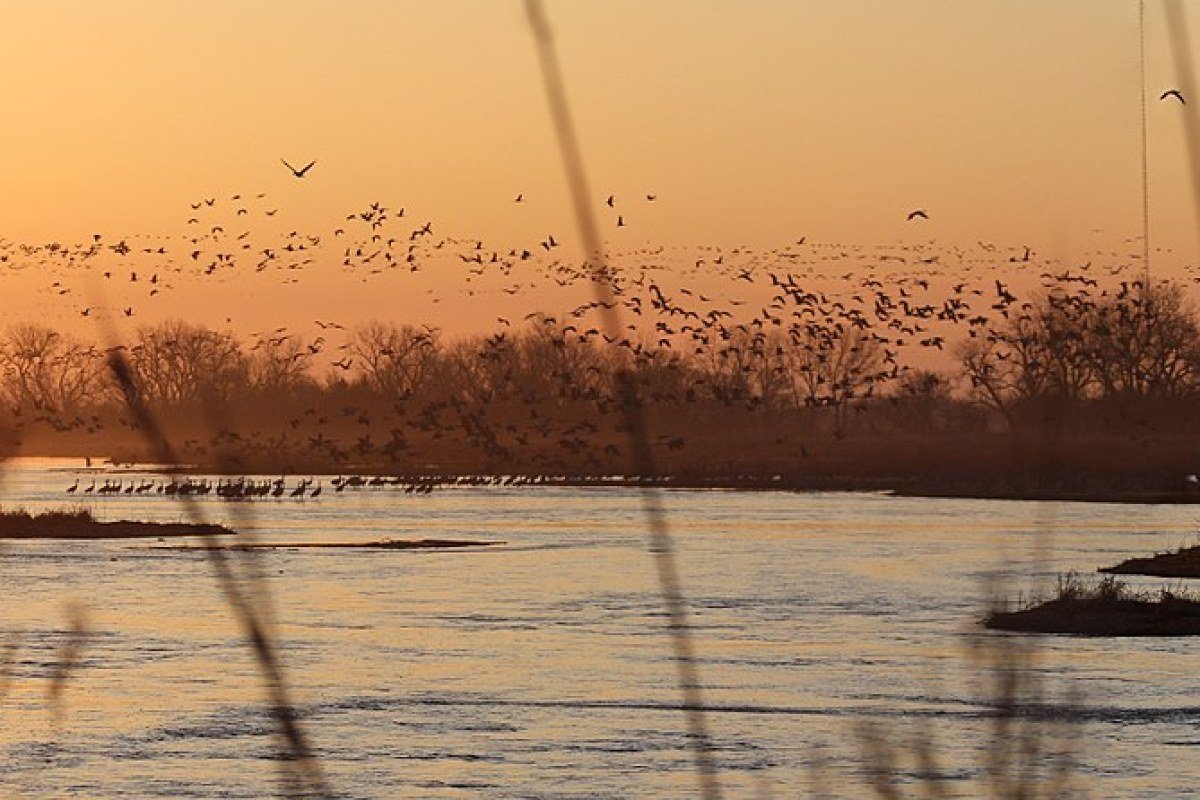
Every February through April, the central Platte River valley near Kearney hosts one of the most spectacular wildlife events in North America — the concentration of 500,000–600,000 sandhill cranes (80% of the world population of this species) on a 75-mile stretch of the river, staging for their spring migration north to the Arctic nesting grounds. The cranes use the Platte’s shallow, braided channels and the surrounding corn fields as a rest and refueling stop, consuming waste grain left from the corn harvest before continuing north. The sunrise and sunset flights — when hundreds of thousands of cranes rise from the river simultaneously in a spectacle of sound and motion that observers consistently describe as one of the most overwhelming wildlife experiences on earth — are accessible from the Rowe Sanctuary near Gibbon (which offers guided blind access for viewing at close range) and from multiple road bridges over the Platte. The Sandhill Crane migration is Nebraska’s most significant natural attraction and one of the most extraordinary wildlife events available to any American traveler.