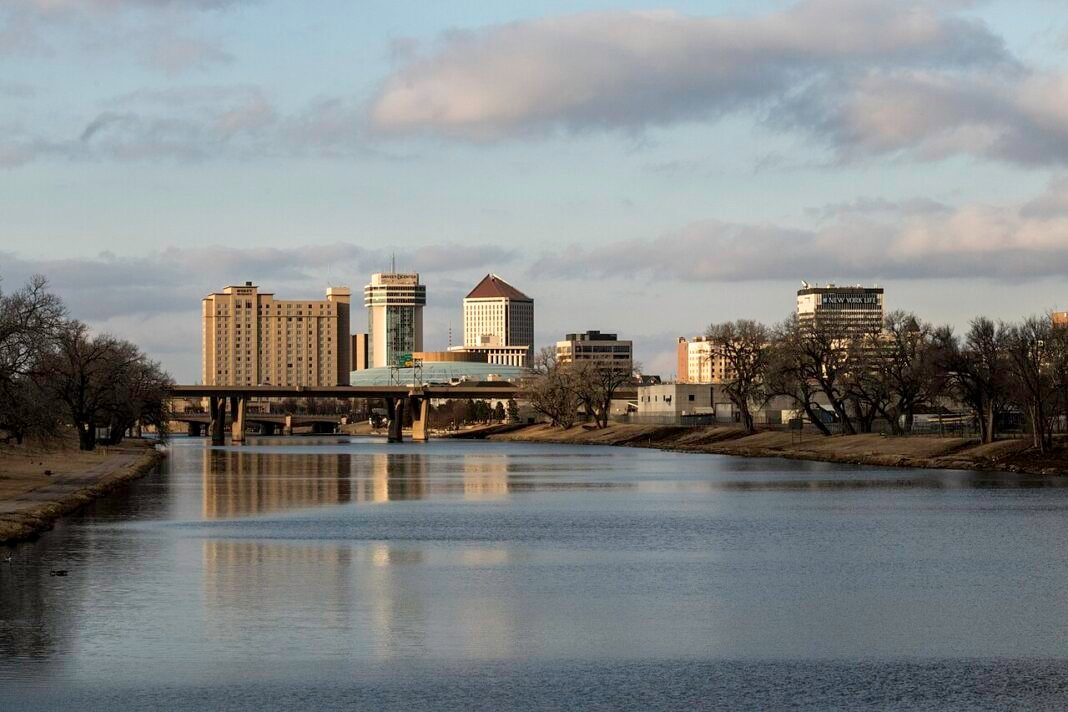
By nearly every measure that lands on a household budget — housing, groceries, taxes, utilities, healthcare — Kansas sits comfortably below the national average, frequently by a wide margin. For anyone whose paycheck is not pegged to the local economy — remote workers, retirees, owners of location-independent businesses — that gap translates into real money kept. And the trade-off that once came with it has narrowed: cities like Wichita and Lawrence have built quality-of-life amenities over the past two decades that simply were not there before, which makes the math easier to accept.
.jpg?width=1200)
Housing: Among the Most Affordable Metro Markets
Housing is where the state’s affordability shows up most plainly. Wichita, the largest city with a metro population around 650,000, posts median home prices in the $235,000–$285,000 range, which keeps it among the cheapest major metros in the country — roughly half the national median. The most sought-after neighborhoods — East Wichita near Bradley Fair, the historic College Hill district, Delano, and Riverside along the Arkansas River — typically land between $250,000 and $400,000, and aside from custom estates in the outer suburbs, very little of the market breaks $500,000.

Lawrence, home to the University of Kansas and the liveliest of the state’s small cities, carries a premium for it: medians run $230,000–$320,000, a step above Wichita that academic jobs and college-town energy help explain. Across the metro line in Johnson County, the Kansas City suburbs of Overland Park and Olathe sit higher still, generally $400,000–$500,000 — pricey for Kansas, yet a clear discount against the Missouri side of the same metro and against comparable suburbs in the South and West. Topeka, the capital, comes in lowest among the big names at $140,000–$200,000, while Manhattan (home to Kansas State), Salina, and other mid-sized cities cluster around $150,000–$220,000.

Rentals follow the same curve. A one-bedroom in Wichita averages $700–$1,000 a month; near the Lawrence campus, expect $900–$1,200; Overland Park and the Johnson County suburbs push to $1,000–$1,400. Step down to Topeka or the smaller cities and one-bedrooms often land at $600–$800 — a monthly figure that, paired with full urban services, barely exists in larger markets anymore.
State Income Tax: Competitive and Trending Lower
After years of contentious back-and-forth, Kansas settled in 2024 on a streamlined two-bracket income tax. For 2026, single filers pay 5.2% on taxable income up to $23,000 and 5.58% on anything above it; for married couples filing jointly, the breakpoint sits at $46,000. The same reform sharply raised personal exemptions — to $9,160 for a single filer and $18,320 for a married couple — which pulls the effective rate for most middle-class households well below the headline numbers. It is a far cry from the turbulence of the 2012 “Kansas experiment,” which zeroed out taxes on business pass-through income, blew a hole in the budget, and was eventually rolled back.
Property taxes land in the moderate tier, with effective rates of roughly 1.2–1.4% of assessed value — heavier than Iowa, lighter than Illinois or Nebraska. On a $250,000 Wichita home, that works out to somewhere around $3,000–$3,500 a year. Johnson County runs at the upper end, 1.3–1.6%, the price of the school funding that underpins much of the area’s appeal.
Cost of Daily Life
Groceries here run about 8–10% under the national average, and the reason is written into the landscape: Kansas grows more wheat than any other state — enough in a typical year to hand every person on Earth six loaves of bread — and that agricultural base keeps food prices in check. The savings got a boost in January 2025, when Kansas finished phasing out its state sales tax on groceries entirely, dropping it to zero (local sales taxes still apply, and prepared food is taxed at the full rate). Dillons, the Kroger banner that dominates Kansas grocery aisles, and Walmart set the price floor in most towns. At the pump, drivers usually pay $0.40–$0.60 below the national average, a function of the state’s nearness to Mid-Continent crude and a competitive retail fuel market.
Utilities come in a touch under national norms. Natural gas for heating tracks the regional market, and electricity runs near average — helped along by wind, which now supplies close to half of the state’s in-state generation and has tempered rate increases compared with other Plains states. The asterisk is summer: with afternoons routinely hitting 95–100°F, air conditioning is a genuine line item, so budget for cooling costs steeper than a milder climate would demand.
Healthcare and Education
Healthcare costs track the rest of the picture, sitting below national averages. The University of Kansas Health System in Kansas City and Ascension Via Christi — the state’s largest healthcare provider, anchored in Wichita — supply the major academic and regional medical infrastructure. Rural Kansas is the harder case: like much of the Plains, the state has watched rural hospitals close, and residents outside the metros should plan on traveling for specialist care. Public schools vary widely by district, with the Johnson County systems — Blue Valley, Shawnee Mission, Olathe — ranking among the strongest in the state and the country.
The Kansas Financial Proposition
The advantage hits hardest for households earning between $50,000 and $120,000. In that band, the modest income tax, cheap housing, and below-average everyday costs combine into a financial position that is hard to match anywhere else. Climb higher and the edge narrows against no-income-tax states like Texas and Florida; drop lower and rural healthcare gaps can eat into the savings. But for the broad middle, the case for Kansas is straightforward — and more people are running the numbers as remote work loosens the tie between where they earn and where they live.
Budgeting Practically for Kansas
Knowing the averages is the starting point; the next move is sorting the fixed costs from the ones you can shape. Housing is the biggest lever in almost any budget, and picking the right neighborhood — College Hill versus Overland Park, say — can swing your monthly outlay dramatically while still keeping you near the amenities you actually use. Smaller gaps in utilities, gas, and groceries look trivial month to month but compound into real numbers over a year. Treat the ranges above as a framework rather than a quote, and confirm current rents and prices for your specific target area, since local markets can move faster than the annual cost-of-living studies that track them.
Frequently Asked Questions
Is Wichita, Kansas affordable to live in?
Yes — Wichita ranks among the most affordable major metros in the United States. Median home prices run roughly $235,000–$285,000, about half the national median, and one-bedroom apartments average $700–$1,000 a month. Even the most desirable neighborhoods (College Hill, Riverside, East Wichita near Bradley Fair) typically stay between $250,000 and $400,000, with little of the market above $500,000. For a mid-size city with a full slate of metro amenities, Wichita’s housing costs are exceptionally accessible.
What is the average rent in Kansas?
Wichita one-bedroom apartments average $700–$1,000 a month. Near the Lawrence campus, figure $900–$1,200. Overland Park and the Johnson County suburbs run $1,000–$1,400. Topeka and the smaller cities often offer one-bedrooms at $600–$800 — rents that have largely disappeared from comparable markets elsewhere.
What is Kansas’s income tax rate?
As of 2026, Kansas uses a two-bracket income tax: 5.2% on taxable income up to $23,000 for single filers (5.58% above that), with the breakpoint at $46,000 for married couples filing jointly. Generous personal exemptions — $9,160 single, $18,320 joint — pull the effective rate well below those figures for most households. Property taxes run 1.2–1.4% of assessed value, roughly $3,000–$3,500 a year on a $250,000 Wichita home.
How does the Kansas City, Kansas side compare to Missouri?
Johnson County, Kansas (Overland Park, Olathe, Shawnee) posts median home prices of $400,000–$500,000 — higher than the rest of Kansas but a real discount against comparable Missouri suburbs and other metro-adjacent markets in the South and West. The county’s high-performing districts (Blue Valley, Shawnee Mission, Olathe) give it one of the best school-quality-to-housing-cost ratios in the greater Kansas City region.
What are grocery and gas costs like in Kansas?
Groceries run 8–10% below the national average, and as of January 2025 Kansas charges no state sales tax on groceries at all (local taxes still apply). As the nation’s leading wheat producer, the state carries structural food-cost advantages that show up at the register. Gas typically runs $0.40–$0.60 below the national average, thanks to proximity to Mid-Continent crude production.