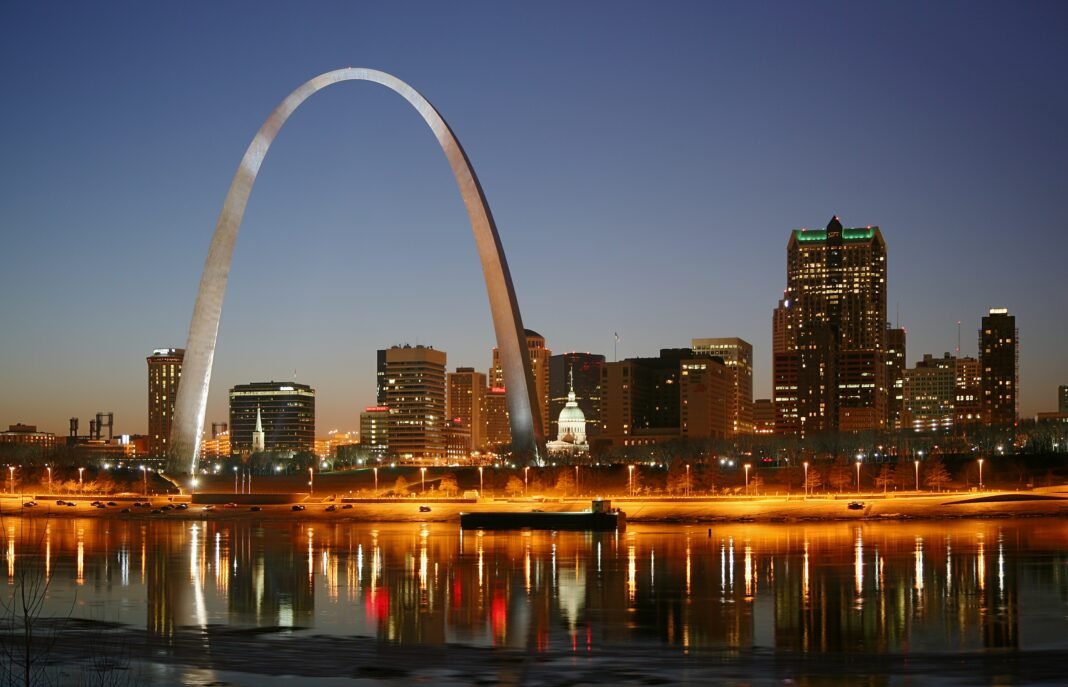

Missouri‘s best residential options cluster in two metro areas with very different personalities. St. Louis is the older river city, architecturally richer and home to some of the most affordable urban real estate in the country. Kansas City is the newer, faster-growing of the two, and over the past two decades it has built one of the Midwest’s liveliest food and arts scenes. Beyond the metros, the college towns of Columbia and Springfield and the lake communities around the Ozarks and Table Rock round out the picture for households with remote income or a specific job tying them to one place.
1. The Central West End – St. Louis’s Urban Best
The Central West End mixes late-19th and early-20th-century apartment buildings, historic rowhouses, and the Maryland Avenue commercial strip, where cafes, restaurants, independent boutiques, and the long-running Left Bank Books all sit within an easy walk. Year after year it ranks as the most sought-after neighborhood in St. Louis, helped by its position next to Forest Park and Washington University’s medical campus. The walkability is real, and the prices would be unthinkable in any coastal city with the same amenities. Median home prices run $250,000 to $450,000 for renovated single-family homes and condominiums, with one-bedroom rents between $900 and $1,600.
Sitting beside Barnes-Jewish Hospital and Washington University School of Medicine gives the neighborhood a steady base of healthcare and research jobs that carries it through downturns. The Euclid Avenue restaurant row, with Brasserie by Niche, Olio, and a long list of well-regarded kitchens, has made the CWE St. Louis‘s leading dining destination. If you want city living at Midwest prices, this is where to start looking.
2. Lafayette Square – Historic Preservation at Its Best
Lafayette Square sits in south St. Louis around Lafayette Park, the oldest urban park west of the Mississippi River, set aside in 1836. The neighborhood is the city’s finest stretch of historic preservation: elaborate Victorian homes and Second Empire mansions built in the 1860s through the 1890s, flattened by an 1896 tornado, rebuilt, and then nearly abandoned by the mid-20th century before a preservation push in the 1970s brought it back. The park itself runs 30 acres of mature trees around a man-made lake, with pavilions and an intact 19th-century iron fence that frames the whole district.
Victorian homes here, some of the most ornate in the city, sell for $200,000 to $400,000, a striking figure for the craftsmanship and character on offer. Soulard’s market and entertainment district sits a short walk away, adding to the appeal. Buyers who care more about period architecture than a quick commute tend to fall hard for Lafayette Square.
3. Crossroads Arts District – Kansas City’s Creative Neighborhood
The Crossroads Arts District, anchored by the Freight House and the gallery-and-restaurant strip along Southwest Boulevard and 19th Street, has become Kansas City’s most creative urban quarter. A former warehouse district, it now holds gallery spaces, architecture and design firms, restaurants, and the mixed-use buildings that define a modern arts neighborhood. The First Friday gallery walk, when the galleries open together on the first Friday of each month and pull crowds of 10,000 to 20,000 into the streets, is the city’s signature cultural night.
Loft apartments in converted warehouses and new mixed-use construction run $180,000 to $350,000 to buy and $1,200 to $1,800 for a one-bedroom rental. Being close to the T-Mobile Center, the Power and Light entertainment district, and the downtown job corridor makes this the most urban place to live in Kansas City. For younger residents drawn here by the food and arts scene, the Crossroads is the obvious landing spot.
4. Clayton – St. Louis County’s Premier Suburb
Clayton, the St. Louis County seat and the most prestigious of the inner suburbs, is about as complete as a suburban municipality gets in Missouri. This city of about 17,000 has its own downtown, where the corner of Forsyth and Central concentrates law firms, financial institutions, and restaurants; MetroLink light rail to downtown St. Louis and the airport; and a school district that rates among the best in the state. Pair walkable streets, strong schools, and easy transit and you get median home prices of $450,000 to $700,000, the highest in the metro.
Many St. Louis-area companies keep their headquarters or major operations in Clayton, which makes it a natural fit for households whose work is in the county’s corporate sector. The Forsyth Boulevard restaurant scene holds its own against the Central West End. For families who want suburban basics, good schools, safety, easy parking, without giving up the option to walk somewhere, Clayton is hard to beat in the St. Louis metro.
5. Columbia – Missouri’s University Town
Columbia, home to the University of Missouri (Mizzou), is the state’s most engaging mid-sized city. A community of about 130,000 sits midway between St. Louis and Kansas City on I-70, with a university that anchors research jobs and a downtown cultural calendar, the Ragtag Cinema for independent film, the True/False Documentary Film Festival in early March, the Roots N Blues festival in the fall, that punches well above the city’s weight. Roughly two hours from both metros, Columbia gives residents big-city access while keeping a college-town pace.
Median home prices of $200,000 to $320,000 make for solid value in a university city with this much going on. The Benton-Stephens neighborhood offers historic homes near campus, the Grasslands area to the west leans toward newer construction, and downtown lofts fill in the middle. Healthcare adds depth beyond the university, with MU Health Care and Boone Health among the largest employers for medical professionals. Between the two metros, Columbia pairs urban culture with Midwest affordability better than anywhere else in the state.

Frequently Asked Questions
What makes Central West End and Lafayette Square St. Louis’s most livable neighborhoods?
Central West End, next to Forest Park and the Barnes-Jewish/Washington University Medical Campus, Missouri’s largest private employer, is the city’s most complete urban neighborhood: Maryland Avenue’s independent restaurants, Left Bank Books, one of the Midwest’s finest independent bookstores, and the edge of one of America’s great urban parks add up to a residential setting that holds steady despite the city’s broader population loss. Single-family homes run $250,000 to $450,000; one-bedroom rents of $900 to $1,600 reflect demand from the medical campus alone. Lafayette Square, a few miles south, preserves the most impressive collection of Victorian and Second Empire mansions in Missouri, built between 1860 and 1890 around Lafayette Park, the oldest urban park west of the Mississippi River. The $200,000 to $400,000 range for architecturally significant homes, plus a short walk to Soulard’s farmers market and music scene, makes Lafayette Square one of the Midwest’s best neighborhood values.
What makes the Crossroads Arts District Kansas City’s most dynamic neighborhood?
The Crossroads Arts District, just south of Union Station in Kansas City, is the liveliest urban neighborhood in Missouri: a converted warehouse district where First Friday gallery walks draw 10,000 to 20,000 people a month, where independent restaurants and bars have built a real food and nightlife scene, and where the nearby T-Mobile Center and Power and Light district deliver a density unusual for a mid-sized American city. Converted warehouse lofts and condominiums in the $180,000 to $350,000 range, and one-bedroom rents of $1,200 to $1,800, are Kansas City’s most urban housing options. A short distance away, the 18th and Vine Jazz District keeps the city’s defining musical heritage alive: it is where Charlie Parker came of age as a musician, and the American Jazz Museum anchors a district that produced one of the 20th century’s most important musical traditions.
What makes Clayton the best choice for St. Louis-area families?
Clayton, the seat of St. Louis County immediately west of the city, combines a top-rated public school district with walkable streets, MetroLink light rail to both downtown St. Louis and Lambert Airport, and a cluster of corporate headquarters and professional-services jobs at the Forsyth and Central intersection. Median home prices of $450,000 to $700,000 reflect the school premium, but Clayton offers something most suburbs do not: real walkability, independent restaurants, and urban density. For families with parents working in Clayton’s professional corridor or at the Barnes-Jewish Medical Campus, it is the highest-confidence school investment in the St. Louis market.
Why is Columbia considered Missouri’s most livable mid-sized city?
Columbia, midway between St. Louis and Kansas City and about two hours from each, is Missouri’s most livable mid-sized city: a community of roughly 130,000 anchored by the University of Missouri’s flagship campus, with MU Health Care and Boone Health providing regional medical jobs and a cultural calendar that outpaces the city’s size. The True/False Documentary Film Festival, held on the first weekend of March, has become one of North America’s most acclaimed documentary festivals; Roots N Blues in the fall draws national acts; Ragtag Cinema runs the kind of arthouse programming you usually find in much larger cities. Median home prices of $200,000 to $320,000 are the best value of any Missouri city with genuine metro-level culture. The Tiger Hotel on Broadway and the Ninth Street arts corridor give downtown a walkable core that most mid-sized university towns lack.
What does Springfield offer as a major southwest Missouri city?
Springfield, with about 170,000 residents on the Ozark Plateau, is Missouri’s third-largest city and the commercial hub for a regional population of roughly 600,000 across the Missouri-Arkansas-Oklahoma border country. Bass Pro Shops, one of the largest outdoor retailers in the world, was founded here, and its original Outdoor World store is the most-visited tourist attraction in the state. Missouri State University and Drury University add academic jobs and community programming. Table Rock Lake to the south and the Mark Twain National Forest put float streams, fishing, and hiking within easy reach. Median home prices of $175,000 to $260,000 make Springfield one of the most affordable Missouri cities with full metropolitan services, and its overall cost of living ranks among the lowest of any US city its size.